Founding master
Adnan Şemiye18 years in the field
MYK-certified master
Adnan Şemiye reads this job in the field. The price is written before work starts.
Estimate 750–1,500 TRY
A short circuit is two conductors meeting where they should not. The breaker reports it. The breaker is not the cause. If you smell burning I do not want a second reset. The range 800–1,800 TRY is for a job that stays in the socket or the junction box. It is not a quote written before the wall is opened.

Call a certified electrician
Asian side 24/7 emergency. European side by appointment. Arrival time is confirmed on the call.
Founding master
Adnan Şemiye18 years in the field
MYK-certified master
Adnan Şemiye reads this job in the field. The price is written before work starts.
From the field
Emergency van · +90 582 403 10 8701 / 08
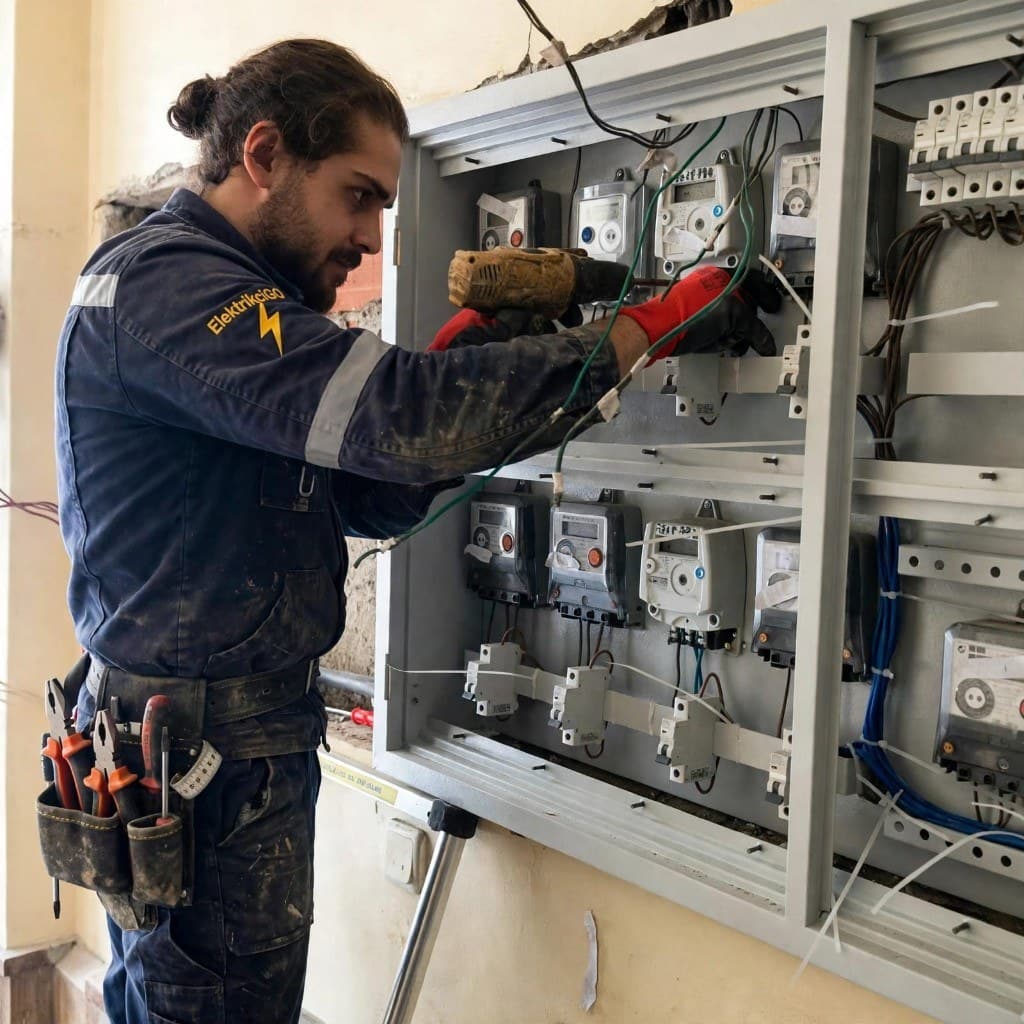
Adnan Şemiye, ElektrikçiGO electrician, fitting an Istanbul meter cabinet
If the breaker tripped once and there is no smell, I may tell you to unplug and reset once. If it trips a second time that circuit stays off. An iron, a kettle, a cooker and an old extension lead are the contact points I see most often in a home. I ask which room went dark, whether the neighbour's light stayed on, and whether the sound came from the panel or from a socket. The photo should not show an open cover. A close frame of the warm socket, with the plug out, is enough.
Do not touch a socket with wet hands. If there is water on a bathroom or kitchen floor, you switch that circuit off and I open it when I arrive. Closing the door so a child stays out is enough. I do not want you forcing the panel cover with a screwdriver. This page is not a jointing recipe. I do not write which colour goes where, because half a fact starts a fire.
A socket crushed behind a sofa, a skirting pierced by a nail, a junction box that took damp, and a multi-plug jammed into a tired socket. Those are separate from a fault inside the panel. The panel page is about the cover, the busbar and the residual-current device. Here I am looking for the circuit itself. I look at a blistered line under the wallpaper, a yellow mark on a socket cover and the heat of a junction lid with a meter, not with my hand. I do not open a junction box while it is live.
In old flats an unearthed circuit trips the breaker when it leaks to the metal body, and people think the appliance died. Before I blame the appliance I measure the earth pin of that socket. I do not swap the socket and leave without a measurement. If a new run is needed I do not hide it inside this page's price. Pulling a circuit is a separate job, with its own range. I cannot strip the whole flat that day. I isolate the shorted piece and leave the sound room on supply.
In a workshop a short is usually a crushed cable tray, a melted lug on a motor terminal, or a phase touching the frame. I do not mix that with a thermal trip. Thermal means the load lasted too long. A short means the contact was sudden. I ask you to note the alarm code and the last button that was pressed. I open the panel. I do not touch a drive parameter before a backup. That job belongs on the PLC page and I do not cheapen it here.
I do not lock a price on the phone. The range I give is an estimate drawn from similar jobs. The binding figure is written after I have seen and measured the fault, before I start. Extra work does not begin without your approval. Payment is on completion, invoiced, in Turkish lira. Nights and public holidays are a separate rate, and I say so before I leave. We work as an approved technician network. I give you the arrival window for your district on the call, and a live location link is shared once the technician sets off.
Separating a short circuit from an overload is the most important distinction on this page, because both trip the same breaker while the remedies are opposite. In a short, line touches neutral or earth directly; current rises to thousands of amps and the breaker opens instantly on its magnetic element. In an overload the current is slightly above nominal and the breaker opens on its thermal element within minutes. So the speed of the trip is the first piece of diagnostic data: a circuit that trips the instant you plug something in points to a short, one that trips ten minutes later to an overload. On the measurement side the distinction is clean: with the supply off, the resistance between line and neutral is read with an ohmmeter, and a value near zero proves the contact is genuinely there.
If two rooms in the same flat go dark together I look for the shared junction, I do not blame every socket in turn. If the corridor junction lid is warm, the job is there. If the lid is cold and only one socket blackened, I look at that socket's terminal. If the terminal is blackened I do not tighten the screw and leave. I cut the end and connect it clean. A loose screw smells like a short but is not always a short. Someone who changes the breaker without separating those gets called again the next day. I do not like that call. I separate them the first time.
When I finish I do not leave the room with a broom, but I do not leave before the junction lid I opened is seated. I write which end I cut, which socket I left dead, and which room I switched back on. If there is no paper I read it into the note on your phone. I do not leave it to memory. If the same socket smells again the next day, that note stops me digging the same place twice. If digging is needed I do not say it like a surprise. I do not paint the wall. Paint, curtains and plumbing are not my work. I close the electrical side and leave the wall to you.
800 to 1,800 TRY is for a short that stays in the socket or the junction box. A job that opens the wall does not enter this range. A new run along the wall, a panel renewal or a whole-flat rewire sit outside it. If I put them in the same sentence I would be misleading you. I say the travel, night and public-holiday difference before I leave. I do not copy an advert that writes a fixed price for the back of a wall it has not seen. I wrote this from the jobs I go to.
I do not put the ohmmeter on before every plug on that circuit is out. A kettle element reads twenty to forty ohms. The iron's base does the same. That is not a short. It is the load's own resistance. The number I would have called near zero while the plugs stayed in is actually a working appliance. After the appliances are out, if phase-to-neutral is under one ohm the contact is in the cable. Ten ohms, a hundred ohms, is not the cable itself. If the fridge plug stayed in, its winding also reads low and I would blame the cable. The cable's fault is written after the plugs are out. I do not put a 500 volt megger on a boiler board or on a plug-in adapter. The megger punches the board and the contact is still there. Low-voltage continuity comes first, with the appliances clear.
Phase-to-neutral is not enough. Phase-to-earth is written too, with the supply off. If phase-to-neutral is high and phase-to-earth is under one ohm, the phase is touching the body or the box. Blaming the neutral and changing the socket then leaves the contact where it is. If neutral-to-earth is also zero, neutral and earth have met under one screw. That may not be the sudden short the magnet sees. The residual-current device sees it and the breaker stays quiet. I do not treat the two as one number. The numbers are three lines on the sheet. I do not cut the cable before the three are full.
If the breaker is still up and only the 30 mA fell, this is not a short where phase and neutral are welded together. The magnet is quiet. What fell is the small current going to a body or to a neutral-earth contact. Upsizing the breaker does not cut that current. It heats the cable. The letter on a Schneider or Siemens breaker is the curve. A home socket is B. Making a B16 into a C25 moves up the current at which the magnet opens. The short stays, the copper heats, and the smell comes the next day. I do not fit a larger body in the same empty slot before I read the letter. If a nail pierced the NYM, the short is at the mouth of the nail, not in the breaker on the panel. The copper is bright beside the nail and black a few centimetres away. I cut back to bright copper. I do not tape the hole and put the power on. The tape leaves the nail's metal on the copper.
A blackened screw may not read zero ohms. Carbon makes the smell before it closes the contact fully. If it is not near zero I cut the end. I do not give the screw one more turn and leave. Tightened carbon smells again the next day, and I would look as if I had changed the cable. The work does not leave Istanbul. Gebze is not written from this page.
After I cut the end I write the same three readings again. The plugs are still out. Phase-to-neutral and phase-to-earth are no longer under one ohm. If they still are, there is a second contact, past the nail or in a crushed trunking. I do not close the box. I do not put the power on. Writing the first cut as finished while the second contact stays brings the same smell the next day. I cut the second place too, back to bright copper, and I write the three readings again. What I call open is the ohmmeter showing infinite or megohms with no load. Ten ohms is still a contact. The lid does not seat before the three are open. If ten ohms comes back after the cut, the cut has not reached bright copper. I cut one more centimetre before I seat the lid.
The band below is the published 2026 list. It is an estimate. The binding figure is written on site after measurement, and the work starts after that.
The bands below are the labour ranges actually seen on recent call-outs and exclude materials. The binding figure is given in writing after on-site measurement, and no work starts without approval.
| Job | Typical price range | What is included |
|---|---|---|
| Fault diagnosis and measured survey | 750 TRY – 1,500 TRY | Diagnosis with a True-RMS clamp, megohmmeter and thermal camera; the survey fee is deducted if the repair is accepted. |
| Breaker / RCD replacement | 1,250 TRY – 3,200 TRY | A 30 mA Type A device; varies with the number of ways and whether Schneider or Siemens is specified. |
| Dedicated air conditioning circuit | 2,400 TRY – 5,500 TRY | 3x2.5 or 3x4 mm² solid copper with a C20-C25 breaker; varies with run length and trunking route. |
| Flat board renewal (modular DIN) | 6,500 TRY – 16,000 TRY | Varies with room count, circuit splitting and whether a surge arrester is included. |
| Chandelier, spot and socket installation | 650 TRY – 2,800 TRY | Priced per unit; heavy chandeliers include a steel anchor set into structural concrete. |
| Internet and Cat6 data cabling | 1,100 TRY – 4,200 TRY | Includes a Cat6 run per room, an RJ45 data outlet and verification with a cable tester. |
| Factory / power factor periodic maintenance | 4,500 TRY – 18,000 TRY | By panel and step count; includes a thermal sweep and a written measurement report. |
Prices are estimated labour ranges and exclude materials. A binding quote is issued in writing after the technician measures on site and before any work begins. Last updated: October 2026.
Service covers the neighborhoods of Istanbul's 39 districts. Not the whole of Turkey. A survey is not a binding quote.
Once, if there is no smell. After a second trip that circuit stays off.
The window helps, but that circuit's breaker stays off. I look for the source on site.
Blackening is a contact mark. I do not change the cover and leave without measuring the cause.
A multi-plug is not a circuit for a continuous load. Unplug it and switch the circuit off.
Leave that circuit off. Do not move the nail. I look at the insulation on site.
Do not use it. Do not test it by hand on a wet floor. Leakage and a short get mixed here, and I measure both.
Not always. The building supply can drop as well. I separate the meter and the main breaker.
No. A larger breaker does not protect the cable. It heats it.
No. There is no jointing recipe on this page. A wrong joint smells again the next day.
Not on every call. If the mark is inside the junction box I do not break. If the damage runs along the circuit I write that and take your approval.
If the breaker holds when the plug is out, I separate the appliance. If it does not, I look for the circuit. I do not change both on a guess.
No. A phase-to-frame contact on a motor is read separately. I do not price it in the same sentence as a home socket.
I do not mix them. A short is a sudden contact. Leakage is a seep to the body. I measure both, and I do not bridge.
No. Night and public holidays are separate. I say the difference before I leave.
Yes. If a cable tray turns into a long plant job I write that at the start. I do not talk as if I had a crew.
It depends on the queue and the traffic. The arrival window is stated clearly on the call. If there is a smell I give the first step on the phone.
No. It is the estimate for a socket or a junction. Inside the wall is another row. The quote is written after I see and measure the circuit.
No. Pulling a circuit has its own range. I do not mix them.
I do not change the panel that day just to silence a short. If a renewal is needed I write it separately.
Which piece I isolated, which room I left on supply, and what I deliberately wrote for later.
I look. I do not cover a joint until I have opened it and connected it properly. I do not assign blame. I measure.
No. The range is from my own calls. The sentences belong to this page. They are not multiplied by swapping a neighbourhood name.