Founding master
Adnan Şemiye18 years in the field
MYK-certified master
Adnan Şemiye reads this job in the field. The price is written before work starts.
Estimate 650–2,800 TRY
A burnt plastic smell from a socket or plug, crackling from inside the box and a deformed face plate all say the same thing: a connection at that point has loosened and arcing has started. This is not a fault that can wait. Current crossing a loose screw connection carbonises the copper surface, resistance climbs further and the terminal passes two hundred degrees, melting the cable insulation. Take that outlet out of service at once and switch off that room's breaker at the board.
Call a certified electrician
Asian side 24/7 emergency. European side by appointment. Arrival time is confirmed on the call.
Founding master
Adnan Şemiye18 years in the field
MYK-certified master
Adnan Şemiye reads this job in the field. The price is written before work starts.
From the field
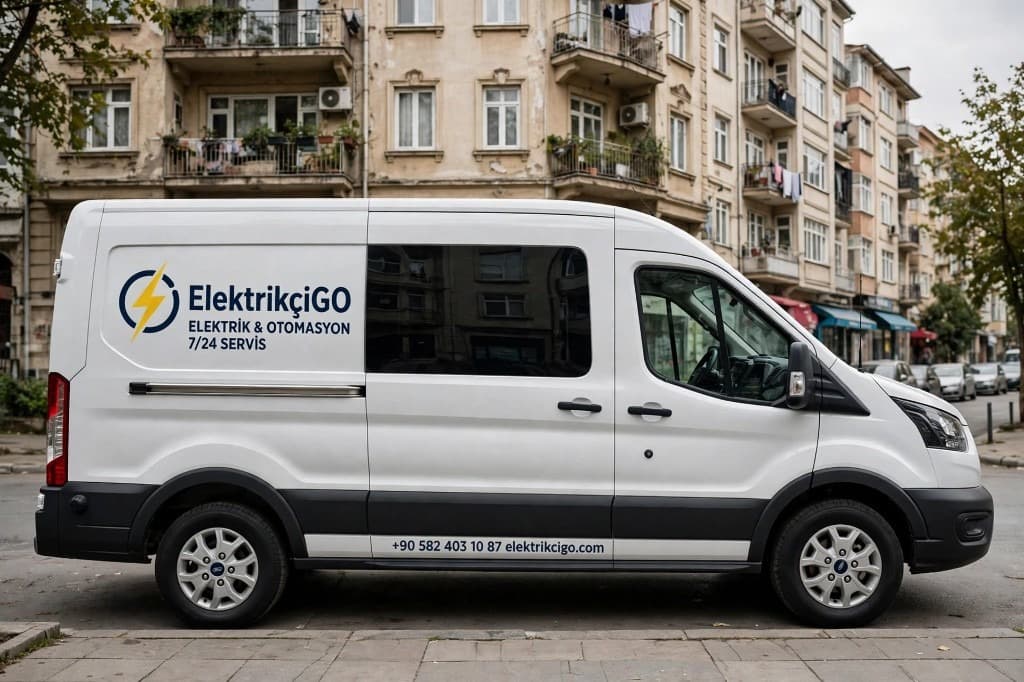 Emergency van · +90 582 403 10 87
01 / 08
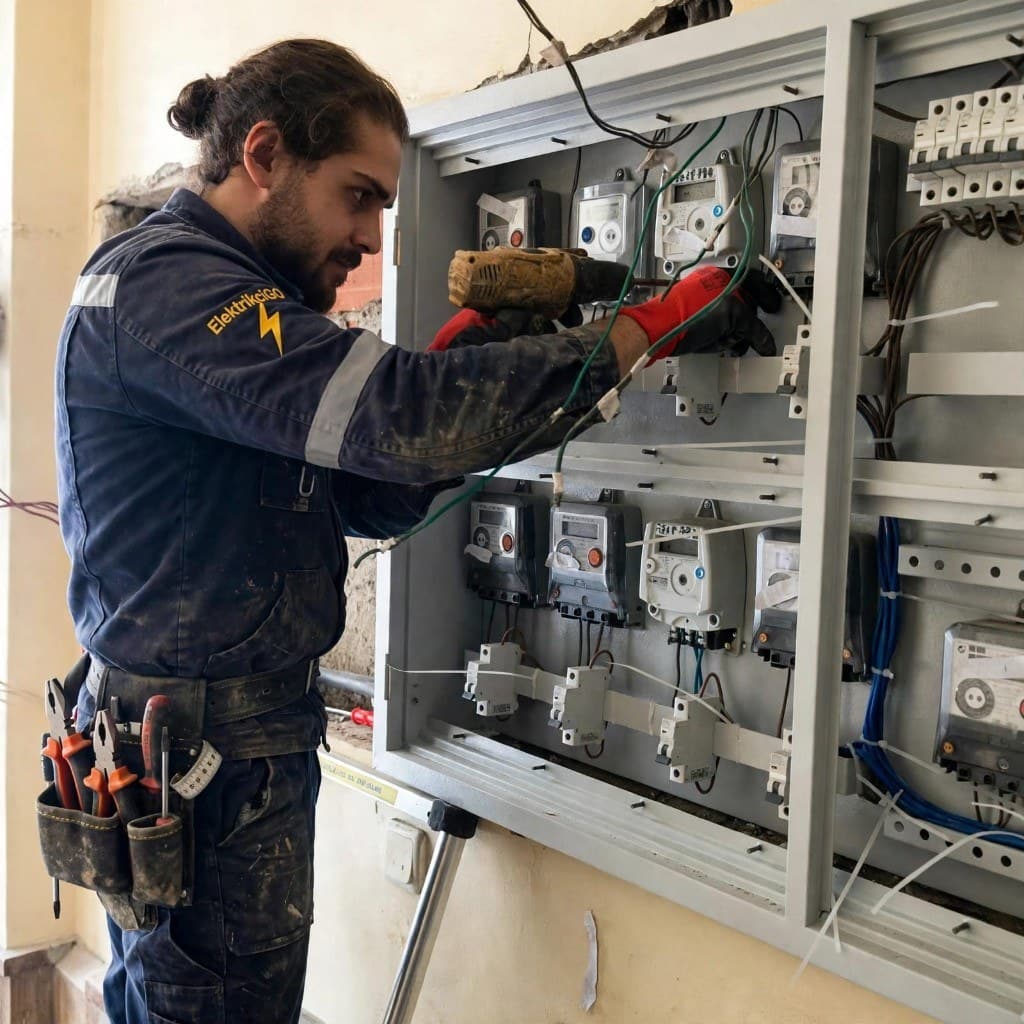
Adnan Şemiye, ElektrikçiGO electrician, fitting an Istanbul meter cabinet
When a socket terminal is tightened by hand, an invisible slackness and a residual contact resistance remain. As current crosses that resistance it releases heat; the heat oxidises and carbonises the copper surface, the carbon layer raises the resistance further and more heat is released. That self-feeding cycle is called thermal runaway. As it progresses the terminal passes two hundred degrees, the cable insulation melts, two cores touch and the Bakelite socket body ignites.
The process takes weeks and gives a warning at every stage. At the first stage there is no sign at all. At the second the face plate is warm to the touch. At the third you hear crackling from inside the box and a sharp plastic odour spreads. At the fourth the plate yellows or deforms and the wall around the socket feels warm. The moment you smell or hear it you are at the third stage, and waiting at that point is a gamble.
The point is found with a FLIR thermal camera under load, without opening the wall. A loose connection shows as a clear hot spot on the thermal image; sound terminals read around forty degrees while the faulty point reads between one hundred and sixty and two hundred. The sweep must be done under load, because heating is invisible in a de-energised board and the fault stays hidden. This method reduces the area to be opened to centimetre scale.
If bulbs keep blowing in the same fitting, the problem is not the bulb brand. There are three causes and measurement separates them. The first is overvoltage: if a lost neutral or riser imbalance pushes that phase above 250 volts, incandescent and halogen lamps die quickly and LED drivers are short-lived too. The second is a loose contact inside the lampholder; the arc kills the filament or the LED driver by impulse. The third is an LED transformer overheating in an unventilated suspended ceiling void.
Diagnosis starts by measuring voltage at the lampholder under load; readings above 235 volts say the riser or neutral side needs examining. The holder and junction box are then opened and the contact faces checked, blackened ends cut back to clean copper and the joint closed with a Wago 221 lever terminal. LED transformers in suspended ceilings are moved out of the unventilated void into an accessible ventilated recess and swapped for original, surge-protected drivers.
Blackened conductor ends are not patched; carbonised copper never gives a reliable contact again. The ends are cut back to clean copper, the socket back-box replaced and joints closed with a Wago 221 lever terminal rather than a twist or tape. Because a lever terminal does not loosen over time the way a screw does, it largely prevents the same fault returning. Where a section of cable is charred, that branch is not patched but renewed back to the board.
The root cause is usually bigger than a single socket. At heavy points such as a kitchen counter the oven, dishwasher and water heater share one 2.5 mm² branch; once the current approaches thirty amperes the insulation chars. The answer there is not replacing the socket but splitting the circuit: a separate run from the board for each major appliance, 3x4 mm² on a C20 for continuous loads and 3x2.5 mm² on a C16 for the washing machine.
On completion the board and the repaired point are swept again under load with a FLIR thermal camera. Any latent hotspot above seventy degrees is found and re-torqued, so the customer does not smell the same thing again a few days later. All screw connections are tightened with a calibrated screwdriver to the torque printed in the manufacturer catalogue, between 2.5 and 3.5 Nm, and the measured values written onto the service report.
In an old flat the branch may be aluminium, not copper. Aluminium cold-creeps under a screw. A terminal that was tight in the first year is slack by the fifth. The gap makes resistance, the resistance makes heat, and the heat makes white oxide. An oxidised end is not sanded and put back under the same screw. The end is cut back to clean metal. If the remaining aluminium is short and dry, that branch is renewed in copper NYM back to the board. Aluminium and copper are not twisted together in a bare joint. The joint between the two metals is closed with a connector made for both. A Wago 221 is for copper. Forcing aluminium into a copper terminal is how the smell returns from the same socket a few months later. The television, the satellite receiver and a camera adaptor are not plugged back in before the end is renewed.
On a circuit that has already arced, arc-fault protection is discussed only after the carbon is cut off and the copper is renewed. That device does not stand in for the loose screw. The end is cut first, then the board is checked for room for an arc-fault detector. The Schneider Acti9 range has a module for this. It is not fitted to every flat. It is written only when that branch has already smelt and the DIN rail has room. The module does not cover a bridged residual-current device. The 30 mA Type A stays. The decision is made after the thermal sweep and the megohmmeter sit on the same sheet. No minute promise is added to it.
Even if the smell has stopped, the sheet closes under load. A hot spot hides when the socket is empty. That room's breaker is not switched off for the test. A load that is safe for the branch is plugged in and the clamp current is written. At the same time the thermal camera reads the terminal. A sound end stays around forty degrees. Above one hundred and sixty means the end is still carbonised and was not renewed. The television and the camera adaptor stay off that circuit until the measurement is finished. Both look small and still heat on a slack spring. The measurement is not done with those two plugs in. If it is, the temperature is written against the appliance and the socket is cleared by mistake. That error is a common way for the smell to return the next day.
Four numbers sit on the sheet: clamp amperes, thermal degrees, the megohmmeter result and the screw torque. If one is empty the job is not finished. Torque is in the maker's range, between 2.5 and 3.5 Nm, and the feel of a hand-tight screw does not replace that number. On the 2026 list a thermal check with socket and terminal renewal sits in the 950–2,800 TRY band. Splitting a circuit or renewing cable back to the board is a separate item, and the 2,400–5,500 TRY air-conditioner band is written only when a new run is pulled. The band is an estimate. The binding figure is written on site after the four numbers are full, before the screwdriver starts the repair. Materials sit outside the band. Workmanship is one year. A sealed meter is not opened.
The socket behind a wall-hung television is read on its own. The bracket presses the plate to the wall and holds the heat in. If the smell comes from there, the plate comes off, the end is cut and the television does not go back on that circuit. If the satellite receiver, a games console and a camera recorder adaptor share that box, each plug is written separately. A small adaptor can sit hotter than a large cooker on a slack spring. Wallpaper or paint is not rolled over a yellowed plate. Paint hides the smell and does not wipe the carbon. After the socket is renewed the plate sits flush and the space behind it stays open. If the plate stays warm, the circuit is switched off and the sheet is opened again. This check is done after the four numbers are written. Until it is done the job is not finished.
The band below is the published 2026 list. It is an estimate. The binding figure is written on site after measurement, and the work starts after that.
The bands below are the labour ranges actually seen on recent call-outs and exclude materials. The binding figure is given in writing after on-site measurement, and no work starts without approval.
| Job | Typical price range | What is included |
|---|---|---|
| Fault diagnosis and measured survey | 750 TRY – 1,500 TRY | Diagnosis with a True-RMS clamp, megohmmeter and thermal camera; the survey fee is deducted if the repair is accepted. |
| Breaker / RCD replacement | 1,250 TRY – 3,200 TRY | A 30 mA Type A device; varies with the number of ways and whether Schneider or Siemens is specified. |
| Dedicated air conditioning circuit | 2,400 TRY – 5,500 TRY | 3x2.5 or 3x4 mm² solid copper with a C20-C25 breaker; varies with run length and trunking route. |
| Flat board renewal (modular DIN) | 6,500 TRY – 16,000 TRY | Varies with room count, circuit splitting and whether a surge arrester is included. |
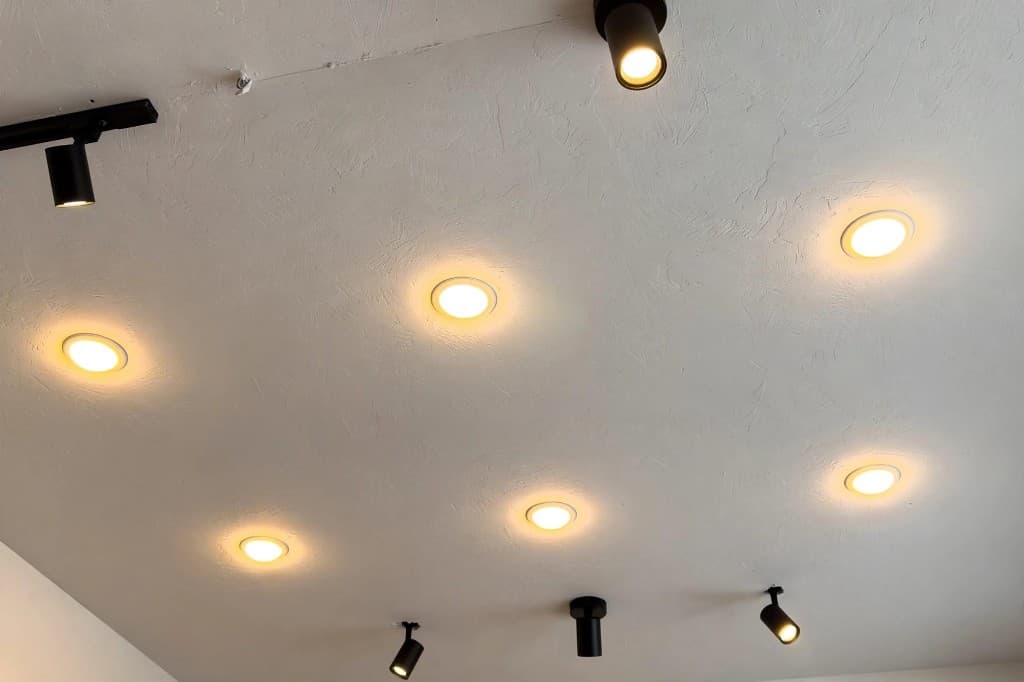
| Chandelier, spot and socket installation | 650 TRY – 2,800 TRY | Priced per unit; heavy chandeliers include a steel anchor set into structural concrete. |
| Internet and Cat6 data cabling | 1,100 TRY – 4,200 TRY | Includes a Cat6 run per room, an RJ45 data outlet and verification with a cable tester. |
| Factory / power factor periodic maintenance | 4,500 TRY – 18,000 TRY | By panel and step count; includes a thermal sweep and a written measurement report. |
Prices are estimated labour ranges and exclude materials. A binding quote is issued in writing after the technician measures on site and before any work begins. Last updated: October 2026.
Service covers the neighborhoods of Istanbul's 39 districts. Not the whole of Turkey. A survey is not a binding quote.
Take that outlet out of service at once, unplug anything in it and switch off that room's breaker at the board. Do not touch a hot or blackened face plate with bare hands. If the board or socket is alight, never pour water on it; water conducts and intensifies the arc flash. Use a Class ABC dry powder or carbon dioxide extinguisher if you have one.
In most cases no. The point is found with a FLIR thermal camera under load without opening the wall; a loose connection shows as a clear hot spot and the area to be opened drops to centimetre scale. If the concealed run is permanently broken, a cable fault locator usually narrows the point to within a metre and only that area is opened.
Replacing the socket body removes the visible damage but does not fix the cause. If the carbonised conductor end is not cut back, the new socket heats the same way; if the branch is overloaded, the new socket melts too. The section of cable behind the blackened terminal may also have taken heat, and that is only established by an insulation test with a megohmmeter.
There are three causes. Overvoltage: if a lost neutral or riser imbalance pushes that phase above 250 volts, lamps die quickly. A loose contact in the lampholder: the arc kills the lamp by impulse. Or an LED transformer overheating in an unventilated suspended ceiling void. Measurement separates the three, starting with a voltage reading at the lampholder under load.
Yes. The odour spreads while the arc is live; when the load drops the smell stops, but the carbonisation does not reverse and the cycle resumes from where it left off on the next heavy load. A smell that has passed shows the load fell, not that the fault cleared. With the thermal check done under load the point is still found.
Yes. A burning smell and arcing are not faults to leave waiting; there is an on-call team 24/7 including Saturday, Sunday, public holidays and night hours. In terraced buildings no drill is used after 22:00; the fault is located silently with a thermal camera and a cable tracer, and noisy permanent work is booked for the next day.
There are two possibilities and they need separating. If the appliance draws excess current both plug and socket heat; in that case the current it draws is measured with a clamp meter and compared with the nameplate figure. The other possibility is fatigue in the contact faces between plug and socket; worn socket springs no longer grip the pins and the contact resistance generates heat. Measurement settles which it is.
The survey fee is stated clearly on the call and deducted if the repair is accepted. Thermal inspection with socket and terminal renewal is typically between 950 and 2,800 TRY; splitting a circuit or renewing cable back to the board are separate items. The binding figure is written after measurement and no work starts without your approval.
On completion the board and the repaired point are swept again under load with a FLIR thermal camera and the measured temperatures written onto the service report. A sound connection reads around forty degrees under load. That figure on the form lets you compare at a later check. Where aluminium conductors are present the terminals are diarised for a further check after six months because of cold creep.