Founding master
Adnan Şemiye18 years in the field
MYK-certified master
Adnan Şemiye reads this job in the field. The price is written before work starts.
Estimate 3,500–7,500 TRY
Connecting a home inverter is not plugging a lead into a socket. The inverter's AC output lands on its own breaker. Pushing energy onto the grid is not done without a connection agreement with AYEDAŞ or BEDAŞ. An output tied in without that agreement is an attempt to defeat anti-islanding. Anti-islanding is the inverter's job and it is not bridged. The direct-current side is not worked live. The isolator is opened and the maker's discharge time is waited. Whether the roof can carry the array is not the subject of this page. The meter seal is not cut. No production promise and no bill saving is written.
Call a certified electrician
Asian side 24/7 emergency. European side by appointment. Arrival time is confirmed on the call.
Founding master
Adnan Şemiye18 years in the field
MYK-certified master
Adnan Şemiye reads this job in the field. The price is written before work starts.
From the field
 Emergency van · +90 582 403 10 87
01 / 08
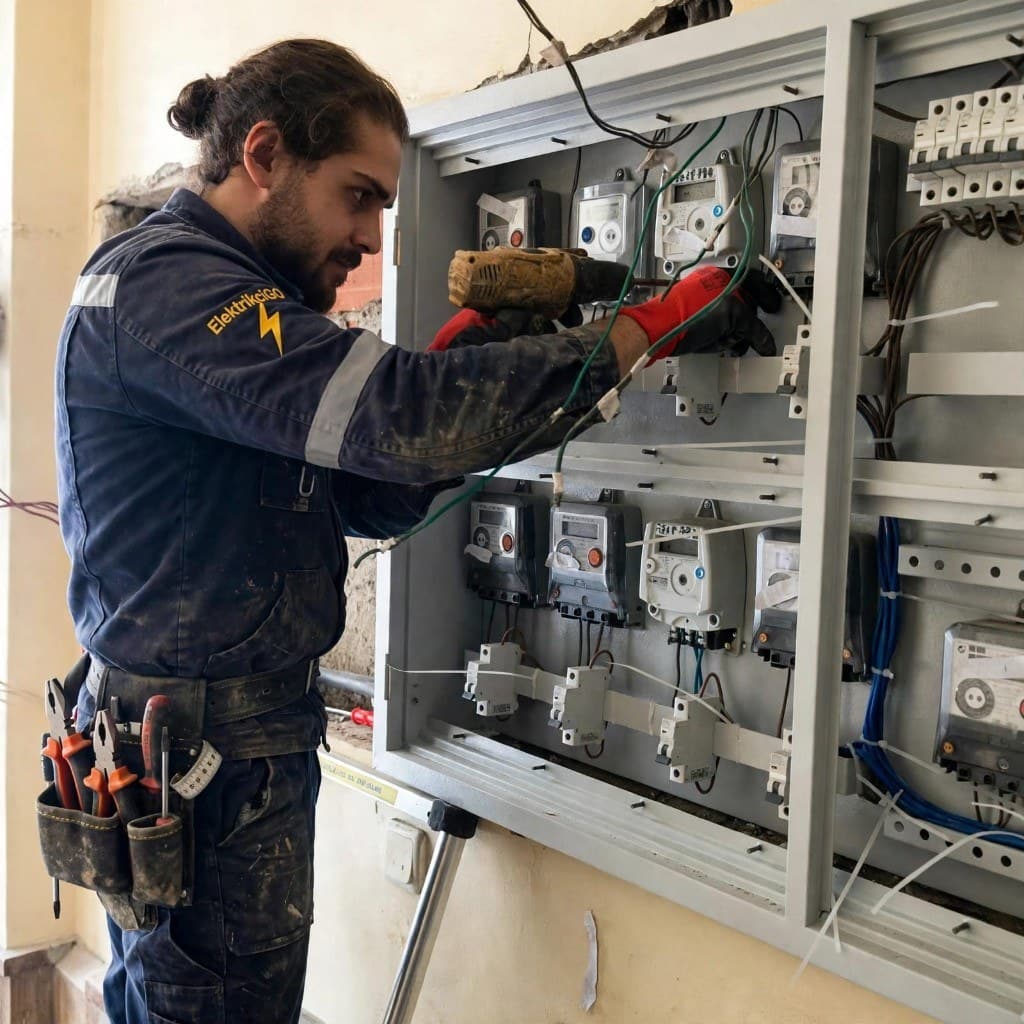
Adnan Şemiye, ElektrikçiGO electrician, fitting an Istanbul meter cabinet
The inverter output is not left on a socket or a multi-way adaptor. The run is pulled in the section the maker wrote. On small home inverters that is often 3x4 or 3x6 mm² copper. Which one is not said before the output current and the run length are seen. If the cable is in dry plaster, NYM is written. If it goes outside or through a wet room, NYY is written. The breaker is not chosen larger than the cable can carry. Schneider or Siemens is fitted to the curve in the inverter manual. The output is not added to the existing socket breaker. That breaker also carries the fridge and the sockets. When the inverter lands on it, the neutral heats.
The residual-current device type is written in the manual. Some inverters want Type A, some Type B or the special type the maker names. A 30 mA Type AC already on the board is not put in its place. The device is not bridged. A bridge hides a leak to the body. If the DIN rail has no room, the inverter breaker is not forced into the old layout. If the rail, the neutral bar and a surge arrester are renewed together, the job enters the flat-board band. A single breaker and a short run are not an automatic part of that band. The DC fuse and the panel cable are handled with the isolator open and the discharge time elapsed. An MC4 connector is not pulled apart by hand while the sun is on the array.
A grid-tied inverter must not feed the street during islanding. That protection is inside the inverter. It is not switched off in a parameter and it is not bridged with a relay. Without an agreement the output is given only to the house load, from the backup or island output the maker allows. That output is not pushed onto a multi-way socket either. If there is an agreement, the meter change and the connection point belong to the company. AYEDAŞ is the Asian side and BEDAŞ the European side. Both use 186. The electrician does not change the company meter and does not cut the seal. The grid tails are not landed on the board before the agreement paper is seen. The seal boundary in detail is on the meter and riser page.
If there is a battery, the lithium pack tails are not shorted. The pack is isolated with the disconnector the inverter maker wrote. The electrician does not open a cell and does not enter the BMS parameters. The battery is not closed into an unventilated cupboard. This page does not write the roof scaffold, the tiles or a structural calculation. Panel yield, shade and a yearly production estimate are not written either. What is measured is the inverter output current, the breaker section and the device type. If the three do not agree with the manual, the system is not energised.
A measured survey is 750–1,500 TRY. A dedicated run for the inverter sits in the air-conditioner band: 2,400–5,500 TRY. Where it falls is not said before the current and the length are seen. If the board is renewed, the 6,500–16,000 TRY band is entered only when the rail, the device type and a surge arrester are written together. The inverter, the panels, the battery and the company meter sit outside this list. The band is an estimate. Materials are invoiced separately. The binding figure is written after the section in the manual and the run on site sit on the same sheet. Workmanship is one year. The amount produced and a fall in the bill are not the subject of that period. No time promise is given.
A hybrid inverter has two AC tails. One is the grid and one is the backup or island output. Their terminals sit side by side and get mixed up. The house load is not pushed onto the grid terminal, and the street is not energised, while there is no agreement paper. The backup output carries the load the manual allows. A fridge, a few sockets and the lighting are written on that list. An oven, an instant heater and a lift are not clamped onto the backup output. Their starting currents put the inverter into fault. The list is written on paper with the flat owner. If there is no list, the backup output is not energised.
On the board side a surge arrester, if the inverter manual asks for one, is written as Type 2 and on the AC side. If the earth bar is weak, the arrester is not fitted. Without an earth measurement the arrester is not counted as protection. The green-yellow conductor lands with its own screw. A water pipe does not stand in for earth. The inverter body and the board bar are joined in the same section. A thin earth tail burns during a leak and leaves the device meaningless. Labels are written in permanent pen: grid, backup, battery, direct current. An unlabelled terminal sends the next technician to the wrong tail. The wrong tail can take anti-islanding out of service. That is why the label is part of the job, not decoration.
Commissioning starts with the DC isolator open and the discharge time elapsed. First the AC breaker is switched off, the clamp reads zero, then the breaker is raised and the output current is written against the label. If the current is above the label, the load list is cut and the breaker is not upsized before the section is. Zero current measured when there is no sun is not a fault. The measurement is repeated while the panels are producing voltage. What the production is worth in lira is not written. The sheet closes with the current, the section, the device type and whether the agreement paper was seen. The system is not left until the four are full.
If the neutral bar in an old flat board is narrow, the inverter neutral is not crammed onto the socket neutral. Two neutrals under the same screw heat, and the fridge on the backup output and the living-room socket go dark together. The neutral lands on the bar with its own screw. If the bar is not enough, the bar is enlarged or the board band is written. If there is paint between the inverter's metal body and the board cover, the earth path is sanded. A screw through paint is not counted as earth. This check is the last line of commissioning. If the line is empty, the breaker is not left up.
An inverter fault code, when the supply voltage is present and the section is right, is written to the maker's service. The electrician does not clear the code and does not update the software. If the code appears while there is no voltage, the run and the breaker are measured first and the code is not blamed. The two lines are not joined on one invoice. The panels, the battery and the roof structure stay outside this invoice.
When the work ends, the AC breaker is labelled and the flat owner reads the label. If there is no label, the breaker is not left up. No trial is done at night. If the panels are not producing voltage, the measurement is postponed and zero current is not written as a fault. Workmanship is one year and materials are written separately.
The inverter output lands on its own breaker. Energy is not pushed onto the grid without an agreement. The roof string is live direct current, and pulling a plug while the sun is up makes an arc. An MC4 is not opened under load. The inverter is switched off first, then the string isolator is opened, and only then is the end read. If the polarity is reversed the inverter writes a fault and the string is not connected. Positive and negative are not shorted in the same clamp jaw. Insulation is read with a megger suited to direct current, after the string is separated from the inverter. An alternating-current megger is not put on a live string. The residual-current type is not bridged. If the manual says Type B, a Type AC is not fitted. Anti-islanding is not switched off in a parameter. Switching it off is the roof feeding the street when the grid falls. That is the same door as export without an agreement, and it is not done.
An alarm code is written once and a part is not ordered before it is cleared. An earth-fault code and a grid-loss code are not the same invoice. One is the string insulation, the other is the grid itself. Forcing the inverter to start while the grid is down punches through anti-islanding. The place of the roof isolator is written on the door. The lever that will shut the string when the fire crew arrives is not hidden inside the inverter menu. The lever is tried once with the inverter off, not while the sun is on the panels. The job does not close before that trial is written. The 2026 band is for the customer-side alternating output connection. The panels, the frame and the agreement papers sit outside that band. The night rate is said separately. Workmanship is one year.
The string fuse is direct current and the grid breaker is alternating current. Writing them in the same box is mistaking a roof fault for the flat panel. If the string fuse has opened, insulation is read first and the fuse is not upsized. A larger fuse carries the short circuit into the panel. If the grid breaker has opened, the roof is not climbed and the inverter output current is written with a clamp. If the clamp is above the breaker label, the load is high and the output run is split, not the string. If the clamp is under the label, the breaker itself is tired, the body is changed and the string is not touched. The earth is not tied to the roof rail with a thin wire. The equipotential comes down as its own conductor, at the section in the inverter manual. A thin wire vapourises in lightning and also leaves the manual's anti-islanding with nothing to stand on.
Four numbers close the sheet: string voltage with the inverter off, insulation in megohms, output clamp amperes, and that anti-islanding is on. If one is empty the connection is not finished. Voltage changes with the sun's angle, and one noon reading is not the whole day. The number is therefore written with its hour. A regulator or a battery is not offered before the hour is written. A battery is not this page's job. If a battery is wanted it is a separate approval, because storing direct current is not the promise of this connection. The work does not leave Istanbul. Gebze is not written from this page. The arrival window is said on the call for the district.
Daily production on the inverter screen does not stand in for string voltage. Production writes kilowatt hours and does not write insulation. If one panel on the roof sits in shade, production falls and the fuse does not open. That is a shade note, not a string fault, and the panel's place is left in a photo. If a connector has heated, the MC4 is changed and the panel frame is not bent. The reason a connector heats is a slack pin. The pin is read in its own socket, not with a clamp. A burnt pin is not sanded and put back. The pair is changed. If only one side is renewed, the arc returns at the same place on the next sunny day. That change is not written inside the alternating-output band. It is its own line.
The band below is the published 2026 list. It is an estimate. The binding figure is written on site after measurement, and the work starts after that.
The bands below are the labour ranges actually seen on recent call-outs and exclude materials. The binding figure is given in writing after on-site measurement, and no work starts without approval.
| Job | Typical price range | What is included |
|---|---|---|
| Fault diagnosis and measured survey | 750 TRY – 1,500 TRY | Diagnosis with a True-RMS clamp, megohmmeter and thermal camera; the survey fee is deducted if the repair is accepted. |
| Breaker / RCD replacement | 1,250 TRY – 3,200 TRY | A 30 mA Type A device; varies with the number of ways and whether Schneider or Siemens is specified. |
| Dedicated air conditioning circuit | 2,400 TRY – 5,500 TRY | 3x2.5 or 3x4 mm² solid copper with a C20-C25 breaker; varies with run length and trunking route. |
| Flat board renewal (modular DIN) | 6,500 TRY – 16,000 TRY | Varies with room count, circuit splitting and whether a surge arrester is included. |
| Chandelier, spot and socket installation | 650 TRY – 2,800 TRY | Priced per unit; heavy chandeliers include a steel anchor set into structural concrete. |
| Internet and Cat6 data cabling | 1,100 TRY – 4,200 TRY | Includes a Cat6 run per room, an RJ45 data outlet and verification with a cable tester. |
| Factory / power factor periodic maintenance | 4,500 TRY – 18,000 TRY | By panel and step count; includes a thermal sweep and a written measurement report. |
Prices are estimated labour ranges and exclude materials. A binding quote is issued in writing after the technician measures on site and before any work begins. Last updated: October 2026.
Service covers the neighborhoods of Istanbul's 39 districts. Not the whole of Turkey. A survey is not a binding quote.
No. Without an agreement, energy is not pushed onto the grid. The output lands on its own breaker. Anti-islanding is not bridged. The meter seal is not cut.
The type the manual writes. Some units want Type A, some Type B. Type AC is not put in its place. The device is not bridged.
No. Direct current is not worked live. The isolator is opened and the maker's discharge time is waited. An MC4 is not pulled apart by hand in the sun.
No. This page is the inverter's AC output and the board connection. Roof structure, scaffold and tiles are not written here.
It is not written. What is measured is the output current, the section and the device type. No production promise is given.
No. A lithium pack is not shorted. A cell is not opened and the BMS parameters are not entered. Isolation is done with the disconnector in the manual.
Survey 750–1,500 TRY. Dedicated run 2,400–5,500 TRY. Board renewal 6,500–16,000 TRY. The inverter, panels, battery and meter are outside it. The binding figure is written on site.
The board and circuit work, for one year. The inverter, the panels, the battery, the roof and the company meter are not in that period. Materials are invoiced separately.