Founding master
Adnan Şemiye18 years in the field
MYK-certified master
Adnan Şemiye reads this job in the field. The price is written before work starts.
Estimate 750–1,500 TRY
Some rooms have power and some do not, and no breaker in the board appears to have tripped. That pattern says the fault is not inside the flat but on the supply side ahead of the meter: either one of the three phases is missing, or a terminal in the main service head has loosened, or the neutral bar has overheated and carbonised. Switching breakers on and off will not clear this, and if a neutral is lost it keeps damaging your appliances.
Call a certified electrician
Asian side 24/7 emergency. European side by appointment. Arrival time is confirmed on the call.
Founding master
Adnan Şemiye18 years in the field
MYK-certified master
Adnan Şemiye reads this job in the field. The price is written before work starts.
From the field
 Emergency van · +90 582 403 10 87
01 / 03
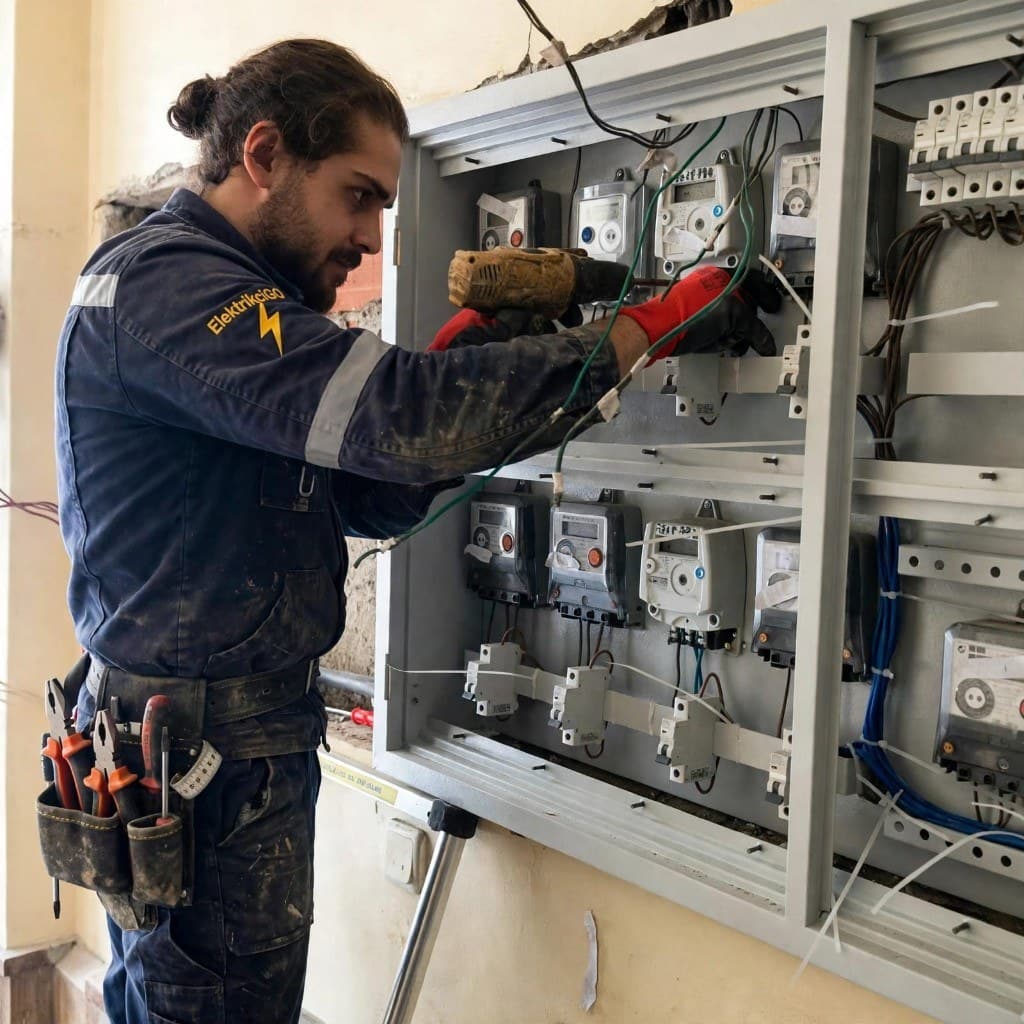
Adnan Şemiye, ElektrikçiGO electrician, fitting an Istanbul meter cabinet
In Turkish domestic wiring a flat is usually fed from three phases, and the circuits in the flat board are shared out across them. The kitchen and bathroom may sit on one phase, the living room and bedrooms on another. When a phase goes missing, every circuit on that phase dies while the others carry on normally. That is exactly the pattern you see: half the home works, half does not, and because the levers in the board are still up the fault stays invisible.
The phase is lost at one of three points. A fuse in the street distribution pillar may have blown; in that case the neighbours see the same thing and the distribution company has to be notified. A terminal in the building's main service head may have loosened; this is the most common cause and is resolved inside the building. Or one pole of the main switch after the flat meter has failed; the lever looks up but that pole passes nothing.
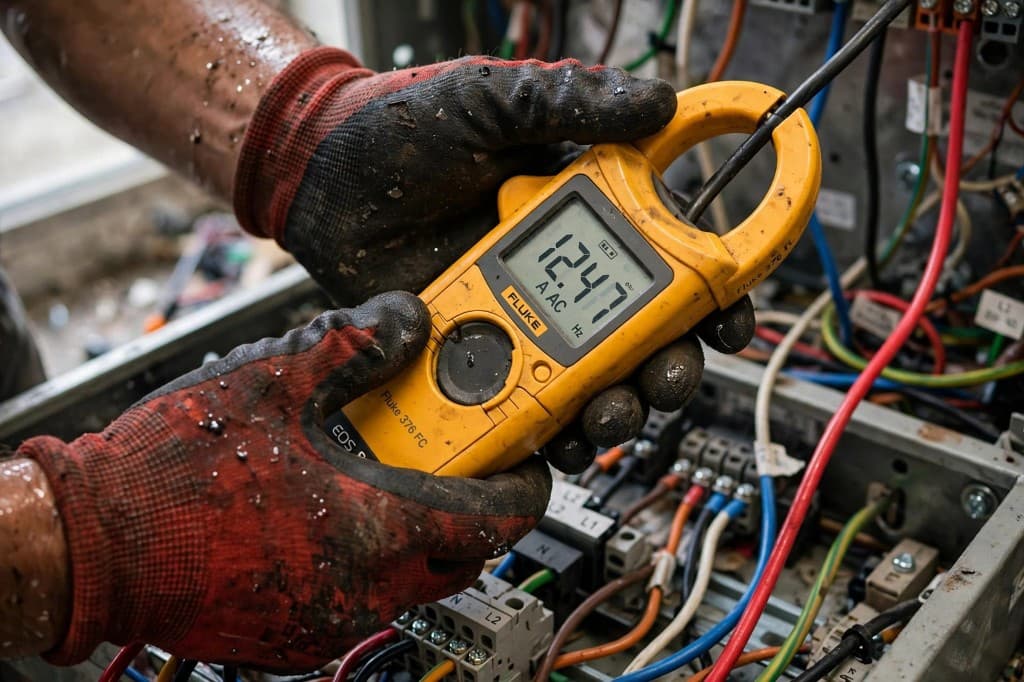
Diagnosis is by measurement, not guesswork. The technician first reads voltage phase by phase at the flat board intake: the healthy phases show between 220 and 235 volts, the lost one shows close to zero. The measuring point then moves to the meter panel and from there to the building's main service head, tracing upstream to find where the voltage stops. That order matters, because opening the service head first is both unnecessary and risky while live.
The most dangerous form of a partial outage is not phase loss but neutral loss. The neutral conductor is the return path for all three phases and the voltage reference. When that reference loosens and gains resistance, the load imbalance between phases distorts the voltage: on the lightly loaded phase it climbs above 250 volts while on the heavily loaded one it falls to 180. The result is a television, modem, boiler board and refrigerator board all failing on the same night.
Neutral loss is identified definitively by measurement. In a sound installation the voltage between neutral and earth is under one volt; anything above a few volts points to a loose or oxidised neutral connection. If lamps burn brighter than usual, some appliances hum and the voltage at the sockets reads differently from room to room, the diagnosis is near certain. The first thing to do in that case is unplug sensitive appliances.
The repair opens every neutral connection downstream of the meter, cleans oxidised surfaces with dielectric solvent and torques the terminals to the manufacturer's figure, between 2.5 and 3.5 Nm with a calibrated screwdriver. Where the neutral bar has carbonised it is replaced with a fire-rated ceramic modular block. To prevent a recurrence an over/undervoltage protection relay and a Type 2 arrester are added to the main board; that relay opens the circuit on the next neutral loss before appliances burn.
There is a pattern common in Istanbul's added-storey building stock: the new flats were wired straight into an old service head at ground level that was never dimensioned for the current number of flats. Unable to carry that load, the main neutral bar heats under evening demand, the terminals carbonise and the voltage starts swinging on the upper floors. Your breaker tripping when a neighbour starts a washing machine is the typical symptom of this arrangement.
In these buildings, when the floors' neutral returns are pressed onto the same terminal, one flat's load flows through another's neutral. For diagnosis the load currents inside the service head are read phase by phase with a True-RMS clamp meter and each floor's neutral current measured separately. The fix is separating every floor's neutral onto an independent busbar, renewing melted terminals with fire-rated ceramic blocks and giving each flat its own 30 mA Type A residual current device.
Where the service head cross-section is genuinely insufficient for present load, this is a renewal job rather than maintenance. In that case the measurement report is submitted to the building management in writing with a proposal to upgrade the riser to 4x16 or 4x25 mm² NYY cable. The report shows numerically which current was measured on which floor and how hot each terminal ran; a management decision comes far faster with a document like that.
First ask your neighbours: if other flats in the building have the same problem, the fault is not in your wiring but in the building riser or the street distribution, and that information lets the technician start at the right point. Then unplug everything in the dead section; if a neutral is lost the voltage at the socket can be higher than you expect and anything left plugged in takes damage. Flipping the levers in the board up and down does not clear this fault, it only muddies the picture.
Do not open the meter panel or the building's main service head yourself. Those points sit ahead of the protective device, where the prospective fault current reaches thousands of amperes; a contact made live turns into an arc flash. If you can smell burning or hear crackling and the board is not yet alight, isolate the supply at the building intake using a dry wooden handle, never pour water onto switchgear, and mention this when you call.
With no load, the meter can show tens of volts on a dead phase. That voltage is a ghost. It is capacitive and it carries no load. When a small lamp is connected to that phase the ghost collapses and the needle falls to zero. A value that does not collapse is a real phase. While a cooker, a three-phase heater or a motor wired between phases stays plugged in, the dead phase is backfed from a live phase and reads as if it had arrived. A phase is not called present before the plugs are out. Which phase is open is read from the phase-to-phase pairs. The pair between the two sound phases holds near 400 volts. The pairs from the open phase to the other two fall. A single-phase meter does not show this picture. If the meter is single phase and half the flat is dark, the break is in a pole after the meter or in an intermediate box. It is not written to the street distribution. The meter type is the first line of the note.
The circuits that stayed dark are not moved onto a sound phase for the evening meal. A cooker and a washing machine moved across double the remaining phase and the neutral under the evening load. The heat comes back the next night in the neutral terminal. What is temporary is a lamp taken from a live socket. A phase change inside the board is not done without the measurement report and written approval. The approval stands before the screwdriver starts. A move without approval brings the same darkness back the next night. The breaker of the remaining phase is not sized to carry that load either.
If the input screw of one pole on the main switch is live and the output screw is zero, that pole is open inside. The lever standing up does not mean the pole is sound. On a Schneider or Siemens four-pole body one pole can die while the other three still pass current. The body is not replaced together with the whole board. The open pole is written in the note. A temporary bridge thrown onto the neighbour's neutral puts both flats' load on one neutral. The light comes, the neutral heats, and both flats take damage. That bridge is not made. A water pipe does not take the neutral's place either. Bare copper does not enter the same hole as an aluminium riser on a Wago 221. That part is only for copper. If the two metals have to remain together, the part is made for both metals. Sanding wipes the oxide for a day. In a damp service head the oxide comes back.
A voltage relay has to see all three phases. A two-pole relay leaves the third phase free during a neutral loss. The phase left free rises under a light load and burns the board. The lower and upper window on the label are written in the note. The window is not invented from memory. The work does not leave Istanbul. Gebze is not written from this page.
The band below is the published 2026 list. It is an estimate. The binding figure is written on site after measurement, and the work starts after that.
The bands below are the labour ranges actually seen on recent call-outs and exclude materials. The binding figure is given in writing after on-site measurement, and no work starts without approval.
| Job | Typical price range | What is included |
|---|---|---|
| Fault diagnosis and measured survey | 750 TRY – 1,500 TRY | Diagnosis with a True-RMS clamp, megohmmeter and thermal camera; the survey fee is deducted if the repair is accepted. |
| Breaker / RCD replacement | 1,250 TRY – 3,200 TRY | A 30 mA Type A device; varies with the number of ways and whether Schneider or Siemens is specified. |
| Dedicated air conditioning circuit | 2,400 TRY – 5,500 TRY | 3x2.5 or 3x4 mm² solid copper with a C20-C25 breaker; varies with run length and trunking route. |
| Flat board renewal (modular DIN) | 6,500 TRY – 16,000 TRY | Varies with room count, circuit splitting and whether a surge arrester is included. |
| Chandelier, spot and socket installation | 650 TRY – 2,800 TRY | Priced per unit; heavy chandeliers include a steel anchor set into structural concrete. |
| Internet and Cat6 data cabling | 1,100 TRY – 4,200 TRY | Includes a Cat6 run per room, an RJ45 data outlet and verification with a cable tester. |
| Factory / power factor periodic maintenance | 4,500 TRY – 18,000 TRY | By panel and step count; includes a thermal sweep and a written measurement report. |
Prices are estimated labour ranges and exclude materials. A binding quote is issued in writing after the technician measures on site and before any work begins. Last updated: October 2026.
Service covers the neighborhoods of Istanbul's 39 districts. Not the whole of Turkey. A survey is not a binding quote.
Because the fault is not in the section the breaker protects but on the supply side ahead of it. When one of the three phases goes missing, the circuits on that phase die while the lever stays up; the breaker sees no overcurrent so it does not open. Diagnosis starts by measuring voltage phase by phase at the flat board intake.
That is the classic signature of neutral loss and it is urgent. When the neutral reference is disturbed, the voltage on the lightly loaded phase climbs above 250 volts; lamps glow bright, motorised appliances hum and electronic boards fail. Unplug sensitive appliances at once and mention this symptom when you call.
If more than one flat in the building is affected, the fault is in the building riser or the street distribution pillar. The street side is the distribution company's responsibility and must be reported to them. The riser and main service head inside the building are our area; we separate the two by measurement and tell you in writing which it is.
On phase loss the appliances on that phase simply do not run and take no damage. On neutral loss, yes, it damages them directly: on the phase where voltage climbs above 250 volts a television, modem, boiler board and appliance boards can all fail. That is why the first move on suspected neutral loss is to unplug.
A loose terminal or a failed switch pole is resolved in one to two hours in most cases. Replacing a carbonised neutral bar takes two to three hours. If the riser cross-section is insufficient it will not finish the same day; in that case a temporary safe arrangement is made, a measurement report produced and the renewal planned with management approval.
Yes. A partial outage and a lost neutral are not faults to leave waiting, so there is an on-call team 24/7 including Saturday, Sunday, public holidays and night hours. Where a night or holiday rate applies, that difference is stated clearly on the phone before anyone sets off.
Flipping the levers does no harm on its own, but it will not clear this fault because the problem sits upstream of the breaker. What is harmful is taping a tripping breaker or winding wire onto a ceramic fuse; that disables the circuit's thermal and magnetic protection entirely and the conductor glows inside its conduit.
The survey fee is stated clearly on the call and deducted if the repair is accepted. Fault diagnosis with a measured survey is typically between 750 and 1,500 TRY; renewing terminals, replacing a switch or replacing a neutral bar are separate items. The binding figure is written after measurement and no work starts without your approval.
It will if a part is swapped without finding the cause. The root cause of loosening is usually insufficient cross-section, overload or cold creep in an aluminium conductor. So at the end of the repair the board is swept under load with a thermal camera, every point above seventy degrees recorded, and where aluminium is present the terminals are diarised for a further check after six months.