Founding master
Adnan Şemiye18 years in the field
MYK-certified master
Adnan Şemiye reads this job in the field. The price is written before work starts.
Estimate 750–1,500 TRY
In Istanbul the meter belongs to one of two distribution companies. AYEDAŞ on the Asian side and BEDAŞ on the European side. Both use the fault line 186. The seal wire, the meter cover and the company's own cable are that line's job. The electrician does not cut the wire, does not open the cover and does not change the meter. The main switch after the meter outlet, the unsealed customer side of the riser and the flat board are this page. Who the call belongs to is separated on the AYEDAŞ and BEDAŞ page. Here the conductor after the meter is measured.
Call a certified electrician
Asian side 24/7 emergency. European side by appointment. Arrival time is confirmed on the call.
Founding master
Adnan Şemiye18 years in the field
MYK-certified master
Adnan Şemiye reads this job in the field. The price is written before work starts.
From the field
 Emergency van · +90 582 403 10 87
01 / 08
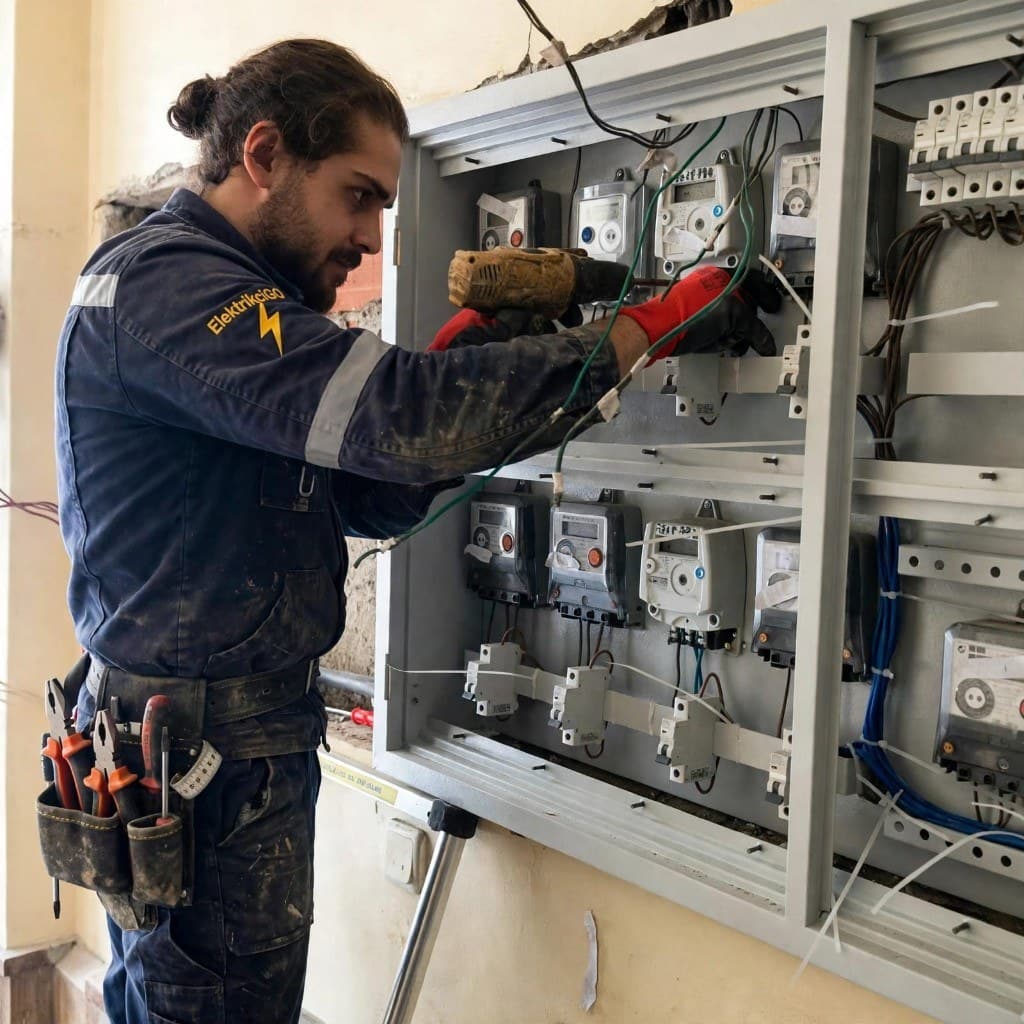
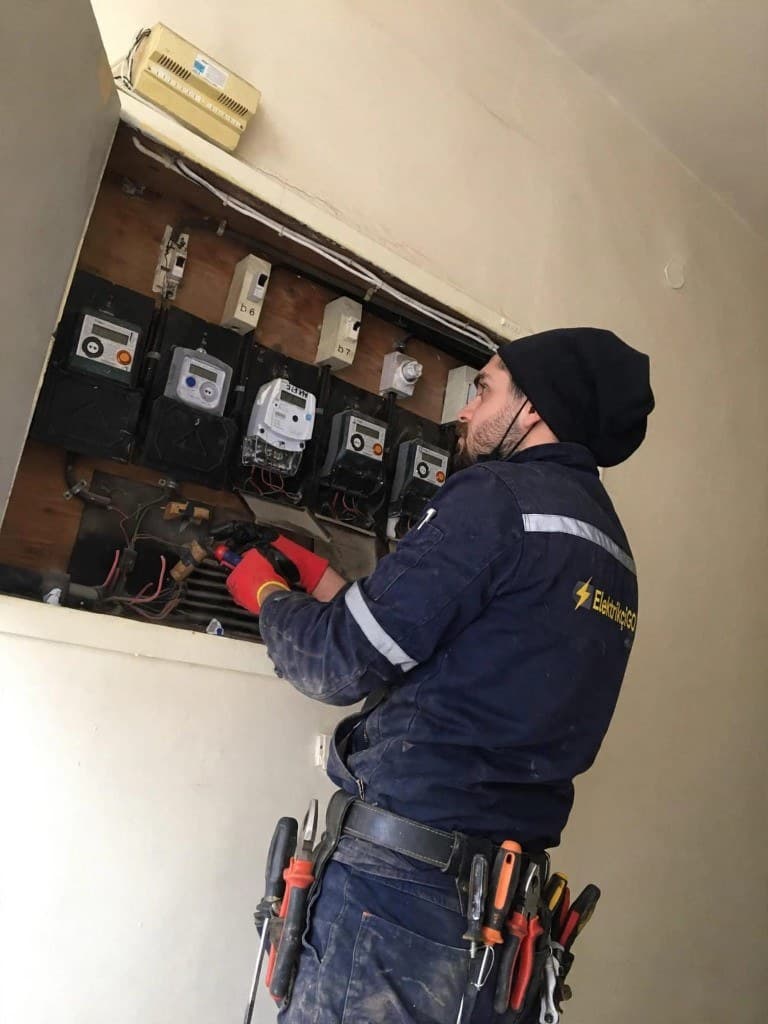
Adnan Şemiye, ElektrikçiGO electrician, fitting an Istanbul meter cabinet
If the screw on the meter cover is tied to the seal wire, the screw is not turned. The number is read through the cover glass and from the bill. If it cannot be read, the address is enough and the cover is not forced. If the riser shaft carries a seal too, that pipe and cable are written into the company record. If there is no seal and the hot tail is at the meter outlet, the voltage is read from the outer terminal without opening the cover. Zero volts at the meter outlet with a dark street ends the measurement and 186 is opened. Voltage at the meter outlet with a dark flat means the fault is the main switch or inside the flat. The two results are not written on the same invoice on the same day.
The main switch is the first protective lever after the meter. A pole that sits up and gives no output is common. After years of a warm body the contact carbonises. That switch is not replaced by increasing the amp rating. The new switch does not go above the current the riser section can carry. Schneider or Siemens is chosen with the same number of poles. The carbonised end is cut, a ferrule is fitted and the torque is tightened in the catalogue range. The neutral bar is read separately. If the neutral is slack, one flat sees above 250 volts and another below 180. Appliances are not left plugged in.
The riser is the shared run from the meters up to the flats. If it carries a company seal, that section is a 186 record and the pipe is not opened. If there is no seal and the fault is at one flat's riser tail, the run is measured on the customer side. The section is NYY. NYM is not put in a riser shaft. In a damp shaft, cloth insulation and aluminium are seen in old buildings. An aluminium end cold-creeps and makes white oxide. That end is not sanded and returned to the same screw. It is cut back to clean metal. A joint to copper needs a part made for both metals. A Wago 221 is only for copper. Renewing the whole riser is a separate job from one flat's main switch and it is not written before it is measured on site.
If one flat is dark and the neighbour is lit, the whole riser is not blamed. That flat's main switch and board intake are read. If the whole floor is dark and there is no seal, the shared box or the floor fuse is looked for. If the whole building is dark and the street is dark too, the riser is not opened. In a building with a generator, lit stairs and a dark flat mean the fault is after the ATS. That separation is on the generator and ATS page. The riser cover is not taken off before these three pictures are written.
Five lines sit on the sheet. The street and the neighbour's light. Whether the seal is on the meter or on the riser. The meter-outlet voltage, without opening the cover. The intake and outlet of the main switch. The neutral-to-earth voltage. No switch is named before the five lines are full. On the 2026 list the survey is 750–1,500 TRY and a main switch or 30 mA device is 1,250–3,200 TRY. If the flat board is renewed, the 6,500–16,000 TRY band is entered only when the rail and the breakers are written together. A riser renewal is not an automatic part of that band. It becomes a separate line after the length and the section are seen. The band is an estimate. Materials are outside it. The binding figure is written on site after the seal line is marked. Workmanship is one year. The company meter sits outside that period.
The Islands are in the AYEDAŞ area. The crossing is a ferry appointment and there is no night crossing. On the European side the survey is by appointment. On the Asian side the duty crew leaves from Pendik and arrival depends on the queue. No side is given a minute promise. Having the doorman cut the seal is not the job this page describes. A cut seal does not repair the fault at the meter outlet and it breaks the company record.
In buildings from the 1970s and 1980s the riser is sometimes cloth-insulated or aluminium. Cloth holds dust in a damp shaft and carbonises. Aluminium cold-creeps under a screw. A white oxidised end does not go back under the same screw. It is cut back to clean metal. If the remaining piece is short and unsealed, that flat's riser is renewed in copper NYY. If the seal line is reached, the renewal stops and 186 is written. Copper and aluminium are not put in the same twist. A part made for both metals is used. A Wago 221 is not put on this job. NYM is not pushed into the riser shaft.
Torque does not get replaced by the feel of a hand-tight screw. The main-switch screw is tightened in the catalogue range, between 2.5 and 3.5 Nm on most power terminals. On a larger breaker with a bar, the range is read on the label and that range is written. A thermal camera reads the riser tail while there is load. If the surface is around forty degrees, the end is counted sound. If it is far above one hundred, the section or the torque is written again and the amps are not increased. The measurement is not done while the neighbour's flat is left plugged in. The neighbour's load can make a faulty end look clean. The door is knocked, the load is separated, then the clamp is written.
The last line of the sheet is a photograph of the seal line. The photograph is taken from a distance and the screw is not turned. If the line is on the meter, the customer side of the riser is marked separately. If the line is on the riser, that pipe stays in the company record and the invoice carries only the reading at the meter outlet. The two jobs are not joined on one line. The next technician then does not guess whether a seal was cut. A guess is not counted as work on this page.
If half the building is dark, a neutral or a single phase is suspected. The measurement is written at the dark flat's main-switch intake as phase-to-neutral and phase-to-phase. If a reading above 250 volts and one below 180 sit on the same sheet, the appliance plugs are pulled. If this picture comes from the sealed meter, 186 is opened and the switch is not changed. If the picture is after the meter outlet, the main switch and the neutral bar are tightened on the customer side. A larger switch is not fitted before the two sources are separated. A riser cover that belongs to the neighbour is not opened while that flat's resident is away.
The meter number is read from the bill and written on the report. If the number does not match, the cover is not opened. The address and the full name are enough for 186. Before a second record is opened for the same flat, the first record number is asked. Two records make the company crew be written to the same address twice.
The inside of the meter cover is not part of this order. On the customer side the first device is the main switch. On a single-phase subscription the switch has two poles, and phase and neutral come down together. On a three-phase subscription it has four poles. A four-pole body is not fitted to a single-phase meter. An empty pole carries the neutral onto another bar, and the flat's 30 mA device cannot see the neutral. A two-pole switch on a three-phase meter leaves one phase outside. That phase goes to the flat on an unsealed joint, and it is not written on the sheet as a missing phase. It is written as the wrong pole count. The subscription current is read from the power on the bill. In flats of five and seven kilowatts this is usually 25 or 32 amps. The main switch does not go above that number. Even if the riser is 4x16 NYY, a 63 amp lever is not written onto that flat's own tail when the tail is 3x6. 63 amps is mixing the protection at the head of the shared riser with the flat's tail. A large switch on a small section carries the short circuit into the flat board. Amps are not chosen before the section and the subscription are written. A Schneider or Siemens body is chosen from the power on the bill, not from the largest body sitting on the shelf.
The 30 mA device does not take the place of the main switch and it is not put alone at the head of the riser. The main switch separates the load. The 30 mA has to see both the phase and the neutral. If the neutral lands on the bar before the device, the test button stays quiet, or the device trips for nothing when the neighbour's load returns. If the riser is on the customer side and unsealed, a 300 mA fire protection may be written at the head of the shaft. A 30 mA at that same head lets one water heater darken the whole stair. They are not the same job and they are not written on the same line. The test button is not pressed before the five voltage lines are full. The button does not prove that the neutral passes through the toroid. That the neutral passes is seen by writing the phase current and the neutral current side by side with a clamp. If the two numbers are equal and the button trips, the device is sound and a leak is not hunted. If the numbers differ and the button stays quiet, the neutral is outside the device. The body is not changed. The neutral tail is brought into the device. That correction does not write a new board inside the 1,250–3,200 TRY band. The board band is entered only when the rail and the breakers change together.
The voltage is written once at the customer terminal in the meter room and once at the flat's board intake. Both readings are taken on the same load. The load the neighbour left in the sockets is separated and the door is knocked. A drop above 11 volts against 230, with a cold joint, shows that the section is short for the length. The section is changed and the amps are not increased. The same drop with a hot joint is not the section's fault. The joint is renewed and the section stays. A hot joint sits above one hundred on the thermal camera, and a cold section does not carry that mark. On a three-phase subscription an open phase is written as L1-L2, L2-L3 and L3-L1. If two pairs are near 400 volts and the third pair is near zero, one phase is open. If the zero is on the intake of the switch, the seal line is looked at. If the line is on the company side, 186 is opened and the switch is not changed. If the zero is only on the outlet, that pole has carbonised, the voltage on the intake is still there, and the body is changed with the same number of poles. If both intake and outlet are zero, the measurement ends. The riser cover is not taken off before this separation is written.
An old riser sometimes comes up the shaft as one combined neutral and earth. The split is made in one place, at the flat board or at the riser board, not at both. Bridging them a second time puts load current on the earth wire. The 30 mA trips with no faulty appliance and the technician hunts for an appliance. A few volts between neutral and earth under load is ordinary. Tens of volts with the main switch down shows that the earth is open or that the neutral is borrowed from another flat. A new earth wire is not pulled before that number is written. A borrowed neutral is not cut without opening the neighbour's cover, and that cover belongs to the resident of that flat. The number is put as its own line beside the seal photograph. The next technician then does not take the drop for a section fault and does not write the company's seal onto the customer's joint. The work does not leave Istanbul. Gebze is not written from this page. Nights and public holidays are a separate rate, and the difference is said before leaving.
The band below is the published 2026 list. It is an estimate. The binding figure is written on site after measurement, and the work starts after that.
The bands below are the labour ranges actually seen on recent call-outs and exclude materials. The binding figure is given in writing after on-site measurement, and no work starts without approval.
| Job | Typical price range | What is included |
|---|---|---|
| Fault diagnosis and measured survey | 750 TRY – 1,500 TRY | Diagnosis with a True-RMS clamp, megohmmeter and thermal camera; the survey fee is deducted if the repair is accepted. |
| Breaker / RCD replacement | 1,250 TRY – 3,200 TRY | A 30 mA Type A device; varies with the number of ways and whether Schneider or Siemens is specified. |
| Dedicated air conditioning circuit | 2,400 TRY – 5,500 TRY | 3x2.5 or 3x4 mm² solid copper with a C20-C25 breaker; varies with run length and trunking route. |
| Flat board renewal (modular DIN) | 6,500 TRY – 16,000 TRY | Varies with room count, circuit splitting and whether a surge arrester is included. |
| Chandelier, spot and socket installation | 650 TRY – 2,800 TRY | Priced per unit; heavy chandeliers include a steel anchor set into structural concrete. |
| Internet and Cat6 data cabling | 1,100 TRY – 4,200 TRY | Includes a Cat6 run per room, an RJ45 data outlet and verification with a cable tester. |
| Factory / power factor periodic maintenance | 4,500 TRY – 18,000 TRY | By panel and step count; includes a thermal sweep and a written measurement report. |
Prices are estimated labour ranges and exclude materials. A binding quote is issued in writing after the technician measures on site and before any work begins. Last updated: October 2026.
Service covers the neighborhoods of Istanbul's 39 districts. Not the whole of Turkey. A survey is not a binding quote.
No. A sealed meter is AYEDAŞ or BEDAŞ work. 186 is called. The main switch after the meter and the flat board are measured.
No. The seal does not repair a slack tail at the meter outlet. If the wire is cut, the company record is broken. If the screw is tied to the wire, it is not turned.
Not at once. That flat's main switch and board intake are read first. If the whole building and the street are dark, the riser is not opened and 186 is written.
One phase climbs above 250 volts and another falls below 180. Appliances are not left plugged in and the main switch is turned off. The neutral bar is read without cutting the seal.
No. The new switch does not go above the current the riser section can carry. Increasing the amps hides a carbonised end.
No. A riser shaft wants NYY. NYM is not put in a wet shared shaft. An aluminium end is not forced into a copper terminal.
Survey 750–1,500 TRY. Main switch or 30 mA device 1,250–3,200 TRY. Board renewal 6,500–16,000 TRY. The riser is a separate line. The binding figure is written on site.
No. The Islands are a ferry appointment and there is no night crossing. The seal is still not cut. No time promise is given.