Founding master
Adnan Şemiye18 years in the field
MYK-certified master
Adnan Şemiye reads this job in the field. The price is written before work starts.
Estimate 650–2,800 TRY
A socket is not the hole in the wall. Inside it are two ends, an earth and a screw. When the screw loosens the cover warms, the plug rocks, and sometimes a spark shows. A switch is a different job in the same box: it clicks and the lamp stays dark, or the lamp lights while the room stays dim because the circuit was split somewhere else. The range below is for one point. A job that opens the wall from end to end does not belong here. If the point is single, the price stays single.
Call a certified electrician
Asian side 24/7 emergency. European side by appointment. Arrival time is confirmed on the call.
Founding master
Adnan Şemiye18 years in the field
MYK-certified master
Adnan Şemiye reads this job in the field. The price is written before work starts.
From the field
 Emergency van · +90 582 403 10 87
01 / 08
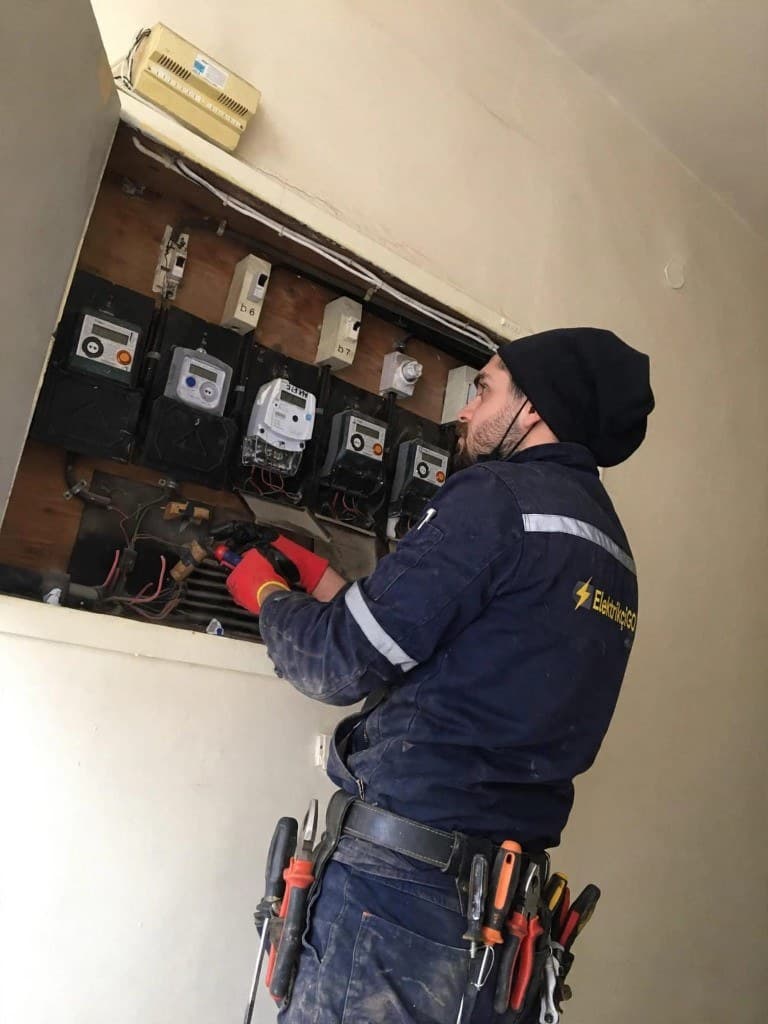
Adnan Şemiye, ElektrikçiGO electrician, fitting an Istanbul meter cabinet
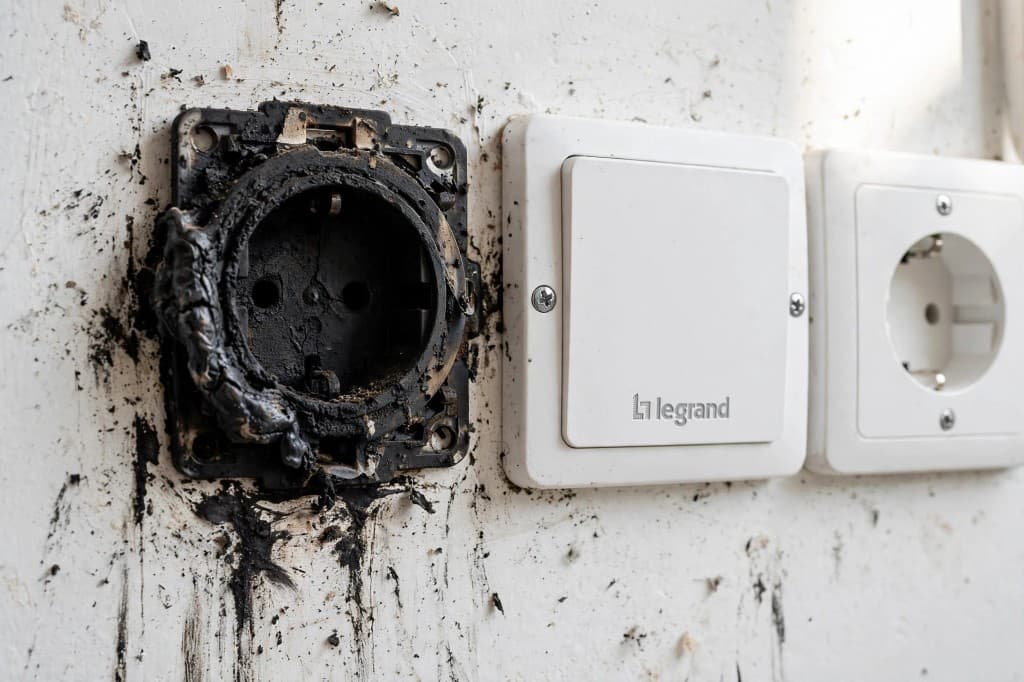
If the cover feels warm I want the plug out and that circuit's breaker down, with a dry hand. I do not want the cover forced with a screwdriver. The heat usually comes from a loose terminal. If the plug's face has melted I do not change the socket without cutting that end, because melted plastic leaves charred copper behind it. A charred end holds for a day when you tighten it, then smells again. I do not like hearing that smell twice. If one socket is warm I do not drag the neighbour's circuit into it. If the whole room is dark, this page is not enough and I look at the short-circuit note, because the cause is the circuit, not the face of the socket.
A switch is another picture. There is a click and no lamp. I do not open the lampholder while the circuit is live. The switch spring may be tired, or a tail in the ceiling rose may have left the ceiling. I do not hang a chandelier on this page. Weight, hook and ceiling rose belong to the lighting job. Here I look at the switch's own box. If one key cuts half the living room and the other cuts the corridor, I do not leave that unlabelled. I write which key cuts which lamp where you can see it, not inside the cover.
If you bought the cover and the box size fits, the job is seating that cover and tightening the screw onto a clean end. The estimate for that sits between 600 and 1,000 TRY. If I bring the mechanism, so the body inside changes too, the estimate sits between 900 and 1,400 TRY. Neither figure is a quote. If the wallpaper is torn, the box is crooked, or four sockets on the same circuit have melted, the figure leaves this range. If it will, I write it before I put the screwdriver in. I do not price one loose socket like a whole-flat rewire. A single socket stays cheap. I do not hide it inside a renewal sentence.
I do not want a new earthed plug forced into an old socket that has no earth pin. If the body is metal, a washing machine or an oven, I do not leave the appliance until earth reaches that socket. If I see an old bridge that tied earth to a water pipe, I take it off and I tell you. A water pipe is not an earth. Earthing has its own page and its own range. Here I only write whether earth is present at the end of that socket. If it is not, I do not change the socket and say done.
When a multi-plug, a heater, an iron and a kettle share one box, the cover warms even though the screw is actually clean. A bigger socket does not fix that. I split the load. I do not leave an extension lead for a heater that stays. An extension is for a guest for one evening, not for a stove all winter. If a new run is needed I do not write it into this range. Pulling a circuit has its own estimate. I do not write a cheap sentence on the socket page that pretends I am pulling a circuit. Do not say «only the cover» on the phone and ask for a heater circuit at the door. I write the two apart.
When I finish I leave the cover square. I do not fill the screw mark with filler and I do not paint. I write one line: which socket changed, which end I cut, and which switch feeds which lamp. Nights and public holidays are separate from the day, and I say the difference before I leave. We work as an approved technician network in Istanbul and The arrival window is stated clearly on the call. I do not write a fixed price for a box I have not seen. The range came from similar single-point jobs. I do not invent another figure at the door.
In an old flat the box is crushed inside the plaster. Even with a new cover the screw goes into a broken plastic ear, not into the wall. I do not force that ear and call the cover seated. If I do not straighten the box, the cover rocks again in a week. In a new flat the box is deep and the mechanism is on a rail. The trouble is often the wrong cover from the shelf: the size does not fit, the screw sits in air, and you think the socket is loose. I see the size on site. A brand name on the phone is not enough, because two ranges of the same brand do not enter the same box. I do not file a cover that does not fit and then tighten it. A filed cover leaves a crack for tomorrow.
There is also the switched socket, which I see often in Istanbul flats. The key on top cuts the holes below. When the key tires, the holes stay dead and people blame the socket. The fault is not the socket. It is the small bridge behind the key. I do not feed that bridge from another circuit's phase and leave it «so it works». If I replace a switched socket with a plain one, I tell you which hole will stay live. I do not close the cover without saying that. I separate it so a child who presses the key at night, thinking it is a lamp, does not start a heater behind the sofa.
A bathroom socket is not a living-room socket. The cover looks the same and the job inside is different. I do not swap a bathroom cover for a living-room cover and leave. Damp enters the spring and the switch sticks on its own. Above a kitchen counter the socket sits near the kettle's steam. Steam turns the screw green. A green screw is not tightened. The end is cut. I do not say the socket is changed before I do that. If a cover has come off in a child's room, you drop the circuit and I look at the box ear when I arrive. I do not tape an open box and leave. Tape lasts a night. It does not bring the earth pin back. I also do not lift a counter socket to head height. When the kettle lead goes tight, the end loosens again.
A socket screw often holds two cables. One comes from the previous socket and one goes on to the next. If I change the cover, tighten only the new body's tails and leave the onward cable in the bottom of the box, the rest of the wall dies. People take that for the breaker. I write how many cables were under that screw. The indoor run is NYM, 2.5 mm². I do not leave a 1.5 mm² lighting cable on a socket. That cable is for a lamp, not for a kettle. I do not put an aluminium end and a copper end under the same screw. The aluminium crushes, the copper stays, and the smell comes back tomorrow. If a part made for both metals is there, I use it. A Wago 221 is only for copper, and it does not sit loose in the box, untaped, rocking. A socket screw is not a main-switch screw. On most mechanisms the range is about 0.8 Nm. Tighter than that strips the brass. Stripped brass sits loose again the next day. Before I tighten, I see that the end is clean. Tightening charred copper is not counted as work on this page.
A cover that heats on one side does not mean the whole socket is finished. On a Schuko socket the earth is the two clips at the sides. If the plug rocks left and right, one clip tires and the other stays. I do not straighten that clip with pliers and bend it back. A bent clip seats once, then opens again every time the plug is pulled. I change the mechanism. Viko and Makel, Schneider Sedna and Asfora, are not filed so they will enter the same box. The size is seen on site. I do not use a living-room cover in the bathroom. The cover beside the shower is IP44. An IP20 living-room cover lets steam into the spring and the key sticks. If the bathroom socket sits on the living-room breaker, I do not write that on the cover and walk off. If that circuit has no 30 mA, a new cover does not cut a leak. I say so, I leave it to the earthing page, and I do not leave this page saying the cover was changed.
The switch that lights a stair lamp from two places is not a plain switch. There are three tails. One is the common and two are the travellers. If I take the common for a traveller and fit a plain switch, the lamp lights from one floor only and the key on the other floor clicks for nothing. If I put a three-tail switch in place of a four-tail intermediate, the lamp either stays on or never lights. If the colours are mixed I do not guess. I drop the circuit and measure continuity between the two boxes. I do not use the earth conductor as a traveller. Green-yellow does not carry lamp current. If it does, the body heats and the residual-current device trips with no cause. I write which tail is the common where you can see it, not inside the cover. I do not close the cover before that is written. The work does not leave Istanbul. Gebze is not written from this page.
A switch has to break the phase, not the neutral. If the lamp is dark and the holder is still live, the switch is in the neutral. I see that without opening the holder. In the switch box the permanent live still carries voltage while the key is open. When the key closes, the outgoing tail should go quiet. If both tails are quiet and voltage remains at the ceiling while the lamp is dark, what was cut is the neutral. I do not then swap tails at random in the ceiling rose. I drop the circuit, I take the phase to the switch, and I leave the neutral at the lamp. If the box has no neutral, I do not invent one from the earth for a lit switch. Green-yellow is not the return of a neon. A neon without a neutral makes an LED lamp flicker while it is switched off. The flicker is not a socket fault. I change the switch for one that does not pass a leak through the lamp, or I write a small capacitor at the lamp tail. I do not hide that inside the socket price. It is its own line. In an old metal box, if earth is on the socket tail it also has to be on the box ear. If the socket is earthed and the box screw is empty, the cover screw can stay live. I write the continuity from the socket's earth hole to the box screw. If it is not there, I do not close the cover.
The band below is the published 2026 list. It is an estimate. The binding figure is written on site after measurement, and the work starts after that.
The bands below are the labour ranges actually seen on recent call-outs and exclude materials. The binding figure is given in writing after on-site measurement, and no work starts without approval.
| Job | Typical price range | What is included |
|---|---|---|
| Fault diagnosis and measured survey | 750 TRY – 1,500 TRY | Diagnosis with a True-RMS clamp, megohmmeter and thermal camera; the survey fee is deducted if the repair is accepted. |
| Breaker / RCD replacement | 1,250 TRY – 3,200 TRY | A 30 mA Type A device; varies with the number of ways and whether Schneider or Siemens is specified. |
| Dedicated air conditioning circuit | 2,400 TRY – 5,500 TRY | 3x2.5 or 3x4 mm² solid copper with a C20-C25 breaker; varies with run length and trunking route. |
| Flat board renewal (modular DIN) | 6,500 TRY – 16,000 TRY | Varies with room count, circuit splitting and whether a surge arrester is included. |
| Chandelier, spot and socket installation | 650 TRY – 2,800 TRY | Priced per unit; heavy chandeliers include a steel anchor set into structural concrete. |
| Internet and Cat6 data cabling | 1,100 TRY – 4,200 TRY | Includes a Cat6 run per room, an RJ45 data outlet and verification with a cable tester. |
| Factory / power factor periodic maintenance | 4,500 TRY – 18,000 TRY | By panel and step count; includes a thermal sweep and a written measurement report. |
Prices are estimated labour ranges and exclude materials. A binding quote is issued in writing after the technician measures on site and before any work begins. Last updated: October 2026.
Service covers the neighborhoods of Istanbul's 39 districts. Not the whole of Turkey. A survey is not a binding quote.
No. Pull the plug, drop the circuit, do not open the cover.
Because I am not bringing the body. The job is seating it and tightening a clean end. Estimate 600–1,000 TRY.
The inner body changes too. Estimate 900–1,400 TRY. Neither is a quote.
That is not one point. It leaves the range. I write it before I start.
It may be the spring or a ceiling tail. I do not open the lampholder live.
No. I write which key cuts which lamp where you can see it.
No. Weight and hook are the lighting job.
I do not fit it. I do not leave a metal body without earth.
No. I remove that bridge. Earth is a separate job.
No. I split the load. I do not leave an extension on a heater.
No. Pulling a circuit has its own estimate.
Drop the circuit, do not force the cover, call.
No. Especially in the kitchen and the bathroom.
No. I close the electrical side and leave the wall to you.
Yes, on a separate rate. I say the difference before I leave.
For socket and switch work one technician attends; for a board renewal two come. I give you the arrival window for your district on the call.
I look. I measure the end first, then I continue.
Rocking is a loose screw. Before I tighten it I see whether the end is charred.
No. That is a short circuit or a panel job.
No. I do not lock a price on a box I have not seen. I take your approval before the screwdriver.