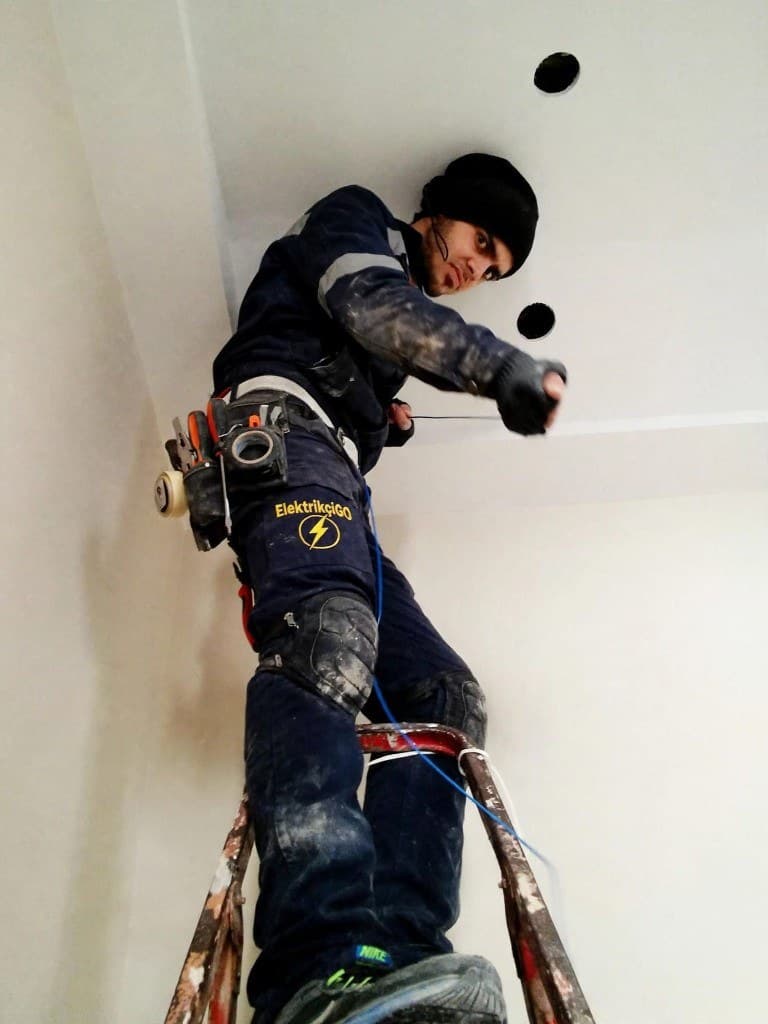
Founding master
Adnan Şemiye18 years in the field
MYK-certified master
Adnan Şemiye reads this job in the field. The price is written before work starts.
Estimate 2,400–14,000 TRY
Lamps flickering in the evening, a boiler that cannot ignite and a refrigerator compressor labouring all point to one cause: your supply voltage is moving outside the accepted band. This is not an appliance fault and replacing the appliance will not fix it. The first step is measuring which way it deviates and by how much, because the remedy for a voltage sag is completely different from the remedy for a surge.
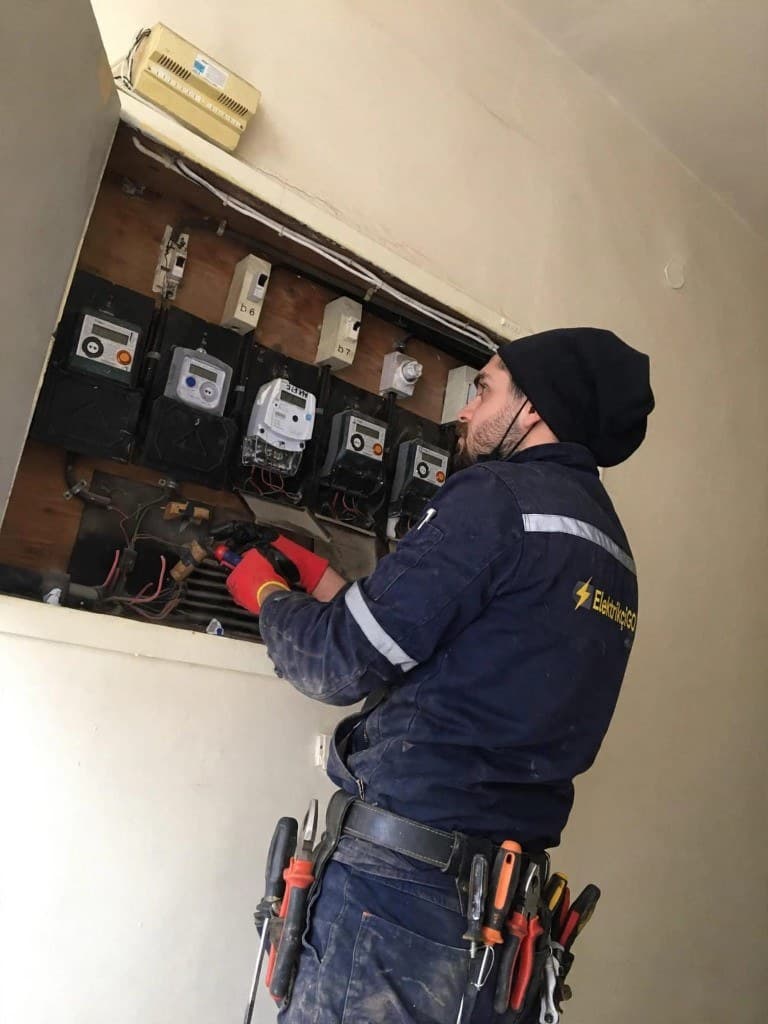
Call a certified electrician
Asian side 24/7 emergency. European side by appointment. Arrival time is confirmed on the call.
Founding master
Adnan Şemiye18 years in the field
MYK-certified master
Adnan Şemiye reads this job in the field. The price is written before work starts.
From the field
 Emergency van · +90 582 403 10 87
01 / 03
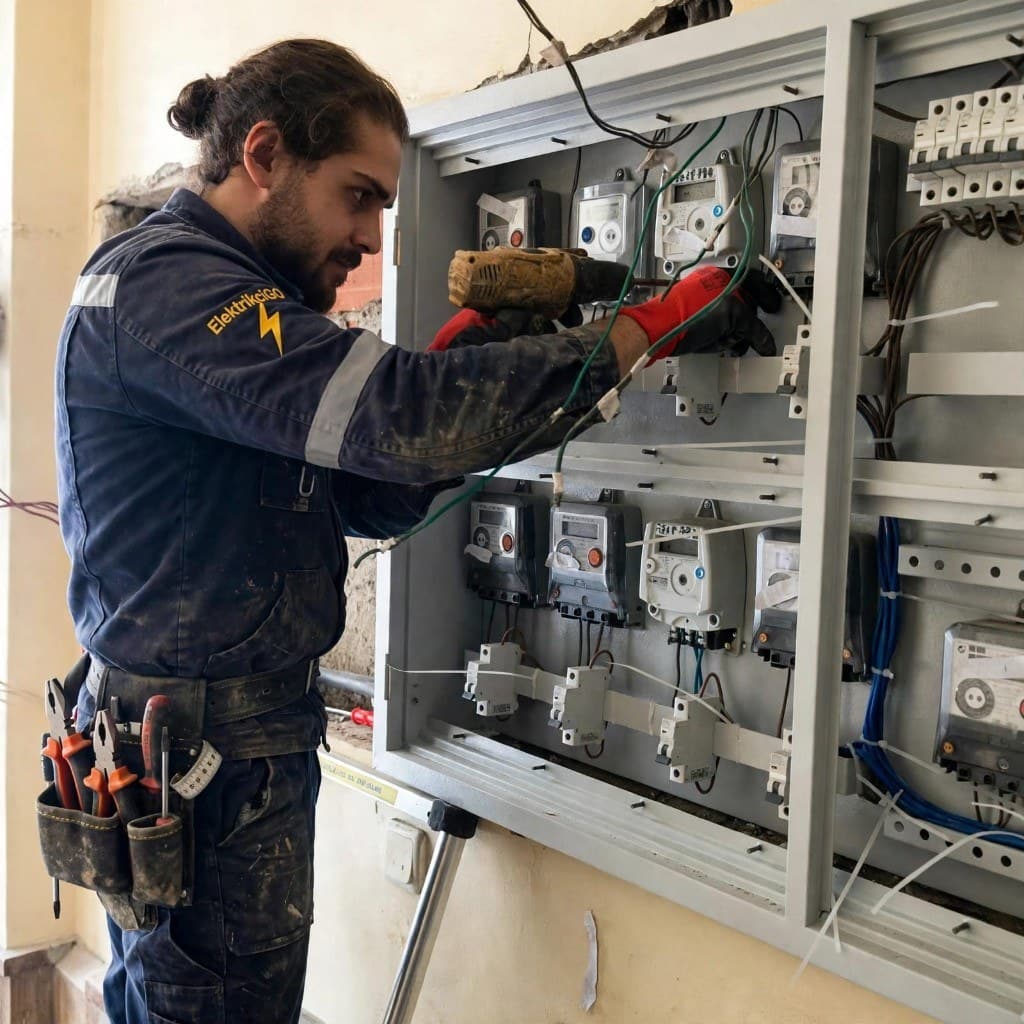
Adnan Şemiye, ElektrikçiGO electrician, fitting an Istanbul meter cabinet
A voltage sag is a problem of cross-section and distance. When the building riser is too thin for present load, the evening voltage on upper floors falls below 200 volts; the boiler board cannot find enough potential to ignite, LED lamps flicker and motorised appliances draw more current than normal and heat up. Diagnosis is reading voltage under load at the riser head and at the furthest flat intake, then calculating percentage drop from run length and cross-section.
A surge, by contrast, is usually a neutral problem and more dangerous. When the neutral conductor loosens and gains resistance, the load imbalance between phases distorts the voltage: above 250 volts on the lightly loaded phase while the heavily loaded one falls to 180. In a sound installation the voltage between neutral and earth is under one volt; anything above a few volts points to a loose neutral, and in that case fitting a regulator is the wrong answer — the neutral must be repaired.
A single reading is not enough, because the fluctuation changes through the day. A recording voltage datalogger is therefore connected at a socket or the board intake and data collected over twenty-four hours to a week. The log shows what value the voltage reaches at which hours and how long the deviation lasts; without that data the right rating and type of regulator cannot be chosen correctly.
A servo-motor regulator adjusts the output voltage mechanically through a carbon brush and a motorised variac. It covers a wide input range with high accuracy at a low cost per kilowatt, which is why it is preferred at the higher ratings that feed a whole flat or a workshop. Its drawback is a slow mechanical response: it cannot follow a sudden impulse, and the brush and variac need periodic maintenance.
A static regulator corrects the voltage by semiconductor switching, changing tap at the zero crossing. With no moving parts it needs no maintenance and its response is in milliseconds, which makes it the right choice for sensitive loads such as a boiler board, a modem or electronically controlled white goods. A 1 kVA static regulator fitted on the boiler supply holds the output steady between 220 and 230 volts even when the grid falls to 160.
The honest recommendation is this: a regulator masks the symptom but does not fix the cause. If percentage drop exceeds five, the problem is the riser cross-section and the lasting fix is upgrading it to 4x16 or 4x25 mm² NYY cable. That is a building management decision and it takes time; meanwhile a static regulator is fitted inside the flat for sensitive loads. But a regulator does not reduce the building's load and the riser keeps heating, which is why the measurement report goes to the management in writing.
A regulator corrects slow deviations; it cannot stop the microsecond impulse that comes from lightning or a utility switching operation. That is the arrester's job, and it is installed in stages: a Type 1 at the building intake, a Type 2 at the flat or board intake, and a Type 3 on sensitive equipment circuits such as a modem or camera recorder. An arrester only works with low earth resistance, because it functions by diverting the impulse energy to ground; if resistance is high the energy cannot flow and the device offers no protection.
Earth resistance is therefore measured with a digital earth tester before an arrester is fitted and assessed against the 2 Ohm target. Where the target is missed an additional solid copper rod is driven or bentonite backfill applied, and the measured value written numerically onto the service report. An arrester whose earthing was never measured is a protective device that is installed but not working, and it gives the customer false confidence.
A UPS, by contrast, is installed not to correct voltage but to keep the supply continuous through an outage. A line-interactive UPS corrects small deviations and switches to battery on failure; an online double-conversion UPS generates its output continuously and passes none of the input distortion through to the load. For loads that cannot tolerate an interruption — a server room, card terminals and registers, a camera recorder, laboratory equipment — the online type is specified and the battery runtime calculated from the real load.
The three phase-to-neutral readings and the three phase-to-phase readings are written on the same sheet, under the same load. If the three phase-to-neutral readings sit together under 200 volts and phase-to-phase also stays under 400, the sag is in the cross-section. If phase-to-phase holds near 400 volts while one phase-to-neutral climbs past 250 and another falls to 180, the neutral is loose or open. The regulator type is not chosen before that split is written. The logger chooses the rating. The split chooses whether a regulator enters that flat at all. A servo fitted while the neutral is loose boosts the high phase further. The rising phase burns the boiler board. The same loose neutral also finishes a Type 2 arrester. If the window on a Schneider or Siemens body has turned red, the cartridge is spent. A red window is not left in place and called installed. The fuse in front of the arrester is the value on the label. It is not upsized. The earth tail is not made into a loop. It comes down to the panel earth bar by the shortest path. A painted screw is not tightened. Even if the flat is single phase, the three phases are written at the riser head. One socket does not show the neighbour's load. When the neighbour starts the air conditioner in the evening the neutral shifts and this socket's 230 climbs to 250. That climb is not explained by the flat's own regulator setting. If a static regulator buzzes continuously it has stuck on the last tap. The input is outside the accepted window. The buzz is not left as «it is working». The input voltage is written in the note and the tap is not forced.
The regulator's neutral screw is the load's neutral. If the load's neutral is left on the incoming bar and only the phase is passed through the regulator, the regulator corrects its own output and the socket sees another voltage. Two voltages are written: the regulator's output screw and the load's tail, at the same moment. If the two separate, the neutral path is missing and the brush is not blamed. The maintenance bypass is a labeled switch. It is not a bridge wire hidden between input and output. If the wire is forgotten, the flat is fed from the regulator and from the mains at once. The regulator sits on the outgoing side of the customer's own main switch. The sealed meter tail is not cut. Carbon dust inside a servo box is not blown into the panel. The dust shorts the variac winding. The dust is removed and the winding is not sanded.
The output of an online UPS is not tied back to its own input bar. If it is tied back, the inverter and the mains meet on the same bar. The meeting pushes back into the mains at the moment of an outage. The UPS sockets are a separate group. That group's neutral is not bridged at random to the input neutral. If a 30 mA that stays quiet on the mains trips only when the unit goes to battery, there is a second neutral-to-earth bond. The bond is on the UPS output or in a bridge plugged into a socket. The 30 mA is not bridged to silence the trip. The bond is written, then removed. The UPS output is not seated in parallel on the generator bar. The transfer job lives on the generator page. Here it is only written that the two sources do not share the same screw.
A battery string is built from blocks of the same age. An old block and a new block are not left in the same string. The old block pulls the string down, the UPS writes a battery fault, and the sound blocks are blamed. A starter battery is not a UPS battery. A starter battery gives a large current for a short time, swells on a deep discharge, and collects gas in a closed cabinet. The cabinet is not closed and the date of the blocks is written in the note. The 1 kVA static regulator on the boiler line does not also carry the cooker and the air conditioner. The air conditioner's starting current is several times the watts on the label. The current is written with a clamp. The kVA is not invented from the watt label. An invented kVA trips its own breaker on the first start, and the boiler goes quiet again. The work does not leave Istanbul. Gebze is not written from this page.
The band below is the published 2026 list. It is an estimate. The binding figure is written on site after measurement, and the work starts after that.
The bands below are the labour ranges actually seen on recent call-outs and exclude materials. The binding figure is given in writing after on-site measurement, and no work starts without approval.
| Job | Typical price range | What is included |
|---|---|---|
| Fault diagnosis and measured survey | 750 TRY – 1,500 TRY | Diagnosis with a True-RMS clamp, megohmmeter and thermal camera; the survey fee is deducted if the repair is accepted. |
| Breaker / RCD replacement | 1,250 TRY – 3,200 TRY | A 30 mA Type A device; varies with the number of ways and whether Schneider or Siemens is specified. |
| Dedicated air conditioning circuit | 2,400 TRY – 5,500 TRY | 3x2.5 or 3x4 mm² solid copper with a C20-C25 breaker; varies with run length and trunking route. |
| Flat board renewal (modular DIN) | 6,500 TRY – 16,000 TRY | Varies with room count, circuit splitting and whether a surge arrester is included. |
| Chandelier, spot and socket installation | 650 TRY – 2,800 TRY | Priced per unit; heavy chandeliers include a steel anchor set into structural concrete. |
| Internet and Cat6 data cabling | 1,100 TRY – 4,200 TRY | Includes a Cat6 run per room, an RJ45 data outlet and verification with a cable tester. |
| Factory / power factor periodic maintenance | 4,500 TRY – 18,000 TRY | By panel and step count; includes a thermal sweep and a written measurement report. |
Prices are estimated labour ranges and exclude materials. A binding quote is issued in writing after the technician measures on site and before any work begins. Last updated: October 2026.
Service covers the neighborhoods of Istanbul's 39 districts. Not the whole of Turkey. A survey is not a binding quote.
Measurement comes first. If the boiler cannot ignite there is probably a voltage sag, and a 1 kVA zero-crossing static regulator fitted on the boiler supply will protect it. But if the cause of the sag is the riser cross-section, the regulator masks the symptom without solving the building's problem; in that case the measurement report goes to the management.
Static for sensitive, smaller loads; servo for a high-power general supply. A static regulator has no moving parts, needs no maintenance and responds in milliseconds, which makes it right for boilers, modems and electronically controlled appliances. A servo covers a wide input range more cheaply but responds slowly, and its brush and variac need periodic maintenance.
Most likely the earth resistance is high. An arrester works by diverting the impulse energy to ground; if resistance is high the energy cannot flow and the device offers no protection despite being installed. The correct order is measuring resistance with a digital earth tester first, driving an extra rod if the 2 Ohm target is missed, and only then fitting the arrester in stages.
A regulator corrects voltage but gives no output during an outage. A UPS keeps the supply continuous from battery. For loads that cannot tolerate an interruption — servers, card terminals, registers, camera recorders — an online double-conversion UPS is used; that type generates its output continuously and passes none of the input distortion to the load.
A single reading is not enough because the fluctuation changes through the day. A recording voltage datalogger is connected at a socket or the board intake and data collected for at least twenty-four hours, ideally a week. The log shows what value the voltage reaches at which hours and how long the deviation lasts; without it the right rating and type cannot be chosen.
Yes. Overvoltage and neutral loss are urgent faults that burn appliances, so there is an on-call team 24/7 including Saturday, Sunday, public holidays and night hours. On suspected surge, unplug sensitive appliances at once and mention the symptom when you call; any night or holiday rate difference is stated before anyone sets off.
The rating is set by measurement, not estimate. The real draw of the equipment to be protected is measured with a clamp meter, total active power and power factor derived, and headroom for growth added. The battery bank is then calculated from the runtime required. For loads like servers and card terminals the online type is specified, and we advise against connecting printers and air conditioning to the UPS.
If more than one flat in the building is affected, the source is the building riser or the street distribution. Measurements are taken under load at the riser head and in the flats, percentage drop calculated and the result submitted to the management as a written report. The street side is the distribution company's responsibility, and the report can be used in that application too.
The survey and voltage logging are a separate item, stated clearly on the call. Regulator installation is typically between 2,400 and 14,000 TRY depending on rating; arrester stages, the earth electrode and a UPS are separate items. The binding figure is written after the log data is read, because the right rating and type can only be chosen from that data.