Founding master
Adnan Şemiye18 years in the field
MYK-certified master
Adnan Şemiye reads this job in the field. The price is written before work starts.
Estimate 750–1,500 TRY
When a lift stops or a hydrophore goes quiet, the fault is not always the motor. The panel in the machine room is fed through a phase-failure relay, a contactor and a thermal relay. If one phase is open the motor hums and does not turn. If the three phases are balanced and the contactor is pulled in while the pump is locked, the fault is mechanical and this page does not strip that pump. The lift car is not entered and the safety gear and the door lock are not adjusted. This job is the electrical side of the panel. Reverse rotation after a generator is separated on the ATS page. A sealed meter is not opened.

Call a certified electrician
Asian side 24/7 emergency. European side by appointment. Arrival time is confirmed on the call.
Founding master
Adnan Şemiye18 years in the field
MYK-certified master
Adnan Şemiye reads this job in the field. The price is written before work starts.
From the field
Emergency van · +90 582 403 10 8701 / 08
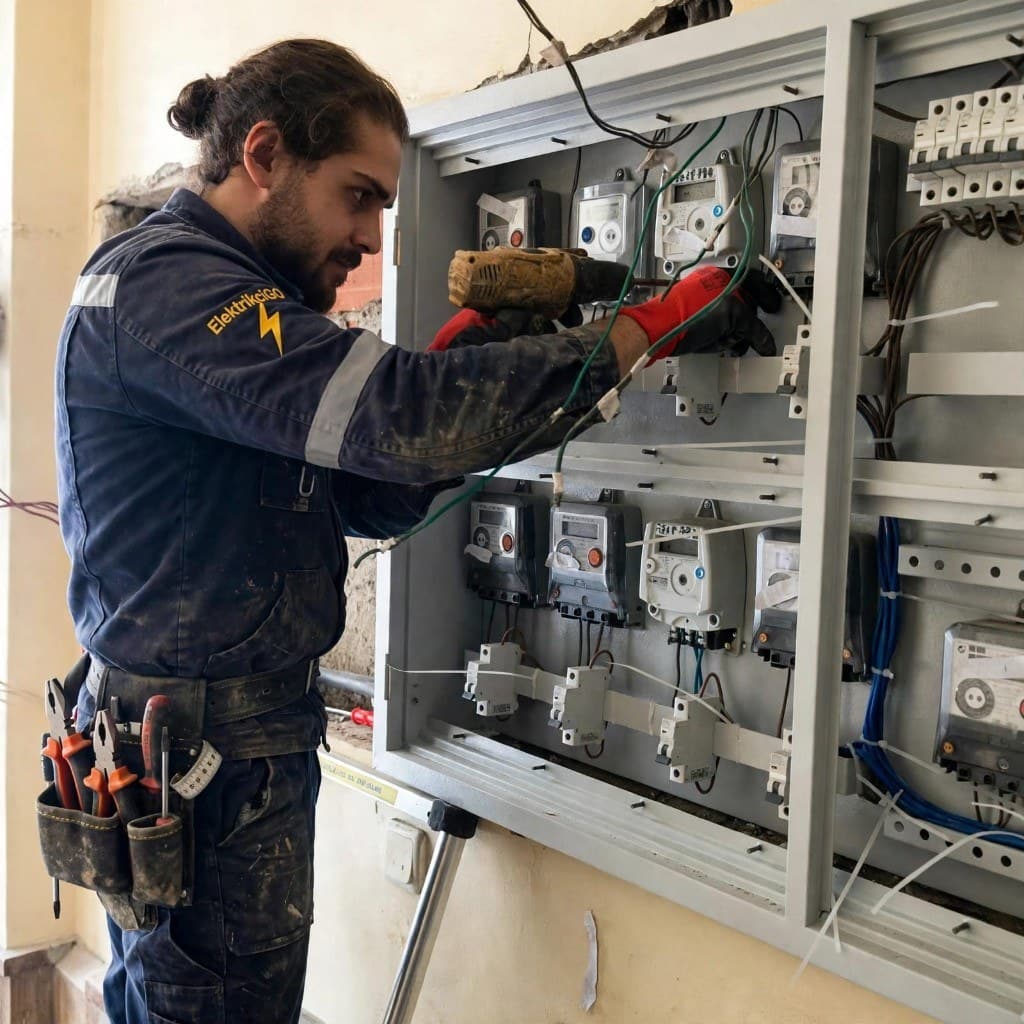
Adnan Şemiye, ElektrikçiGO electrician, fitting an Istanbul meter cabinet
A three-phase hydrophore motor hums, heats and opens the thermal when one phase drops. The first reflex is to raise the thermal amp rating. That is how a winding is burnt. The thermal is not set above the current on the motor label. The three outputs are written separately with a clamp. If one is zero, the fault is in a contactor pole, a fuse or the supply. If all three are close to the label and the motor does not turn, the coupling, the non-return valve or a seized impeller is on the mechanical side. The electrician does not strip that part and fit a pump. On the sheet the electrical and the mechanical are separate lines. Both are not sold together.
If a contactor pole is burnt, that pole is replaced and the whole breaker is not upsized. The coil voltage may be 230 V or 24 V. No coil is fitted before the label is read. A phase-failure relay should not leave the motor running on a lost neutral. If the relay is bridged, the bridge comes off. A bridge also hides a hydrophore running dry. When a float or a pressure switch stays closed, the motor spins dry. That does not mean the electrical panel is at fault. The switch contact is measured. If the contact is stuck and there is no water, the part is written to the mechanical or plumbing side. The panel only cuts the control voltage.
The lift panel's supply intake, phase order and main switch are read. The car, the shaft, the safety gear, the door lock and the inspection control sit outside this measurement. Those belong to the lift maintenance firm and this page does not stand in for that firm's authorisation. If the motor runs backwards, two tails are swapped at the panel outlet. Nobody goes down the shaft to remove a tail. No drill is used on a night fault. If the manager is not there, the panel is not opened. The supply is cut at the machine room's own switch. The building main switch is not turned off to darken every flat.
A hydrophore that starts often at night is not always a chattering contactor. If the non-return valve leaks, the pressure falls and the motor starts at short intervals. If the contactor is sound, the voltage is balanced and the switch opens and closes correctly, the electrical job ends. The valve and the membrane are written to the mechanical side. If the contactor really chatters, the control voltage is low or the coil tail is slack. The end is cut and torqued. If the voltage is still low, the supply section and the run length are written. A thin run drops the voltage on starting current. If the section is not enough, the breaker is not upsized and the run is renewed in NYY.
A measured survey is 750–1,500 TRY. A contactor pole, a thermal or a phase-failure relay sits in the 1,250–3,200 TRY band. If the panel rail, the bars and the supply are renewed together, the job enters the 6,500–16,000 TRY band only when that scope is written. The pump, the membrane, the non-return valve, the lift ropes and the car sit outside this list. The band is an estimate. Materials are invoiced separately. The binding figure is written on site after the three clamp readings and the thermal label sit on the same sheet. Workmanship is one year. A mechanical part is not inside that period. No time promise is given.
In a hydrophore panel the power is 400 V and the control is often 24 V or 230 V. What gets mixed up is a dead 24 V supply. The motor is sound and the contactor does not pull in. The supply is read from the label of the SITOP, Mean Well or the transformer in the panel. The wrong voltage burns the coil. If the float cable was jointed in a wet shaft, the joint is not left there. It is moved to a dry box and closed with a Wago 221. Cloth tape is not a contact inside water. If the float stays stuck closed, the motor spins dry. The panel notices this late, and only through the thermal. A bridged phase relay makes that time even longer. The bridge comes off.
A small hydrophore does not ask for star-delta. If the label current fits one contactor, starting is a single contactor. If a star-delta or a soft starter is already there, the timer may have drifted. A motor that locks in delta is not run by raising the thermal. The time is written again from the label current. This setting is not done from inside the lift car. The lift control board's parameters are not entered. If the board shows a fault code and the supply voltage is present at the panel, the code stays with the lift firm. If the supply is absent, the board is not removed and the phase and neutral are written first. The two jobs are not joined on one invoice.
At the end the three phases are read again for one minute under load. If the balance has gone, the circuit is switched off. A fresh start is not made before the thermal has cooled. On the sheet left with the manager, the motor label, the thermal setting, the clamp values and the part written to the mechanical side stand apart. A pump replacement is not added to the electrical line of that sheet. On a night call, noisy permanent work is left for the next day and the measurement is done quietly. No minute promise is given.
The supply cable leaves for the machine room in NYY. NYM is not put in a wet shaft. The section is written from the motor label current and the run length. If the voltage falls on starting, the thin run is renewed and the thermal is not raised. The gland sits in the steel box. An entry without a gland carries dust onto the contactor spring and chatter starts. The earth conductor is landed on the bar, not on a water pipe. The thin control cable that goes to the lift firm's own board is not stripped as part of this renewal. Touching that cable breaks the firm's fault code and stops being this page's job.
If the hydrophore room is locked and the key is with the manager, the panel is not forced. No price is written before the door is opened. If a water leak has pooled on the floor, no measurement is made and a plumber is called first. The electrician does not open a 400 V cover on a wet floor. That refusal does not shrink the job. A measurement made in a wet panel produces a wrong clamp value and spoils the thermal setting.
When the contactor is changed, the old coil voltage is written onto the new part as it was. A 24 V coil is not fitted in place of 230 V, or the reverse. The number of auxiliary contacts must keep the interlock on the diagram. If there is no diagram, the contact is not bridged and the diagram is asked for.
The lift car is not entered. Even when the call says the lift has stopped, the first reading is at the panel cover in the machine room. The contactor output is written with a clamp on three phases. If one phase is missing the fault is not in the motor, it is in the supply, and the sealed meter's wire is not cut. If three phases are present and the motor turns backwards, two leads have swapped. That shows up after the distribution crew renews a seal and the phase order shifts. The leads are corrected on the customer panel without touching the seal screw. If the hydrophore is fed from the same riser, its contactor output is written on the same sheet as three numbers. The record does not close because the flat sockets look normal: a socket is single phase and does not show reverse rotation. If the non-return valve is leaking, the body is not changed. The thermal is not set above the current on the motor label. Coil voltage is read on its own: 400 volts on a 230 volt coil burns the body, and a 400 volt coil on 230 only hums and does not lift the shaft. The breaker is not upsized. Nights and public holidays are a separate rate, and the difference is said before leaving.
If the hydrophore is quiet the order is this. The float cable first, then the thermal, then the contactor, and the pump body last. If the float hangs in the pit and the cable is wet, the panel cover is not opened. A wet cable trips the residual-current device and the technician mistakes that for a pump fault. The cable is dried, the end is cut, and only then is the panel read. If the thermal has tripped, the label current and the clamp value are written side by side. If the clamp is under the label, the thermal is not turned up and a jammed shaft is looked for. If the non-return valve is shut, it looks as if there is no water and the contactor is sound. The body is not changed before that separation is written. The lift door contact is its own line. If the motor is quiet while the door lock is open, the page does not move to the program and the lock is measured. The two jobs are not merged on one invoice. Written approval is given before the screwdriver starts. Workmanship is one year. Materials sit outside the band.
Pit water and the lift lock are not the same fault. Water concerns the hydrophore float and the residual-current device. The lock concerns the door contact and the safety circuit. Putting the two in one sentence is mistaking a wet cable for a door lock. Two headings sit on the sheet. One carries the float end, the thermal label and the clamp amperes. The other carries the closed-contact resistance of the door lock and the continuity of the safety circuit. If one is empty that job is not finished. If the car light is on and the motor is quiet, the safety circuit is open and the pump page stays quiet. If the stairs are lit and the car is dark, the riser is not the fault and the car lamp and its own breaker are read. If the breaker is sound the lamp holder is changed and the panel is not stripped. No part is ordered before that separation is written.
The price on this page is not one number. The hydrophore reading, the lift safety circuit and the part are separate lines. The 2026 estimate is a narrow band for the reading. The contactor body, the float and the thermal sit outside that band. A night call is not added onto the day band, and it is said before leaving. If the manager is absent and the riser is common, the screw is not turned and an appointment is left. No pen is put on the sealed side. The screwdriver does not start before written approval. On completion the invoice is in Turkish lira and workmanship is one year. One year does not cover the materials invoice. The job does not close before the pit cover is shut and the safety circuit is seated.
If the machine-room door is locked and the key is with the manager, the door is not forced. The measurement waits and the door is not broken. The brake coil is its own line. If the motor hums and the car does not move a centimetre, the brake voltage is read first and the winding is not marked. If the brake is 110 volts, putting 230 on it burns the coil. That number is written from its label. If the label is gone, a similar body is not guessed, a photo is left, and the part is not ordered before the label is read.
The band below is the published 2026 list. It is an estimate. The binding figure is written on site after measurement, and the work starts after that.
The bands below are the labour ranges actually seen on recent call-outs and exclude materials. The binding figure is given in writing after on-site measurement, and no work starts without approval.
| Job | Typical price range | What is included |
|---|---|---|
| Fault diagnosis and measured survey | 750 TRY – 1,500 TRY | Diagnosis with a True-RMS clamp, megohmmeter and thermal camera; the survey fee is deducted if the repair is accepted. |
| Breaker / RCD replacement | 1,250 TRY – 3,200 TRY | A 30 mA Type A device; varies with the number of ways and whether Schneider or Siemens is specified. |
| Dedicated air conditioning circuit | 2,400 TRY – 5,500 TRY | 3x2.5 or 3x4 mm² solid copper with a C20-C25 breaker; varies with run length and trunking route. |
| Flat board renewal (modular DIN) | 6,500 TRY – 16,000 TRY | Varies with room count, circuit splitting and whether a surge arrester is included. |
| Chandelier, spot and socket installation | 650 TRY – 2,800 TRY | Priced per unit; heavy chandeliers include a steel anchor set into structural concrete. |
| Internet and Cat6 data cabling | 1,100 TRY – 4,200 TRY | Includes a Cat6 run per room, an RJ45 data outlet and verification with a cable tester. |
| Factory / power factor periodic maintenance | 4,500 TRY – 18,000 TRY | By panel and step count; includes a thermal sweep and a written measurement report. |
Prices are estimated labour ranges and exclude materials. A binding quote is issued in writing after the technician measures on site and before any work begins. Last updated: October 2026.
Service covers the neighborhoods of Istanbul's 39 districts. Not the whole of Turkey. A survey is not a binding quote.
No. The car, the shaft, the safety gear and the door lock belong to the lift maintenance firm. We read the panel supply, the phase order and the main switch.
No. The thermal is not set above the motor label current. The three phases are written with a clamp first. If one phase is missing, raising the amps burns the winding.
Not always. If the non-return valve leaks, the pressure falls and the motor starts at short intervals. If the contactor is sound, the electrical job ends and the valve is written to the mechanical side.
The phases are read first. If one phase is zero, the pump is not blamed. If it is locked while the three phases are balanced, the fault is mechanical and the pump does not enter this invoice.
The phase order may have changed. Two tails are swapped at the panel outlet. Nobody goes down the shaft. The detail is on the ATS page.
No. The supply is cut at the machine room's own switch. The building main switch is not turned off to darken every flat.
Survey 750–1,500 TRY. Contactor, thermal or phase relay 1,250–3,200 TRY. Panel renewal 6,500–16,000 TRY. The pump and the car are outside it. The binding figure is written on site.
No. One year is the panel and control work that was done. The pump, the membrane, the valve, the ropes and the car are not in that period.