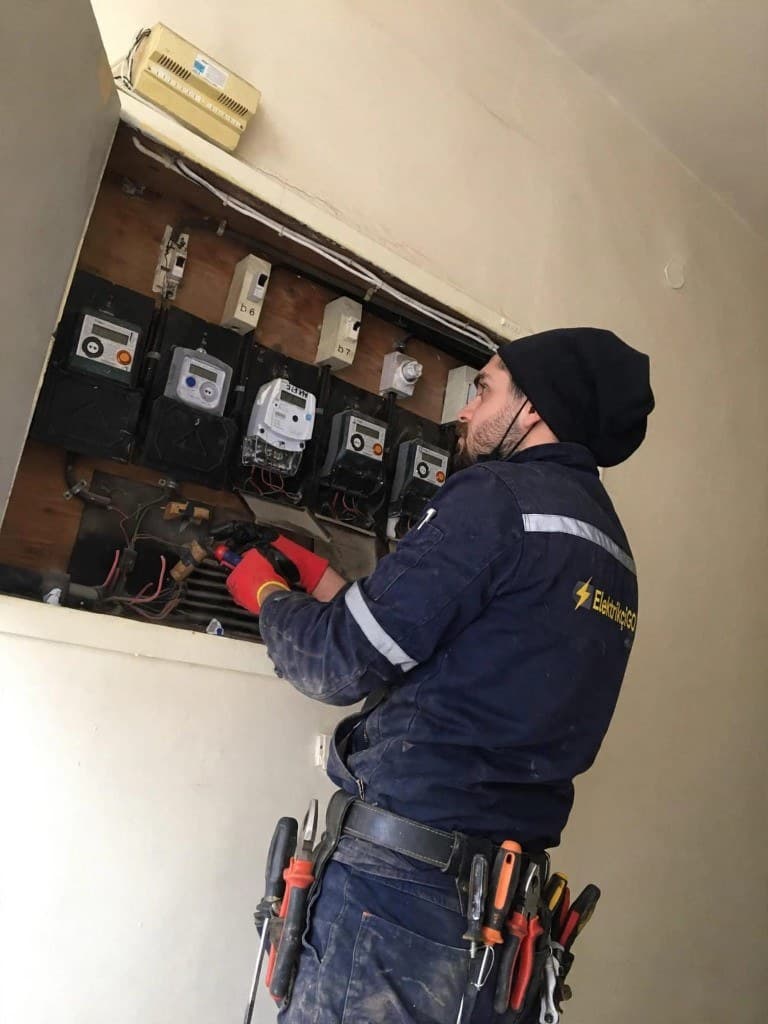
What the word electrician actually names
An electrician is the person who takes energy from the supply point and delivers it to a load without leaving the protective path to chance. The visible end is a socket, a switch and a breaker. The invisible end is conductor cross-section, short-circuit withstand, touch voltage and the trip curve. Without those four, the work is a cable pull, not an installation.
The public supply in Turkey is 50 Hz, taken as 230 V phase to neutral and 400 V between phases. Low voltage ends in that band. Above it is a high-current installation with a different duty of responsibility. An electrician reads that border from the voltage and from who is allowed to operate it.
Installer, technician and engineer do not share one signature
The installation electrician does the work in place: conduit, cable, panel wiring, terminations, labels and tests. A technician follows the same circuit on a schematic, separates faults and plans maintenance. The electrical engineer is the author of the design. Calculation, selection and conformity sit under that stamp. The Chamber of Electrical Engineers is the engineer's professional body. A tradesperson does not carry that stamp, and an engineer's stamp does not tighten a loose terminal the engineer has not seen.
Municipalities and building-control practice ask for an engineer-signed internal-installation design on defined buildings. The build itself is carried out by an authorised installer. The two signatures are not substitutes. The person on site does not upsize a conductor because habit says so when the design says otherwise. A site difference goes back to the design as a revision. A spoken 'we did it this way' is not an installation record.
The vocational qualifications authority defines national levels for electrical installation work. A certificate says those tasks were assessed. A photocopy does not finish an unmeasured panel. Competence is the certificate and the measurement record in the same sentence.
A residential hand and an industrial hand do not open the same panel
A residential electrician lives in final circuits: lighting, sockets, cooker, air-conditioning and the bathroom zone. Breaker curve B or C, a 30 mA residual-current threshold and the IP rating of a wet room are the selection list. That list closes a flat panel. It does not close a motor-control centre.
An industrial electrician reads the motor nameplate: rated current, starting method, thermal-relay setting, contactor utilisation category and the category of the emergency stop. TS EN 60204-1 is the language of electrical equipment of machines. A home panel never speaks that sentence. An industrial panel does not close until it does.
Each hand makes a mess in the other's board. The residential habit tries to cure a drive fault by raising a breaker rating. The industrial habit leaves an ordinary socket inside a bathroom zone. The electrician names which side the job is on before the cover comes off.
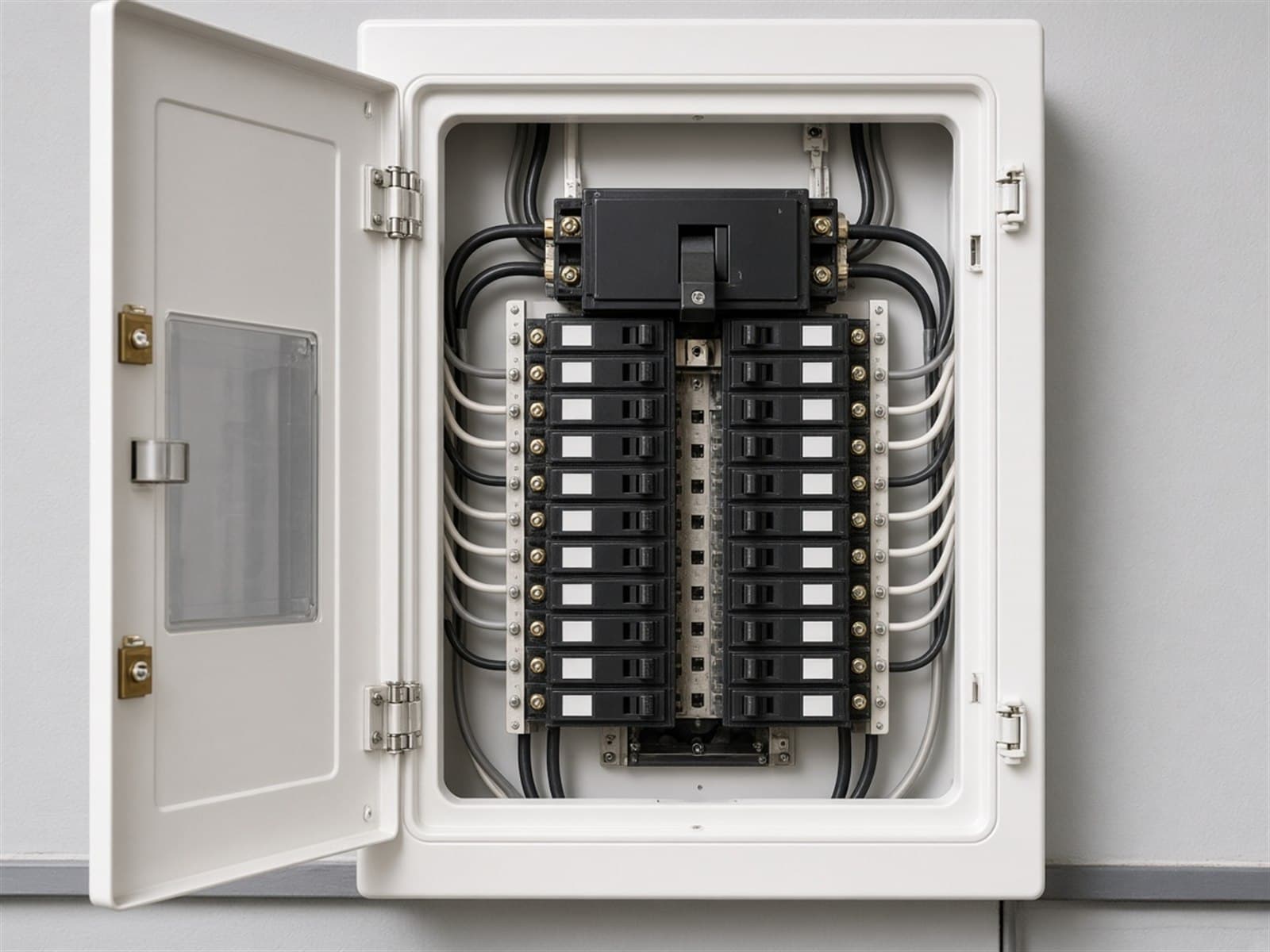
Which texts low voltage stands on in Turkey
The trade runs on texts, not on memory. The text binds conductor colour, disconnection time and the temperature rise of an assembly. An electrician who cannot name the text cannot justify the choice. An unjustified choice becomes the sentence 'we always do it this way'. That sentence is not a standard.
The internal electrical installations regulation
The Elektrik İç Tesisleri Yönetmeliği is the frame for low-voltage work inside a building: the origin, the customer side after the meter, risers, dwelling boards, conductor types and the protective arrangement. It is not a brand catalogue. A Schneider or Siemens family does not replace the regulation. The family is a product that has to provide the protection the regulation asks for.
High-current work sits in a separate regulation. Transformer rooms, cell interlocks and the operating responsible engineer live on that side. A low-voltage electrician does not take that duty with the sentence 'I can have a look'. The border is voltage, before it is courage.
The TS HD 60364 series
TS HD 60364 is the harmonised series used in Turkey for low-voltage electrical installations. Shock protection, wiring systems, earthing and verification are separate parts. The series does not count 'the cable is in' as a finished installation. An installation is finished when automatic disconnection, protective-conductor continuity and a measured loop impedance agree.
Cable designations are the daily face of that series. NYA is the single-core conductor for panel wiring and conduit. NYM is the sheathed installation cable used in walls. NYY is the 0.6/1 kV cable for burial. A buried run is not improvised with NYM. The designation is a construction, not a brand. Prysmian, Nexans, Hes or Öznur manufacture that construction. The maker's name does not change where the construction belongs.
Colour is in the text as well. Present phases are brown, black and grey. Neutral is blue. The protective conductor is green-yellow. An old board may have broken that palette. An electrician does not treat colour alone as proof of a phase. Voltage and continuity are measured, then the core is labelled. Joining neutral to protection because the colour looked familiar is one of the oldest expensive mistakes in the trade.
Assembly, machinery and operation texts
TS EN 61439 covers low-voltage switchgear and controlgear assemblies. A panel is not a steel box with breakers in a row. Temperature rise, short-circuit withstand, the form of internal separation and the labels belong to that standard. A dwelling board and a plant MCC do not have to share one form. In industry the form states how busbars and functional units are separated. A hand that does not know the form closes the door so the board looks tidy. Tidy is not a form.
The TS EN 60947 series is the industrial language of contactors, motor-protective circuit-breakers and moulded-case breakers. Utilisation category AC-3 is a motor contactor's job. A lighting contactor can look like the same body and still be the wrong device. TS EN 50110-1 is the operation standard: dead working, verification of absence of voltage, and the limit of the competent person. This page does not tell a householder to open a cover. Absence of voltage is verified by a competent person, with the instrument proved before and after.
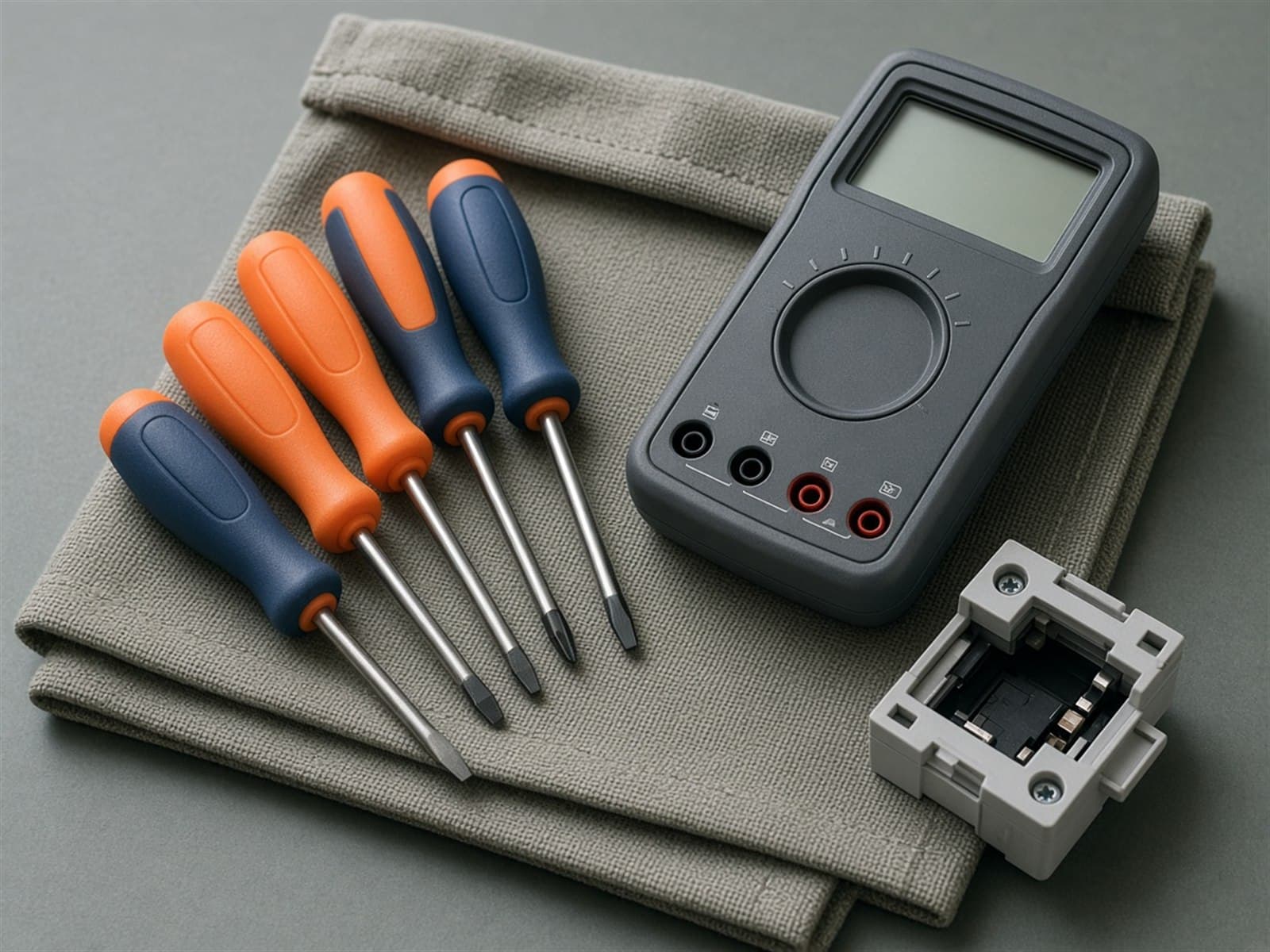
How a competent electrician is recognised
Competence is invisible while it stays on a card. It shows in the panel. Labels present, the protective conductor on its own bar, neutral separated from earth, and the measurements written down: that hand is competent. An engineer title on a card, with blue and green-yellow in the same terminal, is not competence.
Certificate, level and the chamber's border
Not everyone may install an internal installation. The regulation wants an authorised person and an authorised firm. The authorisation is that person's name in front of the administration. The paper does not raise insulation resistance by itself, and it does not protect a crew that never measures. The administration asks for the paper. The installation asks for the test. If either is missing the job is unfinished.
The chamber binds the design author and the person responsible for operation. Responsibility for a high-voltage cell is not handed to the tradesperson who wired a flat board. The reverse is also true: an engineer's stamp does not count as a tightened terminal. Naming the border of one's own work is not refusing the job. Hiding the border writes the address of the next fault in advance.
What residential work has to include
On a dwelling, a competent hand shows the difference between a final circuit and a riser on the diagram. A lighting circuit does not carry the socket load. Cooker, air-conditioning and laundry keep their own runs. A bathroom socket stays outside the zone and on a protected circuit. These are not matters of taste. A fault to a metal part in a wet room finds a person faster than a loose terminal in a dry room.
In a home panel the miniature breaker is for short circuit and overload. The residual-current device is for current that has left the conductors. Tell them as one device and the protection is already short. A competent electrician does not replace a breaker that keeps opening with a higher rating. The trip is the fault announcing itself. Silencing the announcement does not finish the installation.
What industrial work has to include
On a plant, a competent hand does not set a thermal relay before reading the motor nameplate. The setting sits on the rated current. Set it low and the starter nuisance-trips. High, and the winding is no longer protected. The contactor is chosen for power and utilisation category. Star-delta, a soft starter and a variable-frequency drive do not start the same motor for the same reason. Starting current, the speed the process wants and what the supply can stand decide the method.
An emergency stop is not a decorative button. TS EN 60204-1 defines the stop category and the reliability of the control circuit. If the button is wired only as information into a PLC input, and the power contactor is dropped by some other condition, the stop is not a safety function. An industrial electrician sees that sentence on the schematic. A hand that does not see it has fitted a button and has not built a stop.
A compensation panel is part of the same literacy. Capacitors, contactors, reactors and current transformers are not ornaments on a penalty box. Current-transformer orientation, step resonance and harmonics decide whether reactive power is actually offset. This page does not diagnose that fault. Diagnosis belongs to the measured installation. The trade has to have a hand that can read the note.
Earthing is the spine of protection
Earthing is not finished when a rod is driven. The protective conductor, equipotential bonding and automatic disconnection work together. If one is missing the other two do not save a person. An electrician thinks of the three as separate lines and joins them in one installation.
PE and neutral in a TN-C-S arrangement
Common distribution practice in Turkey separates the PEN conductor into a protective conductor and a neutral at the origin of the installation. That arrangement is called TN-C-S. The split happens once. After it, PE and neutral are not joined again in a socket, a junction box, a machine frame or a sub-board. Join them and the residual-current device either trips at once or never sees a frame fault. Neither result is protection.
Older work sometimes landed the neutral on a frame 'so it would be earthed'. That was a habit of its day, not a present installation. The electrician removes that bond, lands the protective conductor on its own bar and leaves the neutral separate. Adding a new row of breakers on top of the bond only hides the old fault behind a new cover.
Foundation earth, equipotential bonding and the tests
The earthing regulation defines the foundation earth electrode and equipotential bonding for new buildings. The conductor in the foundation is the building's earth electrode. A rod driven in the garden later can complete an old building that has no foundation electrode. It does not replace the foundation where one exists. The two are bonded, and the bond is written down, or the next hand cannot see it.
Water, heating, gas and structural steel land on the main equipotential bar so those parts do not rise against each other during a fault. Supplementary bonding in a bathroom is that room's own rule. An electrician does not skip a pipe because 'it is plastic now' without checking whether metal continues.
Two tests are different jobs. Continuity of the protective conductor is a low-resistance check of the conductor itself. Loop impedance says whether fault current will open the protective device. The rod's own resistance does not say that sentence alone. Insulation resistance is measured on a dead circuit with electronics disconnected, at the proper test voltage. A drive output, an electronic ballast and a communication card are not put on that test. The result is written. An unwritten measurement is treated as a measurement that did not happen.

Residual-current protection is not a bridge
A residual-current device compares current leaving on the phase with current returning on the neutral. The difference has left the conductors. A frame, water or earth is the address of that difference. The device opens the circuit when it sees it. A breaker does not do this job. A breaker watches overcurrent. Thirty milliamps through a person will not open a B16 breaker. The two devices stand side by side, and one is not fitted in place of the other.
30 mA and 300 mA are not the same job
30 mA is the threshold used for additional protection of people on final circuits. Socket circuits and wet rooms are its field. TS EN 61008 is the residual-current circuit-breaker without integral overcurrent protection. TS EN 61009 is the device that combines both. One device per circuit keeps the address of a fault narrow. One device for a whole dwelling blacks out every room and hides the fault.
300 mA is a higher threshold used on some origins for fire protection. It does not replace 30 mA. Swapping a 30 mA device that trips as the lever is raised for a 300 mA device silences the trip and leaves the leakage. A time-delayed S type sits upstream so selectivity with the instantaneous 30 mA device is possible. Delay chooses which device opens first. It is not a way to cancel protection.
Types AC, A and B do not replace each other
Type AC sees sinusoidal residual current. It is the type described for older resistive loads. Type A also sees pulsating direct current. Electronic ballasts, some drives and present household electronics produce that component. Type AC can be blinded when direct current saturates its magnetic circuit. A blind device still occupies a way on the din rail and protects nothing.
Type B also sees smooth direct residual current. Variable-frequency drives and some chargers therefore ask for type B, or for the type the manufacturer writes. Fitting type AC ahead of a drive and then saying 'there is earth leakage' is a wrong type, not a diagnosis. The manufacturer note outranks panel habit.
A bridge, a wrap of tape, or a defeated test button is a breach of the trade. The test button is the device checking itself. A device that does not open when the button is pressed is faulty. It is not evidence that the circuit is healthy. If neutral and protective conductor meet downstream of the device, it trips at once. The remedy is not a bridge. The remedy is to separate the joined core and measure insulation. That measurement is not dictated to a householder. A competent person does it after the supply is off and proved dead.
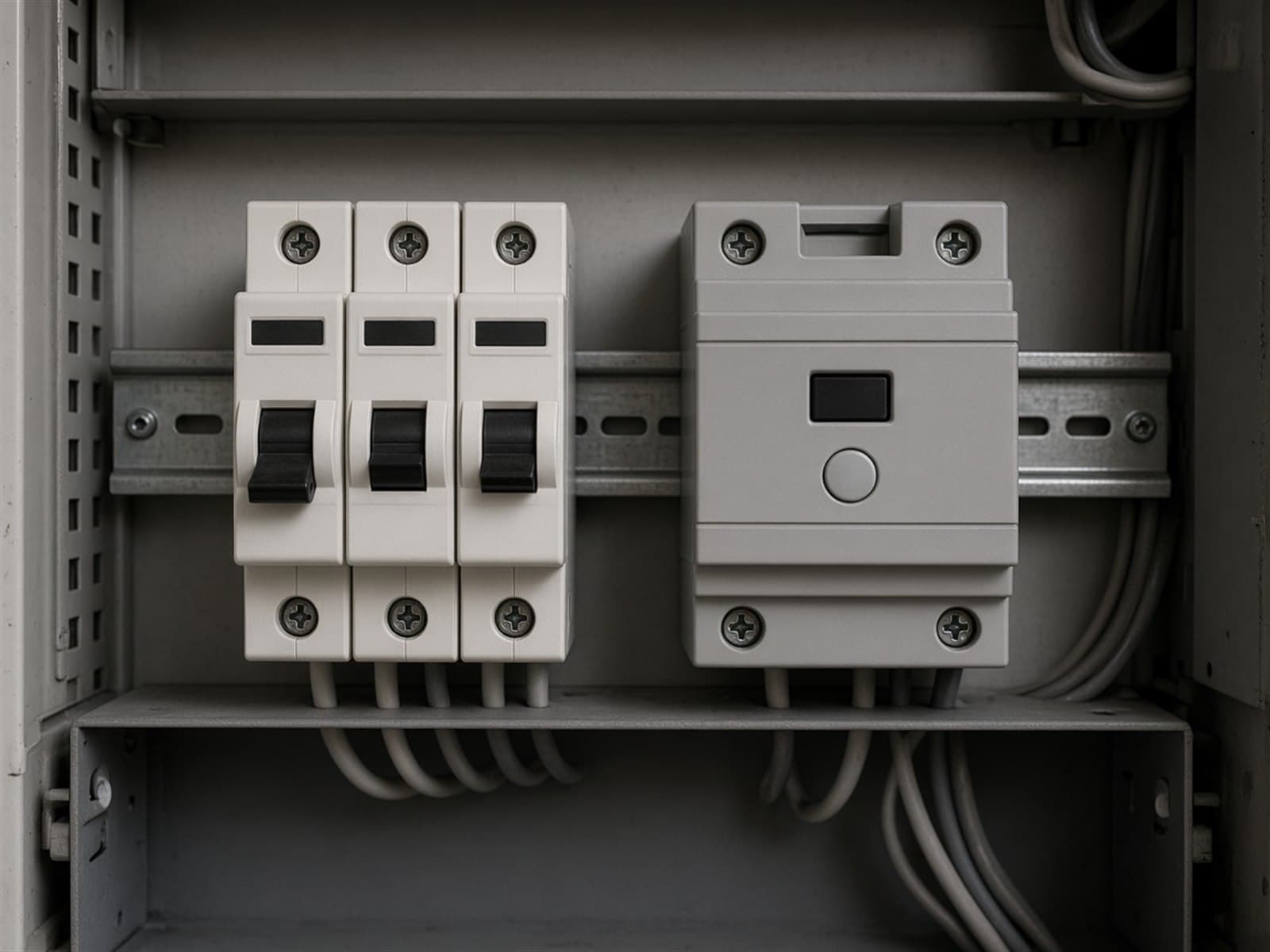
The trade moved from contactors to PLCs and drives
Twenty years ago an industrial panel was pushbuttons, contactors, timers and a thermal relay. That panel still runs, and it still has to be read. Two layers arrived on top. A programmable controller keeps the decision in software. A variable-frequency drive separates speed and torque from the supply frequency. An electrician sees all three layers. Seeing only one produces faults in the other two.
The control schematic is still read
A contactor is a coil and a set of contacts. Coil voltage is on the label. Feeding 230 V to a 24 V coil is as wrong as leaving a 230 V coil on 24 V. An auxiliary contact seals, the thermal relay opens, the emergency stop sits in series. That is the first rung of a ladder. Siemens SIRIUS, Schneider TeSys and ABB AF build the same sentence in different bodies. The body changes. The sentence does not.
Hum is usually magnet faces that do not seat, or a coil on the wrong voltage. A hot body is usually a loose power terminal or a frame sized under the motor. An electrician does not file the magnet face. Filing quiets the noise for a while and finishes the contactor. The diagnosis is measured. Changing the body without the measurement repeats the same fault in a new body.
A PLC is not downloaded without a backup
A PLC is programmed in the IEC 61131-3 languages: ladder, function block, structured text and sequential function chart. The scan reads inputs, solves the program and writes outputs. An output drives a contactor coil. The program is the text of when that coil pulls in. Delete the text without a backup and the plant loses the shift.
Siemens S7-1200 and S7-1500, Schneider Modicon, Omron, Mitsubishi and Delta do the same job in different software. The software name is not a backup. An online change is a controlled act. Saying 'flip one bit' over the phone can lift an interlock. An industrial electrician sees the bit, the schematic and the backup on the same bench, and does not download without them.
Input and output voltages are not mixed. Landing 230 V on a 24 V DC input burns the card. PNP and NPN are not the same sensor family. An inductive sensor, a photoelectric sensor and an encoder are the PLC's eyes. If that cable runs beside power, unscreened and casual, the input counts ghosts. The electrician looks at the cable route before calling the ghost a program fault.
A drive output is not meggered
A variable-frequency drive rectifies the supply, holds it on a DC bus and builds a variable-frequency voltage for the motor. Speed follows frequency. Torque and ramp belong to the process. Schneider Altivar, Siemens SINAMICS, ABB ACS, Danfoss, Delta and Yaskawa are the members of that family seen on site. The member's name does not change how long the DC bus stays charged. After the supply is off the bus can remain live. That is why the cover is not opened out of curiosity.
The motor cable is screened. The screen lands 360 degrees on the gland at the frame. A twisted earth tail is not a screen. A standard insulation tester is not applied to the output terminals. It punctures the semiconductors. If the motor and the cable are to be measured, they are disconnected from the drive first. A test done without that disconnect does not find a fault. It makes one.
A drive fault code is not an excuse to reset. Overcurrent and a short on the output are not started a second time before measurement. Undervoltage and phase loss send the electrician to the supply. A heat fault sends them to the filter, the fan and the temperature inside the panel. The meaning of the code is read for that drive family. A reset before the meaning only heats the same fault.
Why a field electrician is not a neighborhood shop
In search, people look for an emergency electrician or nearest electrician. When you reach us searching for the nearest electrician ('en yakın elektrikçi'), our certified network arrives at your door promptly across Istanbul's Asian Side. ElektrikçiGO is a vetted electrician network coordinated from our Pendik operations hub, providing 24/7 emergency dispatch without surprises.
Shop hours and the field queue are not the same thing
A neighborhood shop closes when the shift ends. A residual-current trip at night, a hot NYY lug and a stopped VFD do not wait for that window. A field electrician arrives on the queue and the traffic; there is no general promise of 20 minutes. A WhatsApp video is not a survey. The measurement is insulation, loop impedance, clamp current and the label.
The survey fee is stated on the call; if the repair is awarded to us it is deducted from the job total, so no surprise line appears. The night and public-holiday difference is given on the phone before the technician sets off, not worked out at the door. Whatever our Google business profile says is what the site says.
Questions about the electrician
What does a certified electrician actually prove?
A certificate shows that a person was assessed at a defined qualification level, or that they are authorised for internal installations. It does not by itself prove that protection in a given panel was selected correctly, that earth continuity was measured, or that the residual-current type matches the load. A competent electrician carries the certificate together with the measurement record.
Which standard governs low-voltage installations in Turkey?
The frame is the internal electrical installations regulation. The working language is the TS HD 60364 series. Panel assemblies are read with TS EN 61439, machinery with TS EN 60204-1, and operation with TS EN 50110-1. A brand family does not replace those texts.
Are a residential electrician and an industrial electrician the same authority?
No. The residential hand builds final circuits, breaker curves, 30 mA protection and wet rooms. The industrial hand reads the motor nameplate, the thermal setting, the emergency stop, the PLC backup and the drive type. Neither closes the other's panel out of habit. The job is separated before the cover is opened.
Is the installation finished once an earth rod is driven?
No. The foundation earth electrode, protective-conductor continuity, equipotential bonding and loop impedance are separate jobs. Rod resistance alone does not say the breaker will open on a fault. After PE and neutral are separated they are not joined again.
Why is a residual-current device chosen at 30 mA?
30 mA is the residual threshold used to protect a person on a final circuit. A breaker does not see that threshold. 300 mA may sit upstream for fire protection in some installations and does not replace 30 mA. Raising the threshold to stop a trip removes the protection.
Why is a type AC device the wrong choice ahead of a drive?
Type AC sees sinusoidal residual current. Drives and some electronic loads produce a direct component that can saturate and blind a type AC device. A drive asks for the type the manufacturer writes, often A, F or B. The type is not chosen from habit.
Does an electrician who does not know PLCs enter an industrial panel?
If they can read the control schematic they can work the contactor layer. They do not go into the PLC layer without the program, the backup and the input type in front of them. A download without a backup deletes the interlock and the shift together. Changing a bit is not a phone job.
Why is a drive output never insulation-tested with a megger?
The output is connected to the semiconductors that build the motor voltage. A standard insulation tester punctures those parts. Motor and cable are disconnected from the drive before they are measured. After the supply is switched off the DC bus can stay charged, so the cover is not opened by someone who is not competent.
Can the colours in an old installation be trusted?
The present code is brown, black and grey for phases, blue for neutral and green-yellow for protection. An old panel may have broken that order. An electrician does not treat colour as a phase. Voltage and continuity are measured, then the core is labelled. A neutral in the wrong colour is not landed on the protective conductor.
How soon do you arrive on a night electrical fault?
Istanbul 24/7. Coordinated from our Pendik operations center, on-duty mobile technicians dispatch rapidly according to queue and live traffic. In hazardous scenarios, immediate safety protocols are guided over the phone.
The residual-current device keeps tripping. Is that dangerous?
A trip is protection, not a habit. Bridging it hides the danger. A wet room, a fridge, an old circuit or the wrong type (type AC ahead of a drive) are split on site. Raising the threshold removes the protection.