Founding master
Adnan Şemiye18 years in the field
MYK-certified master
Adnan Şemiye reads this job in the field. The price is written before work starts.
Estimate 750–1,500 TRY
The sentence “no power at home” means the whole flat is dark. If the stair and the street are dark too, the cut is on the network. If the stair is lit and only your flat is dark, the break is after the meter: the main switch, the residual-current device, or the tails at the meter outlet. If some rooms still work, this is not the page; that is the partial-outage guide. The seal is not cut, a live board cover is not opened, and a breaker is not bridged with wire.
Call a certified electrician
Asian side 24/7 emergency. European side by appointment. Arrival time is confirmed on the call.
Founding master
Adnan Şemiye18 years in the field
MYK-certified master
Adnan Şemiye reads this job in the field. The price is written before work starts.
From the field
 Emergency van · +90 582 403 10 87
01 / 08
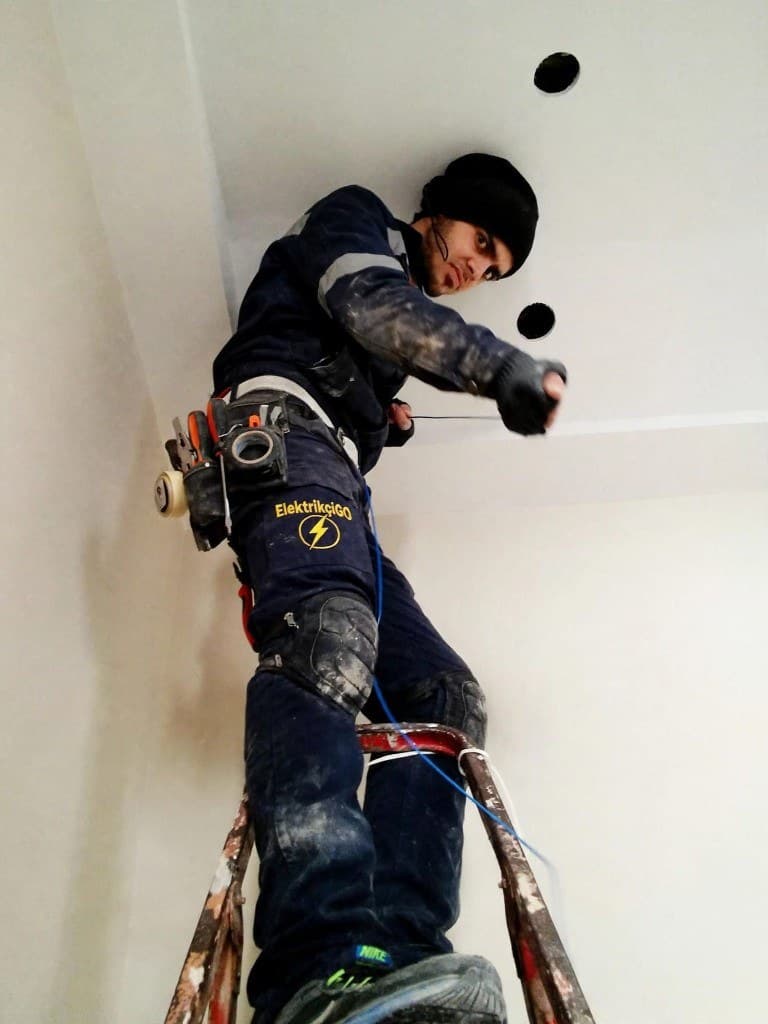
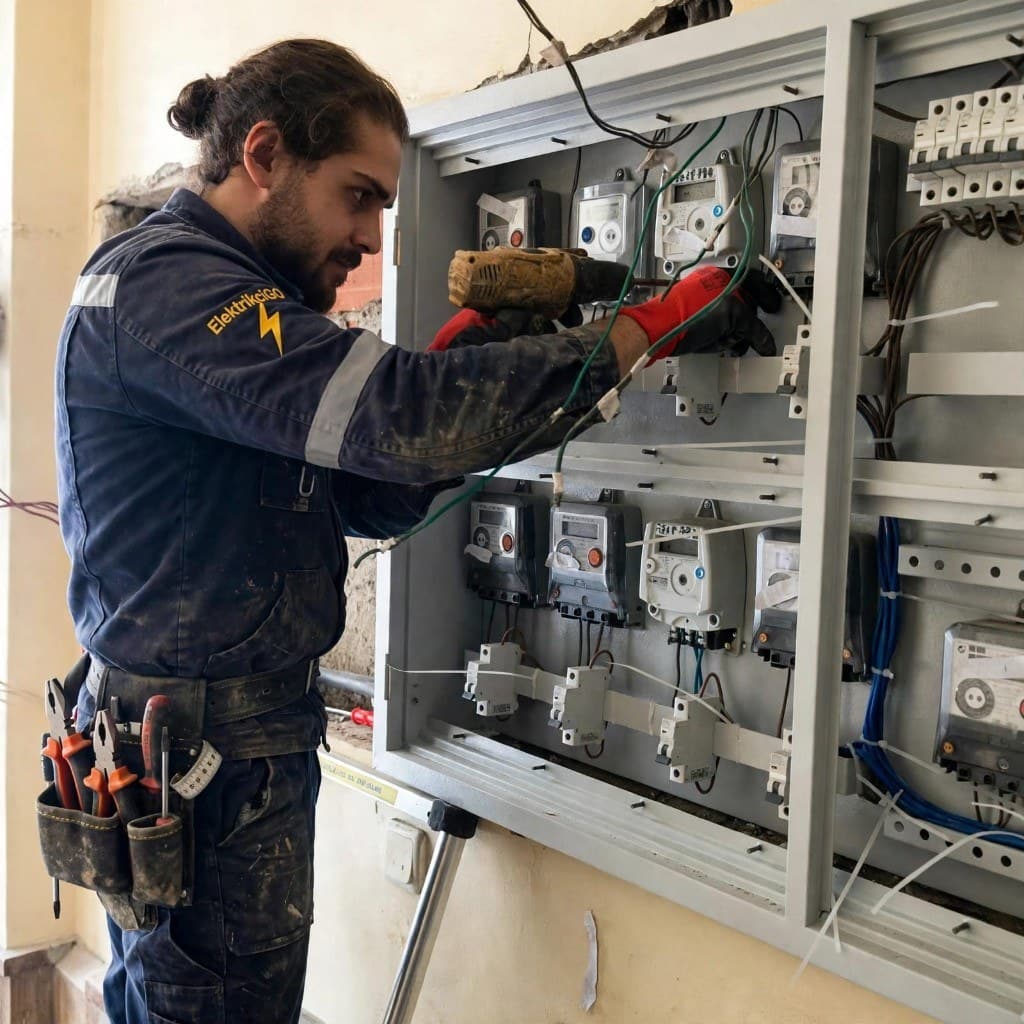
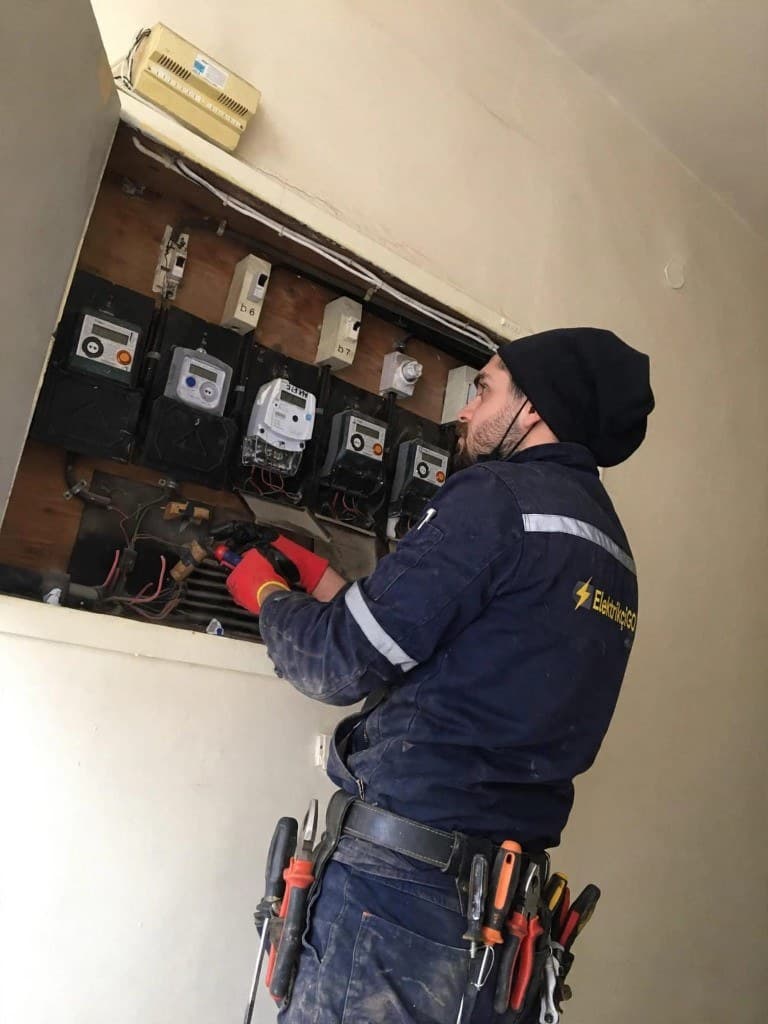
Adnan Şemiye, ElektrikçiGO electrician, fitting an Istanbul meter cabinet
A call opened as “no power at home” has broken in one of three places. The first is the street distribution and the company’s side of the building riser. The second is the main switch, the residual-current device and the tail cable after the meter outlet. The third is a short or a leakage inside the flat that has dropped the main protection. The three are not opened with the same cover. The first look is outside the flat door: is the stair light on, is the neighbour’s bell light on, is the street lamp on. If all three are dark, the cut belongs to the distribution company. On the Asian side that company is AYEDAŞ, on the European side BEDAŞ. Both use the fault line 186. The electrician does not climb the street pole, does not cut the seal wire and does not refit a network fuse. That split is written on the AYEDAŞ and BEDAŞ fault record.
If the stair is lit, the neighbour’s flat is lit and only you have no power at home, the fault is after your meter. That is not a job for the company’s sealed cover. Measurement starts at the customer terminal of the meter outlet, without opening the cover. If 220 to 235 volts is read there and the flat is still dark, the break is in the main switch, the residual-current device or the tail down to the board. If zero volts is read there and the street is lit, the meter outlet is dead; a screwdriver is not put on the sealed body, and the record is split to 186 and, where needed, to the meter, main switch and riser page. The two results are not written on one invoice.
If some rooms are lit and some are dark, the sentence is not “no power at home”. That pattern is phase loss or a disturbed neutral, and it goes to the half the home has no power guide. Mixing the two sends the technician to the wrong point. In a full blackout with a lit stair, the first suspicion is the main switch, the residual-current device and the tail. In a half blackout, the first suspicion is a missing phase and a loose neutral. On a lost neutral the voltage can rise in one room and burn appliances; on a total cut the appliances mostly go quiet, they do not burn. A call described as “half of it is on” is not closed from this page.
If the screw on the meter cover is tied to the seal wire, the screw is not turned. The number is read through the glass and from the bill. Voltage is read on the unsealed customer terminal. A sound dwelling outlet sits near 220 to 235 volts with no load. Zero says there is a cut before the meter, or that the meter’s output pole is open. To separate those, the street and stair note are written on the same line. If the street is dark, measurement stops. If the street is lit and the outlet is zero, the work stops at the seal line and a company record is opened. If there is voltage at the outlet and still no power at home, measurement steps down to the main switch.
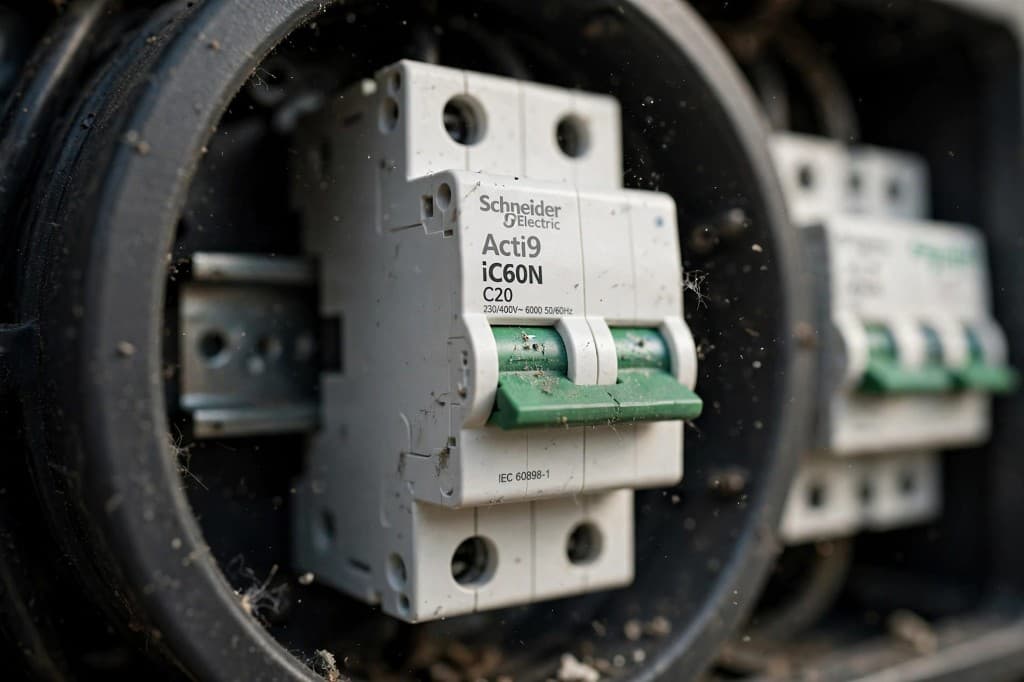
If the main switch lever is down, someone has switched it off or the protection has opened. We do not raise the lever before the fallen pole is photographed. If the lever stands up and the output screw has no voltage, that pole is open inside. Standing up does not mean the pole is sound. On a Schneider Acti9 or Siemens body one pole can die while the other still passes current. On a two-pole domestic switch, an open phase pole darkens the whole flat, and that picture is exactly what gets searched as no power at home. The body is written in the note before the whole board is stripped. A temporary bridge is not thrown onto the neighbour’s phase or neutral. A water pipe does not take the neutral’s place.
When the residual-current device falls, the branch breakers can stay up and the home still looks as if it has no power. A 30 mA device is the common door that feeds the flat. It may be raised once, after the plugs are out. If it falls a second time it is left down. It is not taped, it is not swapped for 100 mA or 300 mA, and its neutral is not bridged to the earth bar. What trips it is often a wet bathroom box, a water heater leaking to its body, a crushed NYM or a refrigerator compressor. That split is measured on the residual-current device page. Bringing the light back by upsizing the device does not clear the leakage. It leaves the body in the hand.
If every lever is up, the residual-current device is up, and there is still no power at home, the fault is not inside the circuit the breaker protects. A breaker does not open until it sees overcurrent or a short. The break is ahead of the breaker: the meter tail, a pole of the main switch, or a burnt neutral screw at the board intake. Flipping the levers up and down in that picture does not bring the light. It only makes you forget which lever was up from the start. Diagnosis is writing the input screw and the output screw side by side with a clamp and a voltmeter. Voltage in and nothing out means that body is open. Both at zero means the measurement moves one box upstream.
On an old fuse board, if the main porcelain is empty the whole flat goes dark and there is no lever called a miniature breaker. Winding wire in place of the fuse wipes the thermal protection off the copper. NYA or NYM can glow inside the conduit. The smell may not come the next hour. The fire comes at night. We do not leave a wired fuse because it “works”. The body is replaced with a miniature breaker of the right rating and a separate 30 mA residual-current device. The cross-section is written from how many square millimetres the old conductor is and what the circuit carries. A cooker load is not parked on a socket circuit. A cooker wants its own circuit.
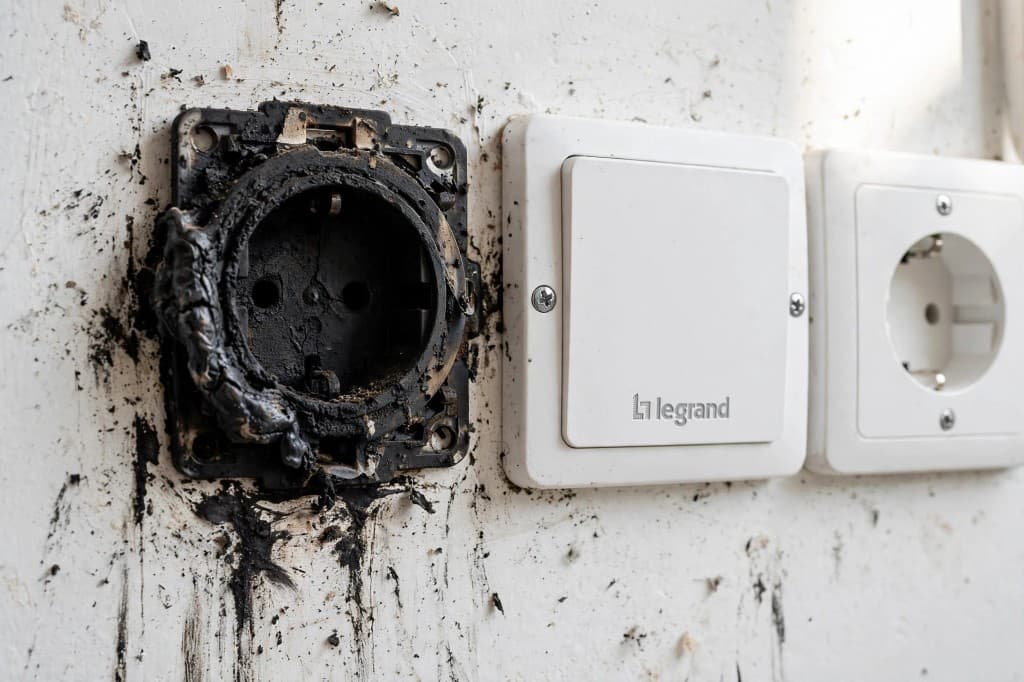
A short and an open make the same darkness and not the same sound. On a short, a breaker or the main switch falls, and sometimes an arc and a smell of burnt plastic remain. On an open, the lever is up and there is no smell. A short with a smell goes to the burning smell from a socket and breaker and board faults pages. If there is smoke or a spark, the only safe move is to drop the main switch lever with a dry hand if it can be reached, not to open the cover, and not to pour water. A screwdriver on a live bar, a wet cloth on a cover screw and a bucket on the board are not a procedure on this page.
When someone has just moved in and there is no power at home, two records get mixed. One is the subscription: if there is no contract, if it was cut for debt, or if the meter was removed, the distribution company puts the energy back. The other is a fault: the subscription stands, a number is moving behind the meter glass, or there is voltage at the outlet, and the flat is still dark. The electrician does not open a subscription, does not enter a debt screen and does not put a bridge where a removed meter was. The job is to write whether voltage exists on the customer side. If there is no voltage and the seal is in place, the call returns to the company. If there is voltage, the call returns to the main switch. Joining the two as “let the electrician turn it on” is a seal breach.
The building generator or transfer panel can feed the common areas during a street cut and still not feed the flat. If the generator is running, the stair is lit and there is no power at home, that does not mean the generator is faulty. The flat circuit may never have been tied to the generator bar. That connection is the building management’s job, and it is not done by carrying a phase into every flat at midnight. Feeding a refrigerator with an extension lead from the neighbour’s flat stresses both residual-current devices and the socket circuit at once. Until diagnosis is finished, an extension is for a temporary lamp, not for a cooker and a washing machine.
An aluminium riser and a copper tail are not pushed bare into the same hole. A Wago 221 is only for copper. If the two metals have to remain together, the part is made for both metals. Otherwise oxide turns the contact into resistance a day later, and the “no power at home” complaint comes back as “it came and it went”. Sanding wipes the oxide for a day. In a damp shaft the oxide returns. The tail cable is NYY where it runs outside. Inside the flat, NYM is seen in the wall void, and NYA in old conduit. The cross-section is written from the measured load. 2.5 mm² is not pressed onto every circuit from memory. A cooker, an air conditioner and a water heater each want the cross-section of their own circuit.
When there is no power at home, note three things before you open the door. Is the stair lit. Is there light in one neighbour’s flat. Which lever on the board is down and which is up. Saying that on the phone decides whether the technician starts at the meter or in the flat. Pull the plugs: refrigerator, oven, washer, dishwasher, boiler and water heater. Then, if the residual-current device is raised once, the same appliance does not drop it again at once. Raise the device once. If it falls again, do not try a second time. Do not tape the fallen lever. Do not wind wire onto a fuse.
Do not open the meter cover, the building’s main service head or the riser shaft. Those points sit ahead of the protective device. The prospective fault current is high, and a contact made live arcs. If there is smell, smoke or a spark, do not stay in the flat; drop only the main switch if you can reach it, and call. Do not pour water on the board. Do not let children push a nail or a wire into a socket in the dark. A torch is enough. Picking at the board cover with a phone torch starts a second fault on a body whose screw is already loose.
The sentence to tell us is short. “No power at home. The stair is lit. The neighbour has power. The main switch is up. The residual-current device is down.” Or “Both are up and there is no light at all.” Those two sentences separate a survey from a company record before anyone sets off. The address, the district and the floor are enough. A door code is written if there is one. Nights and public holidays are a separate rate. The difference is said on the phone before leaving. The arrival window is settled on the call. A minute count is not promised.
Diagnosis does not close on a guess. The meter outlet, the input and output of the main switch, and the input and output of the residual-current device are each written with a True-RMS clamp and a voltmeter. After the power is off, insulation on the suspected circuit is checked with a megohmmeter. After the light is back, the terminals are swept under load with a thermal camera. A screw above seventy degrees is not called tight. The end is cut and terminated again. Screw torque is the value in the body’s catalogue. On a home board that is between 2.5 and 3.5 Nm on most terminals. A torque from memory can be too little on aluminium and too much on copper. The catalogue line is written in the note.
The part that changes is the part of the fault that was measured. A main switch with an open pole is replaced. Sound levers are not stripped so that they “get renewed”. The residual-current device goes back as 30 mA Type A. The miniature breaker is chosen from the circuit cross-section. On a socket circuit a B curve is the domestic load. Making a B16 into a C25 moves up the current at which the magnet opens, and if the short stays the copper heats. A Schneider Acti9 or Siemens body is not fitted in the same empty slot before the letter is read. If the tail is renewed, NYY is used outside and NYM inside the flat. A joint is not left as an open twist in a damp shaft. When the job ends, each lever’s label is written: socket, lighting, cooker, air conditioner, water heater.
The published 2026 survey band is 750 to 1,500 TRY. That is the labour range for fault diagnosis and a measured survey. Materials sit outside the band. If the repair is accepted, the survey fee is deducted from the job. A switch, a device, a tail or a board renewal is a separate item and is priced only after the measurement is written. The binding figure is written on site before the screwdriver starts. Extra work does not begin without approval. Payment is on completion, invoiced, in Turkish lira. The work does not leave Istanbul. The table on the price calculator shows the same bands. A price locked on the phone is not a promise of this page.
The band below is the published 2026 list. It is an estimate. The binding figure is written on site after measurement, and the work starts after that.
The bands below are the labour ranges actually seen on recent call-outs and exclude materials. The binding figure is given in writing after on-site measurement, and no work starts without approval.
| Job | Typical price range | What is included |
|---|---|---|
| Fault diagnosis and measured survey | 750 TRY – 1,500 TRY | Diagnosis with a True-RMS clamp, megohmmeter and thermal camera; the survey fee is deducted if the repair is accepted. |
| Breaker / RCD replacement | 1,250 TRY – 3,200 TRY | A 30 mA Type A device; varies with the number of ways and whether Schneider or Siemens is specified. |
| Dedicated air conditioning circuit | 2,400 TRY – 5,500 TRY | 3x2.5 or 3x4 mm² solid copper with a C20-C25 breaker; varies with run length and trunking route. |
| Flat board renewal (modular DIN) | 6,500 TRY – 16,000 TRY | Varies with room count, circuit splitting and whether a surge arrester is included. |
| Chandelier, spot and socket installation | 650 TRY – 2,800 TRY | Priced per unit; heavy chandeliers include a steel anchor set into structural concrete. |
| Internet and Cat6 data cabling | 1,100 TRY – 4,200 TRY | Includes a Cat6 run per room, an RJ45 data outlet and verification with a cable tester. |
| Factory / power factor periodic maintenance | 4,500 TRY – 18,000 TRY | By panel and step count; includes a thermal sweep and a written measurement report. |
Prices are estimated labour ranges and exclude materials. A binding quote is issued in writing after the technician measures on site and before any work begins. Last updated: October 2026.
Service covers the neighborhoods of Istanbul's 39 districts. Not the whole of Turkey. A survey is not a binding quote.
The stair light, one neighbour’s flat and the street lamp. If all three are dark, the cut is on the network and the line is 186. If the stair is lit and only you have no power at home, the fault is after the meter. Before the board is opened, which lever is down is noted.
No. When the neighbour and the stair are lit and only your flat is dark, the job is the customer side after the meter outlet. AYEDAŞ or BEDAŞ is called when the street and the sealed-meter side are dark. The two records are not merged on one call.
The lever standing up does not show that the pole is sound inside. Voltage on the input screw and none on the output screw says that pole is open. The breaker has not opened because it saw no overcurrent. Diagnosis is measuring the two screws side by side, not flipping the lever again and again.
A 30 mA residual-current device is the common door that feeds the flat. When it falls, sockets and lamps go quiet even if the branch breakers stay up. It is raised once after the plugs are out. If it falls again it is left. It is not taped and it is not replaced with a higher mA rating.
Dropping and raising a lever once does not by itself burn the cable. What is harmful is taping a breaker that falls and winding wire onto a fuse. That wipes the thermal and magnetic protection. If you remember which lever was down from the start, saying so speeds the diagnosis.
No. The cover is not opened while there is smell, smoke or a spark. If it can be reached, only the main switch is dropped, water is not poured, and the call is opened with that information. A hot cover is not touched with a bare hand. A socket that smells goes to the socket guide and is not mixed with a whole flat in the dark.
If there is no contract, it was cut for debt, or the meter was removed, that is a subscription and the distribution company’s job. If the meter is in place and there is voltage at the outlet, it is a fault and the main switch and residual-current device are checked. The electrician does not cut the seal and “turn the power on”.
No. If half of it is lit, the fault is not a total cut. That guide is for phase loss and the neutral. This page separates the street, the meter outlet, the main switch and the residual-current device when the whole flat is dark. We do not close a half pattern here.
The published survey band is 750 to 1,500 TRY, and it is deducted from the job if the repair is accepted. That is not a quote. The binding figure is written after measurement. A loose terminal or a fallen device is often closed on the same visit. If the riser cross-section is not enough, the job does not finish the same day. A report is written and approval is waited for.
Yes. A whole flat left in the dark is not a fault to leave waiting. There is cover on Saturday, Sunday, public holidays and at night. Where the night or holiday rate differs, the difference is said before anyone sets off. The work does not leave Istanbul.
Google Review
Your review is how neighbours searching for an emergency electrician in your area find us. One tap opens the Google review page; there is no account to create and no form to fill in.
Current rating: 5.0 / 5.0 · 30 verified reviews
Leave 5★ On Google
★★★★★
Harika bir işçilik mükemmel bir insan bu devirde böyle bir usta yok ,çok teşekkürler adnan usta emeğine sağlık
★★★★★
Adnan bey oldukça makul birisi, işinin ehli genç bir arkadaş.
★★★★★
ما شاء الله تعالى عليك يا معلم عدنان
★★★★★
İyi deneyim, hızlı performans
These sentences were copied from the Google Business reviews list on 3 Nov 2026. The stars and the count refresh from Google about every 12 hours.
Read every review on Google