Founding master
Adnan Şemiye18 years in the field
MYK-certified master
Adnan Şemiye reads this job in the field. The price is written before work starts.
Estimate 1,100–4,200 TRY
In a workplace, a telephone that does not ring rarely means the exchange has failed. Most call-outs in recent years come from premises where the operator has moved the line to digital while an analogue Karel or Panasonic unit still sits on the wall: the hardware is sound, the line it talks to has changed. So the first job is not replacing the exchange but measuring, at the line intake, which side the problem is on. Misdiagnosis is expensive here, because the gap between an unnecessary new exchange and a gateway is a few thousand lira.
Call a certified electrician
Asian side 24/7 emergency. European side by appointment. Arrival time is confirmed on the call.
Founding master
Adnan Şemiye18 years in the field
MYK-certified master
Adnan Şemiye reads this job in the field. The price is written before work starts.
From the field
 Emergency van · +90 582 403 10 87
01 / 03
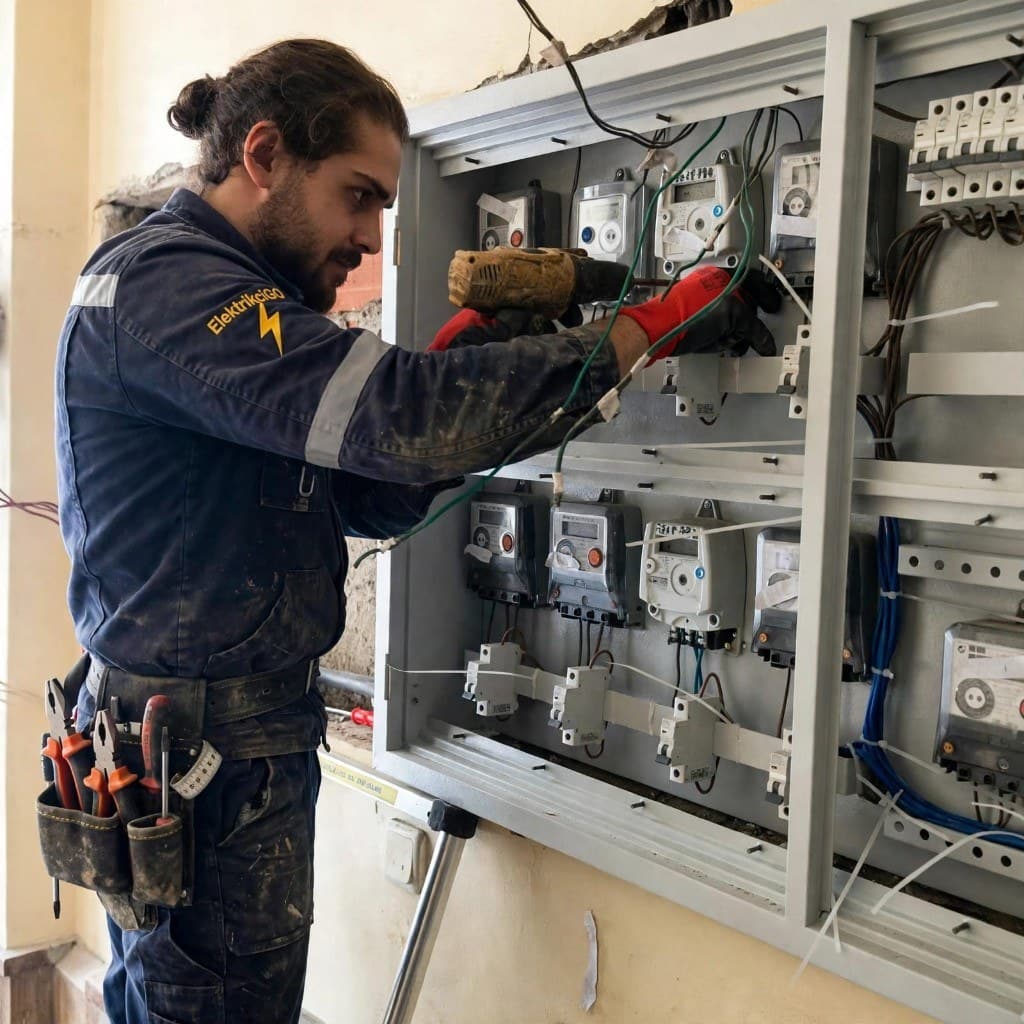
Adnan Şemiye, ElektrikçiGO electrician, fitting an Istanbul meter cabinet
Diagnosis starts at the line intake the operator left behind, not at the exchange cabinet. A test handset on an analogue subscription listens to the line itself: roughly 48 volts DC on hook, a dial tone, and around 75 volts of ringing voltage on an incoming call. If those are present the line is sound and the fault is on the exchange side. If there is no voltage or no dial tone at the intake there is no point opening the exchange at all; the fault is upstream and every intervention inside the cabinet is wasted.
On fibre and VoIP subscriptions the picture changes. The operator no longer leaves a copper pair but a telephone port on the modem or ONT. That port can feed an analogue exchange's trunk input directly, but its ringing voltage and current capacity are lower than copper; in an exchange where four or five extensions ring together the port struggles and calls drop. The answer here is not to blame the exchange but to size the trunk count and the feed correctly.
On the extension side the most common fault is not the exchange at all but a loose or oxidised termination on the krone frame. In a frame opened and closed for years, one extension pair loses contact pressure; that extension either never rings or crackles during a call. Assuming this will be solved by swapping an exchange card is a classic error; re-terminating the frame with a punch-down tool ends it.
In an office with fewer than twelve extensions, on a single floor, with sound existing copper extension wiring, an analogue exchange is still the most economical choice. The Karel MS26 and MS48 family and the Panasonic KX-TES and KX-NS series are durable at that scale; spares are available and a technician can repair them at card level. Throwing out existing cabling to move to IP at that scale is usually unnecessary expense, because the features gained go unused.
An IP exchange genuinely pays off once extensions pass twenty, where there are multiple floors or branches, and where call recording, routing, an IVR greeting or CRM integration is needed. Solutions such as Yeastar, Grandstream and 3CX run over a SIP trunk; each extension is a network point. At that point telephone wiring is not a separate trade but part of the data installation: the same Cat6 infrastructure feeds both the computer and the handset.
There is a third route, and it is the one we recommend most often: leave the existing analogue exchange where it is and put a SIP gateway on the trunk side. The gateway converts the operator's digital line into the analogue trunk the exchange understands. Neither the extension wiring nor the staff's handsets change, and the cost stays at about a fifth of a new exchange. Saying so means less work for us, but if that is the right recommendation after seeing the cabinet, that is what we write down.
When pulling extensions in a new office we now use Cat6 rather than four-pair telephone cable; the cost difference is small, the flexibility difference large. The same cable feeds an analogue extension today, an IP handset tomorrow and a network outlet when needed. At least two runs are left at every desk: one telephone, one data. Runs do not exceed ninety metres, because past that limit packet loss and PoE voltage drop begin on IP handsets.
Low-voltage and mains wiring do not share a conduit. If telephone and data cable run alongside a power circuit for metres, electromagnetic noise from the mains couples onto the line; it is heard as hiss on a handset and as dropouts on an IP phone. Where crossings are unavoidable the cables cross at right angles, and parallel routes keep at least twenty centimetres apart. The rule looks cheap, but correcting it later means reopening the whole trunking.
The exchange cabinet's supply is not tapped off the general lighting circuit. A separate circuit is pulled with its own breaker and its own residual current protection, so a socket fault elsewhere in the office does not take the telephone system down with it. The circuit is clearly labelled at the board; an unlabelled exchange circuit gets switched off by mistake at the next maintenance visit and nobody can work out why.
An uninterruptible supply is not a luxury on a telephone exchange but part of the job, because during a power cut a working telephone matters more than lighting to most businesses. The load of the exchange and of any network switch is measured and the UPS sized to it; if a switch feeding IP handsets over PoE is left out of the calculation, the UPS collapses in the first minute of an outage. Battery health is load-tested once a year, because a standby battery dies quietly and you only discover it during a cut.
Copper telephone line entering from outside the building is a doorway for lightning. A surge arrester made for telecom lines is fitted at the trunk intake and its earth bonded to the building's main earth bar; protection bonded to a separate rod makes things worse by creating a potential difference between two earths. In areas where open-country lines run long, such as Şile, Beykoz and Çekmeköy, a card burnt out by lightning is the single most expensive item, and this protection costs less than a tenth of it.
In a workplace, being able to answer the door from any extension is the most requested integration, because it removes the walk to the door. On analogue exchanges this is done through a door-phone interface wired to an extension port; an incoming press rings a nominated extension and a key sequence drives the door release. The lock's supply is separated from the exchange supply, because the current surge as an electric strike pulls in will tire an exchange card on the same feed over the years.
In noisy areas such as warehouses, workshops and shops, paging is wired through a separate output. The exchange's paging output is a line-level signal and is not connected straight to a loudspeaker; an amplifier of suitable power goes in between, and speaker runs are wired in series or parallel according to its line transformer. Speaker cable does not share a conduit with telephone extensions, because during a page the signal bleeds into the extensions and is heard inside the call.
The most neglected part of an exchange installation is the configuration backup. Extension numbers, routing rules, business hours and greeting announcements live in the exchange's memory; a card failure takes that with it and everything is rebuilt from scratch. On completion the configuration file is exported, a copy handed to the customer and a copy kept on file. That five-minute job prevents a day of rebuilding later.
The handover document records which extension maps to which room and user, the pair numbers on the krone frame, the trunk configuration and which breaker at the board feeds the exchange. This is not a formality: a year later, when a desk moves or a new member of staff arrives, every change needs a fresh survey without that sheet. The brand and model of materials used and the measured values go onto the same form, and the workmanship falls under guarantee.
I do not lock a price on the phone. The range I give is an estimate drawn from similar jobs. The binding figure is written after I have seen and measured the fault, before I start. Extra work does not begin without your approval. Payment is on completion, invoiced, in Turkish lira. Nights and public holidays are a separate rate, and I say so before I leave. We work as an approved technician network. I give you the arrival window for your district on the call, and a live location link is shared once the technician sets off.
The band below is the published 2026 list. It is an estimate. The binding figure is written on site after measurement, and the work starts after that.
The bands below are the labour ranges actually seen on recent call-outs and exclude materials. The binding figure is given in writing after on-site measurement, and no work starts without approval.
| Job | Typical price range | What is included |
|---|---|---|
| Fault diagnosis and measured survey | 750 TRY – 1,500 TRY | Diagnosis with a True-RMS clamp, megohmmeter and thermal camera; the survey fee is deducted if the repair is accepted. |
| Breaker / RCD replacement | 1,250 TRY – 3,200 TRY | A 30 mA Type A device; varies with the number of ways and whether Schneider or Siemens is specified. |
| Dedicated air conditioning circuit | 2,400 TRY – 5,500 TRY | 3x2.5 or 3x4 mm² solid copper with a C20-C25 breaker; varies with run length and trunking route. |
| Flat board renewal (modular DIN) | 6,500 TRY – 16,000 TRY | Varies with room count, circuit splitting and whether a surge arrester is included. |
| Chandelier, spot and socket installation | 650 TRY – 2,800 TRY | Priced per unit; heavy chandeliers include a steel anchor set into structural concrete. |
| Internet and Cat6 data cabling | 1,100 TRY – 4,200 TRY | Includes a Cat6 run per room, an RJ45 data outlet and verification with a cable tester. |
| Factory / power factor periodic maintenance | 4,500 TRY – 18,000 TRY | By panel and step count; includes a thermal sweep and a written measurement report. |
Prices are estimated labour ranges and exclude materials. A binding quote is issued in writing after the technician measures on site and before any work begins. Last updated: October 2026.
Service covers the neighborhoods of Istanbul's 39 districts. Not the whole of Turkey. A survey is not a binding quote.
Most likely not. The first check is the trunk intake: a test handset looks for dial tone and ringing voltage. If there is no signal at the intake the fault is upstream and touching the exchange is pointless. If there is, we move to the exchange or the krone frame.
No. In most cases the existing analogue exchange stays and a SIP gateway is fitted on the trunk side; the gateway converts the digital line into the analogue trunk the exchange understands. It costs about a fifth of a new exchange and the extension wiring is untouched.
Almost always the contact on that extension's pair at the krone frame has weakened, or the cable has broken somewhere. The frame is re-terminated with a punch-down tool and the run verified end to end with a cable tester. Swapping an exchange card is unnecessary for this fault.
Once extensions pass twenty, where there are multiple floors or branches, or where call recording, an IVR greeting and CRM integration are needed. In a single-floor office under twelve extensions an analogue exchange is still cheaper and the features IP brings go unused.
Cat6 on new installations. The cost difference against telephone cable is small and the flexibility difference large: the same run feeds an analogue extension today, an IP handset tomorrow and a network outlet when needed. At least two runs per desk, and no run over ninety metres.
It depends on whether the business can tolerate being without telephones, and most cannot. The load of the exchange and of the switch feeding IP handsets is measured and the UPS chosen accordingly. If the switch's PoE load is left out, the UPS collapses in the first minute of an outage.
Yes; copper telephone line entering from outside is a doorway for lightning. A telecom-type arrester is fitted at the trunk intake and its earth bonded to the building's main earth bar. Protection bonded to a separate rod makes things worse by creating a potential difference between two earths.
Yes. A door-phone interface is wired to an extension port; a press rings a nominated extension and a key sequence drives the release. The electric lock's supply is separated from the exchange supply, because the current surge as the lock pulls in tires an exchange card on the same feed over the years.
An exported configuration backup, the extension-to-room-and-user map, the krone frame pair numbers, the trunk configuration and which breaker at the board feeds the exchange. The brand and model of materials used and the measured values go onto the same form, and the workmanship is under guarantee.