Founding master
Adnan Şemiye18 years in the field
MYK-certified master
Adnan Şemiye reads this job in the field. The price is written before work starts.
Estimate 18,000–45,000 TRY
An electrical refit in a workplace differs from the same job in a flat for two reasons. The first is load: three or four times the appliances of a home go into the same floor area, and they run together at the same hours. The second is continuity: the shop does not close, the office keeps working, the till and the server do not stop. So the real skill in a commercial refit is not pulling cable but deciding up front which task happens on which night and in what order. An unplanned commercial refit produces a loss of trade that costs more than the work itself.
Call a certified electrician
Asian side 24/7 emergency. European side by appointment. Arrival time is confirmed on the call.
Founding master
Adnan Şemiye18 years in the field
MYK-certified master
Adnan Şemiye reads this job in the field. The price is written before work starts.
From the field
 Emergency van · +90 582 403 10 87
01 / 03
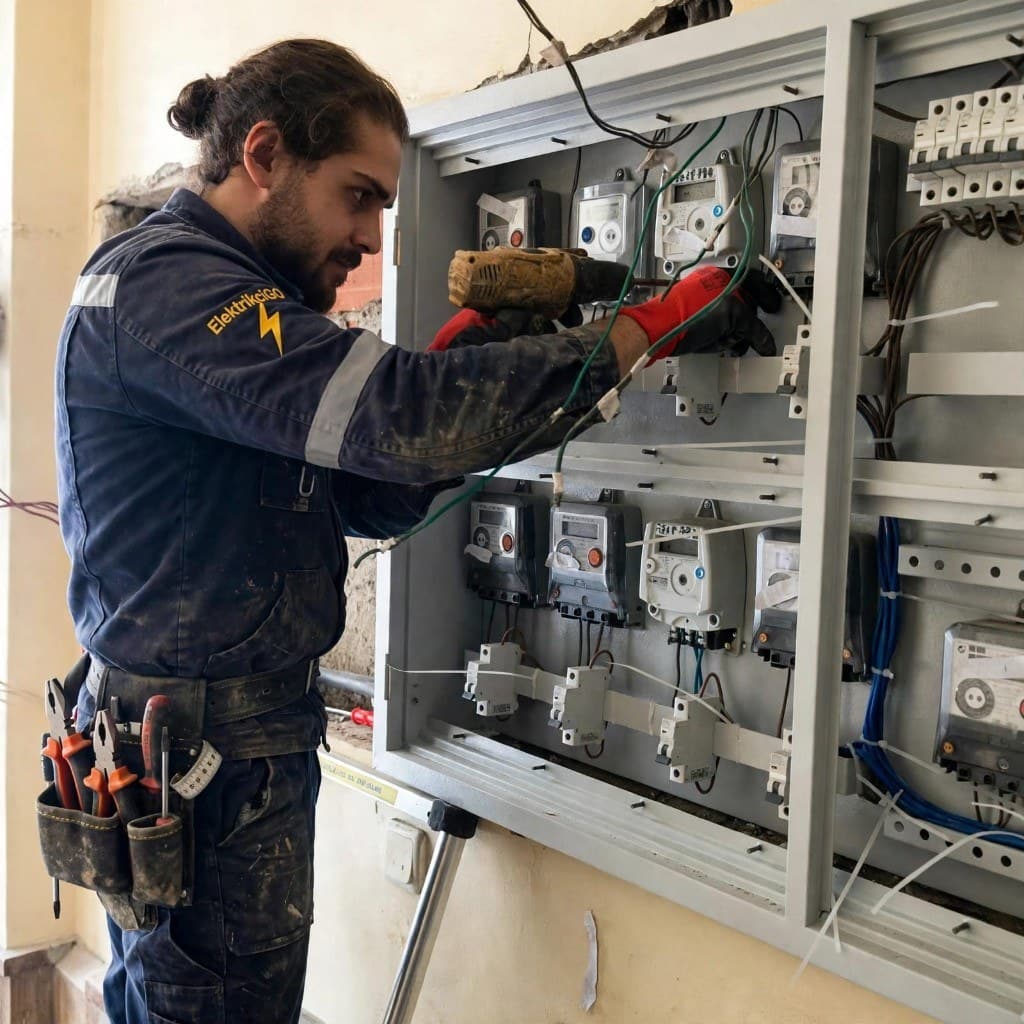
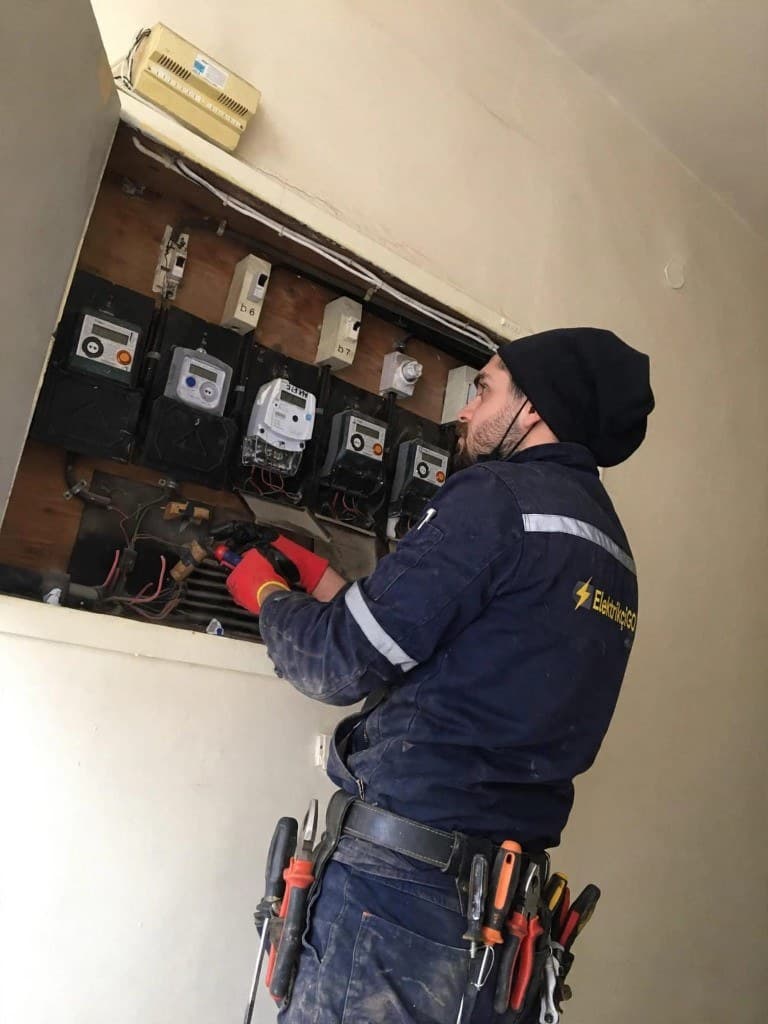
Adnan Şemiye, ElektrikçiGO electrician, fitting an Istanbul meter cabinet
The first step in a refit is not choosing cable but knowing how much power exists before the meter. The contracted supply capacity is written in the agreement and the main switch's amperage confirms it; a single-phase 32 amp supply carries about 7 kilowatts, a three-phase 3x40 amp about 27. The new fit-out's total demand is compared against that figure. An office with three air conditioners, a fitted kitchen, a coffee machine and fifteen workstations will not run on a single-phase supply; discovering that after the refit means rebuilding the whole board.
Demand is not calculated by summing nameplate ratings, because not everything runs at full load at once. A realistic calculation applies a diversity factor to each load group: lighting runs almost entirely together, air conditioning loads to about eighty per cent in summer, office sockets to around forty. Kitchen and heating groups, by contrast, are taken at full load because thermostatic appliances draw fully while they draw. The figure these factors produce tells you whether a supply upgrade is needed, and the utility application time is added to the refit schedule.
In a three-phase premises the second half of the load calculation is phase balance. Putting all the lighting on one phase and all the sockets on another is a common error: in the evening one phase draws ninety amps while another sits at twenty. Imbalance pushes current through the neutral conductor, heats it and raises voltage on the lightly loaded phase. Correct practice splits each load group across all three phases, and on completion each phase current is measured with a clamp meter and balanced; the readings go onto the handover form.
A commercial board carries noticeably more ways than a domestic one, and that is an operating decision rather than an expense. Each way defines the area that goes dark in a fault: if all the shop lighting sits on one breaker, a single short-circuited fitting blacks out the shop. Lighting is split across at least two ways, preferably three as window, sales floor and stockroom; socket groups are separated by room or department. A fault then stops a part of the business rather than all of it.
Labelling inside the board is half the job and the half most often skipped. A permanent label under each breaker states which area it feeds, and a circuit schedule is fixed inside the door. The reason is speed, not tidiness: whoever opens the board during a midnight fault narrows the problem down in minutes if they can read which breaker cuts which section. In an unlabelled board the same task means trying breakers one by one and blacking the business out repeatedly.
Residual current protection is not loaded onto a single device in a workplace. Putting every circuit behind one 30 mA device means a refrigerator's normal leakage drops the entire premises. The correct arrangement groups circuits and gives each group its own device; loads that must not stop, such as refrigeration and servers, sit on a separate device and ideally behind a 300 mA selective main with their own 30 mA protection. A leakage fault is then cut safely without stopping the whole business.
A separate clean circuit is pulled for tills, card terminals, servers and the network rack, and it is never shared with cleaning sockets. The reason is concrete: when a vacuum cleaner or heater runs on the same circuit, the voltage dip it creates restarts the till and loses an open sale. The clean circuit gets its own breaker at the board and its outlets are a different colour or permanently labelled, so cleaning staff do not use the wrong socket.
An uninterruptible supply goes behind that circuit, and the UPS is sized by measurement rather than estimate. The real draw of the till, server, network switch and modem is read with a clamp meter; the UPS is specified at a minimum of one and a half times that figure so it remains adequate across the battery's life. Devices with high instantaneous draw, such as printers and heaters, are not connected to the UPS; they exhaust the battery in minutes and defeat the point of having one.
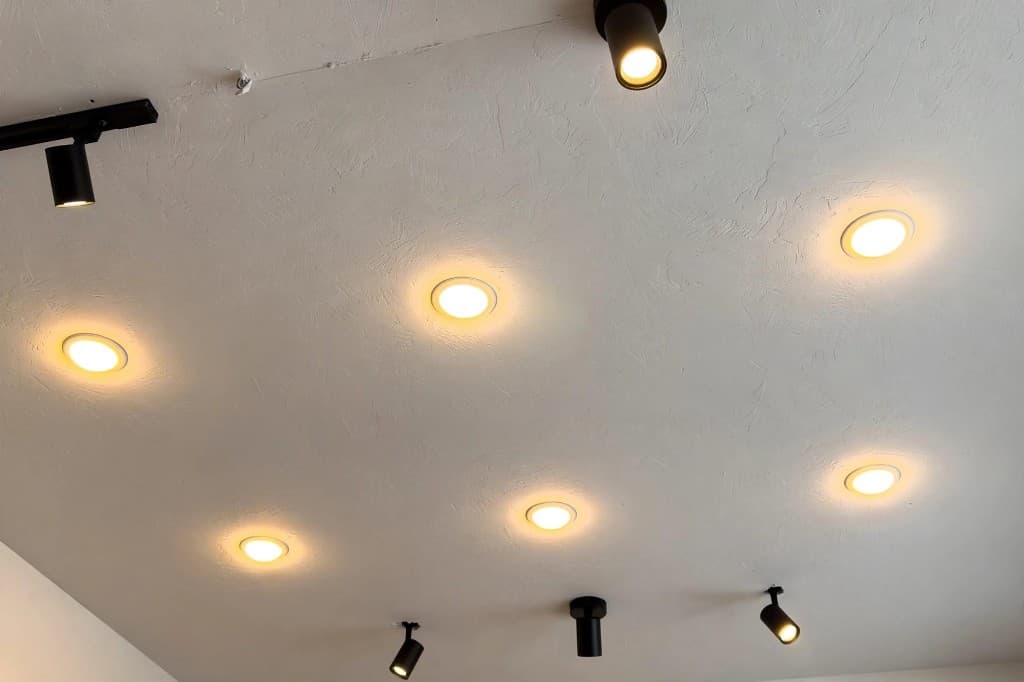
Retail lighting is not one light level but at least three layers. General lighting makes the floor walkable, accent lighting lifts the product, and window lighting sells to the person looking in from outside. Those three layers sit on different circuits and different controls; the window has to be able to stay on after closing while the general lighting goes off. Wiring them all to one switch forces a choice between a dark window in the evening and the whole shop burning until morning.
Track is preferred for accent lighting, because shop layouts change and that change is the one constant. Spots on a track can later be slid, added to and re-aimed; fixed recessed downlights mean cutting the suspended ceiling at every merchandising change. The track circuit is sized at the outset not for today's need but for the total of fittings that might be added later; increasing its cross-section afterwards means opening the ceiling again.
Emergency and exit lighting is not an optional line item in a workplace. Fittings on the escape route and above the exit door have their own battery packs and continue to burn for at least an hour when the mains fails. Their supply is taken from the general lighting circuit, because the battery unit's charging circuit senses that circuit's presence to operate; feeding them from a separate way means the fitting does not notice when the general lighting goes off. That the batteries genuinely work is verified once a year by timing the discharge, not by pressing the test button; an emergency fitting untested for years burns for twenty seconds during an outage and dies.
Phasing is written at the survey, not improvised on site. Tasks that require the supply to be fully off, such as renewing the board, are gathered into a single night window, and the preparation for that night is completed in advance: the new enclosure mounted, cables pulled and labelled, so that the outage lasts only as long as the changeover. Piecemeal work such as cable pulling, opening junctions and mounting fittings is split across evenings, and the premises is handed back working every morning.
In units inside shopping centres and office blocks, the management's working-hours rule sets the schedule and that rule is established before the survey. Many centres permit noisy work only after closing and require the relevant zone of the fire detection system to be temporarily isolated for work above the ceiling. The time to obtain those permissions goes into the schedule; arriving on site without them is an expense that turns the crew around at the door.
The document left with the business on handover is worth as much as the work itself: the board schedule, the measured current on each phase, the trip times of the residual current devices, insulation resistance values and the brand and model of switchgear used. When a business changes hands or an insurance assessor arrives, this file is exactly what is asked for. Circuits that were recommended for renewal but not renewed are also stated plainly in it, because a year later the answer to whose decision a fault on that circuit was sits here.
I do not lock a price on the phone. The range I give is an estimate drawn from similar jobs. The binding figure is written after I have seen and measured the fault, before I start. Extra work does not begin without your approval. Payment is on completion, invoiced, in Turkish lira. Nights and public holidays are a separate rate, and I say so before I leave. We work as an approved technician network. I give you the arrival window for your district on the call, and a live location link is shared once the technician sets off.
The band below is the published 2026 list. It is an estimate. The binding figure is written on site after measurement, and the work starts after that.
The bands below are the labour ranges actually seen on recent call-outs and exclude materials. The binding figure is given in writing after on-site measurement, and no work starts without approval.
| Job | Typical price range | What is included |
|---|---|---|
| Fault diagnosis and measured survey | 750 TRY – 1,500 TRY | Diagnosis with a True-RMS clamp, megohmmeter and thermal camera; the survey fee is deducted if the repair is accepted. |
| Breaker / RCD replacement | 1,250 TRY – 3,200 TRY | A 30 mA Type A device; varies with the number of ways and whether Schneider or Siemens is specified. |
| Dedicated air conditioning circuit | 2,400 TRY – 5,500 TRY | 3x2.5 or 3x4 mm² solid copper with a C20-C25 breaker; varies with run length and trunking route. |
| Flat board renewal (modular DIN) | 6,500 TRY – 16,000 TRY | Varies with room count, circuit splitting and whether a surge arrester is included. |
| Chandelier, spot and socket installation | 650 TRY – 2,800 TRY | Priced per unit; heavy chandeliers include a steel anchor set into structural concrete. |
| Internet and Cat6 data cabling | 1,100 TRY – 4,200 TRY | Includes a Cat6 run per room, an RJ45 data outlet and verification with a cable tester. |
| Factory / power factor periodic maintenance | 4,500 TRY – 18,000 TRY | By panel and step count; includes a thermal sweep and a written measurement report. |
Prices are estimated labour ranges and exclude materials. A binding quote is issued in writing after the technician measures on site and before any work begins. Last updated: October 2026.
Service covers the neighborhoods of Istanbul's 39 districts. Not the whole of Turkey. A survey is not a binding quote.
Usually not. Tasks needing the supply fully off are gathered into one night window with the preparation completed in advance, so the outage lasts only as long as the changeover. Work such as cable pulling and mounting fittings is split across evenings and the premises handed back working every morning.
The load calculation answers that. The contracted capacity and the main switch amperage are read; single-phase 32 amp carries about 7 kW, three-phase 3x40 amp about 27. The new equipment's demand is calculated with diversity factors and compared against that. If an upgrade is needed, the utility application time is added to the schedule.
Because a vacuum cleaner or heater on the same circuit creates a voltage dip and the till restarts, losing an open sale. A separate clean circuit with its own breaker is pulled for the till, card terminal, server and network rack, and its outlets are a different colour or permanently labelled.
By measurement. The real draw of the till, server, network switch and modem is read with a clamp meter and the UPS specified at a minimum of one and a half times that, so it stays adequate across the battery's life. High instantaneous draw devices such as printers and heaters are not connected; they exhaust the battery in minutes.
Lighting is split across at least two ways, preferably three as window, sales floor and stockroom, each on its own control. The window can then stay on after closing while the general lighting goes off. A single-switch installation forces a choice between a dark window in the evening and leaving everything on until morning.
Because shop layouts change and that is the one constant. Spots on track can be slid, added to and re-aimed later; fixed recessed downlights mean cutting the suspended ceiling at every merchandising change. The track circuit is sized at the outset for the total of fittings that might be added later.
Putting all lighting on one phase and all sockets on another leaves one phase at ninety amps in the evening while another sits at twenty. Imbalance pushes current through the neutral, heats it and raises voltage on the lightly loaded phase. Each load group is split across all three phases and the currents measured and balanced on completion.
It can, but it should not. In premises behind a single 30 mA device, a refrigerator's normal leakage drops the whole business. Circuits are grouped with a device per group; loads that must not stop, such as refrigeration and servers, go on a separate device and ideally behind a 300 mA selective main.
The board schedule, the measured current on each phase, the trip times of the residual current devices, insulation resistance values and the brand and model of switchgear used. Circuits recommended for renewal but not renewed are stated plainly too. When the business changes hands or an insurance assessor arrives, this file is exactly what is asked for.