Founding master
Adnan Şemiye18 years in the field
MYK-certified master
Adnan Şemiye reads this job in the field. The price is written before work starts.
Estimate 750–1,500 TRY
A wall-hung combi on a socket circuit is a small load. Pump, fan and board together stay under two hundred watts on most models. A C16 breaker does not heat on that load. If the switch drops, there is leakage, the boiler shares a faulty socket circuit, or the supply has stopped at the fused spur. Failure to ignite is the gas valve and the ionisation probe; if the board and the circuit are sound, that fault is not an electrician's job. The plug comes out first. The lever is not forced. The cover stays shut.

Call a certified electrician
Asian side 24/7 emergency. European side by appointment. Arrival time is confirmed on the call.
Founding master
Adnan Şemiye18 years in the field
MYK-certified master
Adnan Şemiye reads this job in the field. The price is written before work starts.
From the field
Emergency van · +90 582 403 10 8701 / 03
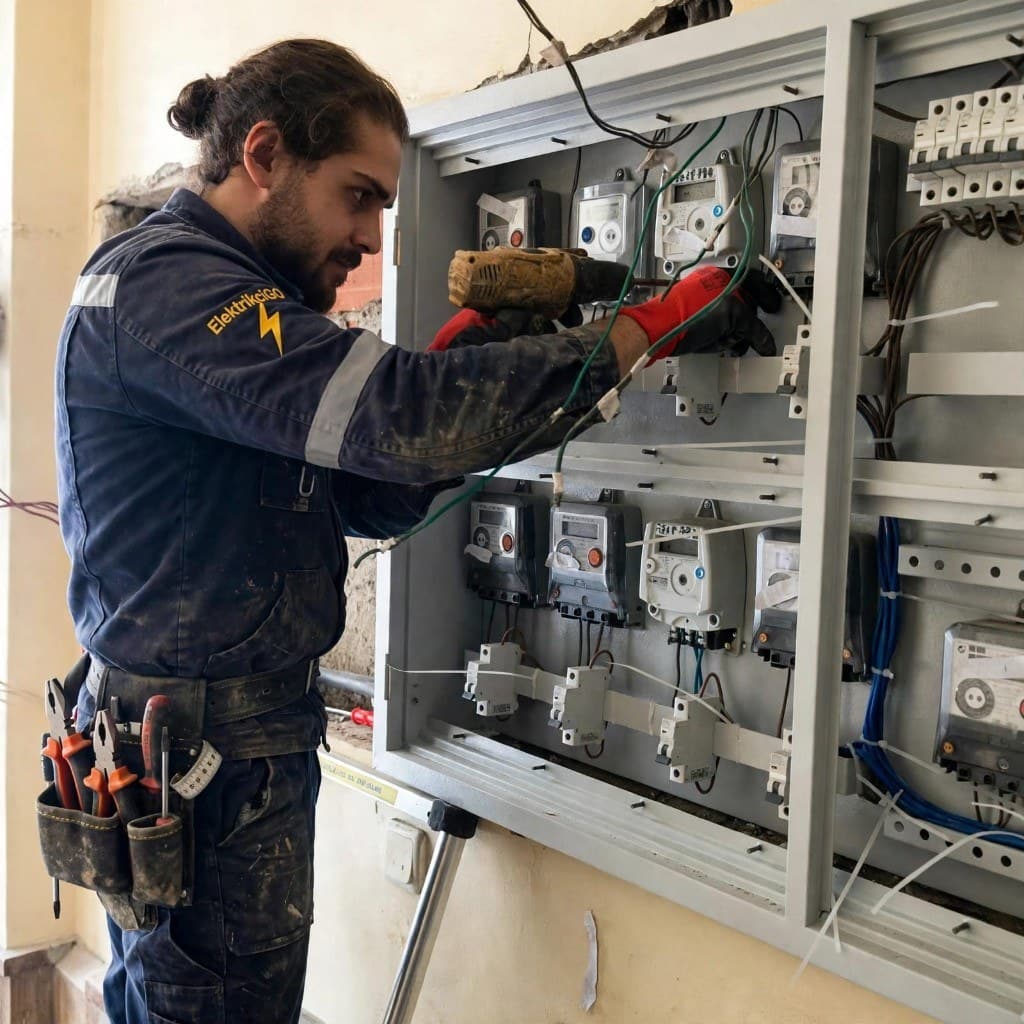
Adnan Şemiye, ElektrikçiGO electrician, fitting an Istanbul meter cabinet
Three pictures get mixed, and a phone call cannot separate them. First: the combi switch does not light, the screen is dark, and other sockets in the flat still work. The supply has stopped in the cartridge inside the fused spur, or on that room's breaker. Second: the residual-current device drops the moment the boiler tries to start. Moisture from a pump seal or the heat exchanger leaks onto the board or the fan body; a 30 mA device is supposed to see that and open. Third: the washer, the dishwasher or a kettle shares the same socket, and the circuit drops at the moment of inrush. That third case is a crowded circuit, not a combi fault.
The combi board sees 230 V and has its own cartridge fuse. That is the first point read when the screen is dark. A blown board fuse with a sound circuit belongs to the appliance; the electrician finishes the circuit measurement and leaves the board replacement to the boiler service. If the circuit has no voltage, the board is left alone. Treating both as one call replaces a board and a breaker for nothing.
The combi plug comes out. The breaker lever is not forced and it is not reset again and again. Every empty reset heats the leaking point once more. The board cover stays shut, and so does the combi cover: 230 V and the gas line share that case. The residual-current device is not bridged. The breaker rating is not increased. If the floor under the boiler is wet, the mat comes away and the metal body is not touched with bare feet.
If the screen flickers, the plug still comes out. That sign means a loose tail or the board's own fuse sitting on the edge. A socket adaptor does not feed another appliance from that point. If there is a smell of gas, the valve is closed and the flat is aired before anyone talks about electricity. This page is not a gas-leak procedure.
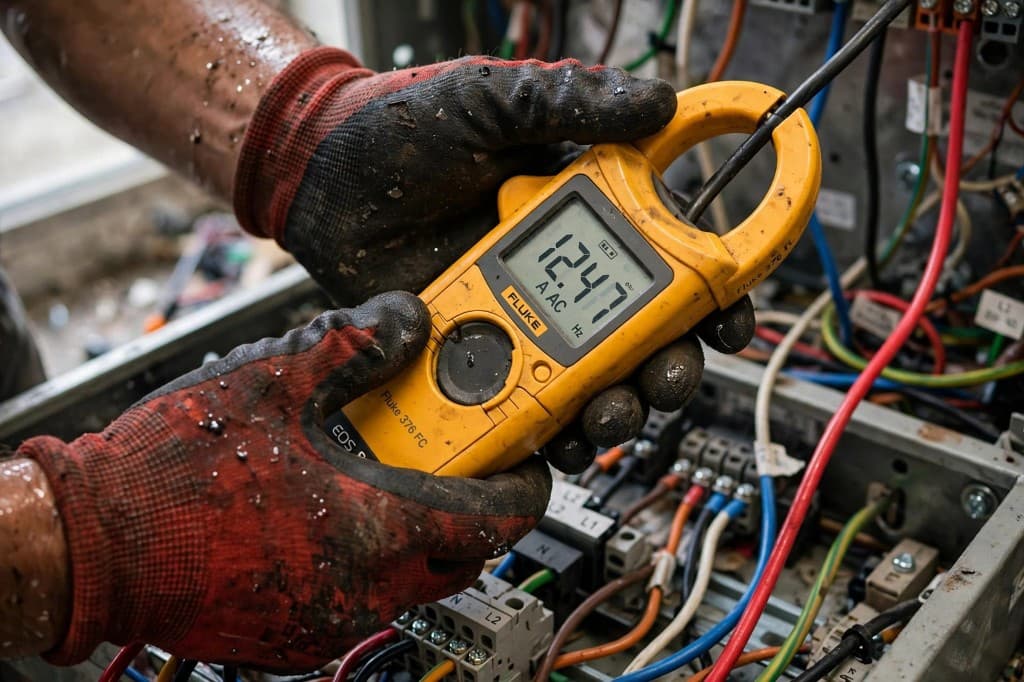
The order is fixed. Voltage is read with a True-RMS clamp at the fused-spur output with the combi unplugged, not while it is plugged in. If voltage is there, the work moves to the appliance: the board fuse, then earth leakage. If voltage is absent, the breaker, the residual-current device and the cartridge are checked at the same rating. The amp value is not increased. Insulation is read with a megohmmeter, plug disconnected, between phase-neutral and earth. A damp circuit and a dry circuit do not give the same number.
Leakage is split circuit by circuit with a leakage clamp. If the device holds once the combi plug is out, the leakage is in the appliance. If it still trips with the plug out, the circuit, a socket or another appliance is the source. No board, device or breaker is replaced before that split is written down. The figure is written on site when the measurement ends. The residual-current page describes the device's own fault; the combi is only one of the loads that can drop it.
If the circuit is sound and the board fuse is blown, the electrical job ends there. If the circuit has no voltage and a tail is loose, the fused-spur terminal is cleaned and torqued. A melted body means a new mechanism. A short NYM tail is jointed inside the box. A residual-current device that has reached the end of its life is replaced with a 30 mA Type A, Schneider or Siemens, with the same number of ways. A charred breaker is replaced at the same rated current. A larger amp rating leaves the cable unprotected.
A dedicated combi circuit is pulled only when the measurement shows the shared circuit dropping because of other appliances. Most flats do not need a new 3x2.5 mm² run. When they do, the section and the breaker are written from the real load on that circuit, not from a guess about the boiler. An air-conditioner circuit does not stand in for this job. The home page carries the emergency call, and Elektrikçi İstanbul is the city page. Pendik, Kartal and Kadıköy keep their own district pages.
The sentence the boiler does not run is not enough on its own. A dark screen, a lit screen with no flame, a breaker that drops, and cold radiators are four jobs. If there is no flame and the screen shows a fault code, the gas valve, the ionisation probe or the fan pressure switch belong to the boiler service. The electrician does not clear that code and does not enter the board parameters. If the screen is dark or the device drops, the measurement is this page. If there is a smell of gas, the valve is closed and the flat is aired first. This page does not replace that step.
The fused spur sits in the bathroom or the kitchen, next to the boiler. It is a small lever with a cartridge inside. If the lever is down, 230 V does not reach the combi and the other sockets in the flat keep working. A blackened cartridge is replaced at the same rating. It is not bridged with a strand of wire. If the spur body is hot, the terminal has loosened. That tail is cleaned and torqued. The combi board is not replaced because of it. If the spur body has melted, the mechanism is replaced. A short NYM tail stays jointed inside the box, not twisted and taped.
A device that drops on the first start at the end of summer is common. A pump seal that sat unused all summer dries, rubs the shaft on the first turn and leaks. That is different from a burnt board in a unit that ran every day through winter. The plug comes out. Resetting it several times heats the pump and damages the seal further. The measurement writes the unplugged state and the plugged state separately. No board, device or breaker is replaced before both sit on the same sheet. The Pendik, Kartal and Kadıköy pages are that district's own note. This fault does not replace it.
The measurement sheet has five lines. The first is the voltage at the fused spur, read with the plug out. The second is whether the residual-current device holds with the plug out. The third is the insulation resistance between phase and earth. The fourth is the board's own cartridge. The fifth is whether another load on the shared circuit drops it at the same time. No board, device or breaker is named before the five lines are full. On the 2026 list a measured survey is 750–1,500 TRY and a breaker or 30 mA residual-current device is 1,250–3,200 TRY. The band is an estimate. The binding figure is written on site after those lines are seen. The phone does not lock the band.
A wall-hung combi in most flats sits between 80 and 150 W. The pump, the fan and the board draw that much. A C16 breaker does not drop because of those watts. If it drops, there is leakage, or a kettle, a washing machine or an instant heater shares the socket. An instant heater draws 7 to 10 kW and has its own page. Treating the two as the same fault pulls a 6 mm² run to the combi and leaves the real leak in place. A dedicated combi circuit is written only when the measurement shows the shared circuit dropping because of another appliance. Most flats do not need a new run. The gas valve, the ionisation electrode and the fan pressure switch are not parts of this page. If the screen shows a fault code and 230 V is at the terminal, the board belongs to the boiler service. The electrician does not clear that code.
If the boiler is outdoors or on a balcony, a dark screen in winter can also come from an isolator box that has taken rain. The small breaker or the 3 A fuse inside the box has opened. That fuse is not made 13 A. Bridging the cartridge with wire is what grows a short. If the box gasket does not sit, water walks onto the board and the residual-current device drops. The joint is not left in a wet box. It is dried, the blackened end is cut and the joint is moved to a dry box. If condensate is dripping onto the board, the electrician does not finish the job by drying the board. The hose and the level are written to the boiler service. The electrician only measures whether 230 V is present.
In most flats the combi is fed from a fused spur. The cartridge is around 3 A and it protects the board. A blown fuse is replaced with the same value. Wire is not wrapped around it. If the switch body is warm, the terminal has slackened. The end is cut back to clean copper, torqued, and the short NYM tail is left inside the box. A Wago 221 suits this joint. A twist is not closed with tape. The main switch being up does not mean there is 230 V at the fused spur outlet. The measurement is taken at the plug or the terminal with the load disconnected. If the reading is zero volts, the fault is in the circuit. If it is 230 V and the screen is dark, the fault is in the board and it is written to the boiler service.
On the 2026 list a measured survey is 750–1,500 TRY and a breaker or 30 mA Type A device is 1,250–3,200 TRY. A fused-spur body and a socket tail enter the 650–2,800 TRY band only when the body has melted. A new circuit is not written for most combis. When it is, the section is chosen from the real load on the shared circuit, not from the combi watts, and the 2,400–5,500 TRY band is used only if that run is pulled. The band is an estimate. The binding figure is written on site after the five measurement lines are full. If there is a smell of gas, the valve is closed and the flat is aired. This page does not replace that step. Workmanship is one year. Materials are written separately.
If the combi plug sits on a multi-way adaptor, the measurement is not written before that adaptor comes off. When a router, a washing machine or a kettle shares it, the trip is blamed on the combi. The plugs are pulled one by one and which lever drops is written each time. The router's small adaptor heats on a slack spring and the combi board is blamed. If the board is still dark while 230 V is at the terminal and the plugs are separated, it stays with the boiler service. If there is no voltage at the terminal, the board is not removed. In winter the frost protection draws a small current. That current is not large enough to drop a C16 breaker. If the breaker drops, there is leakage or a shared load. The breaker is not upsized on the excuse of frost protection.
The band below is the published 2026 list. It is an estimate. The binding figure is written on site after measurement, and the work starts after that.
The bands below are the labour ranges actually seen on recent call-outs and exclude materials. The binding figure is given in writing after on-site measurement, and no work starts without approval.
| Job | Typical price range | What is included |
|---|---|---|
| Fault diagnosis and measured survey | 750 TRY – 1,500 TRY | Diagnosis with a True-RMS clamp, megohmmeter and thermal camera; the survey fee is deducted if the repair is accepted. |
| Breaker / RCD replacement | 1,250 TRY – 3,200 TRY | A 30 mA Type A device; varies with the number of ways and whether Schneider or Siemens is specified. |
| Dedicated air conditioning circuit | 2,400 TRY – 5,500 TRY | 3x2.5 or 3x4 mm² solid copper with a C20-C25 breaker; varies with run length and trunking route. |
| Flat board renewal (modular DIN) | 6,500 TRY – 16,000 TRY | Varies with room count, circuit splitting and whether a surge arrester is included. |
| Chandelier, spot and socket installation | 650 TRY – 2,800 TRY | Priced per unit; heavy chandeliers include a steel anchor set into structural concrete. |
| Internet and Cat6 data cabling | 1,100 TRY – 4,200 TRY | Includes a Cat6 run per room, an RJ45 data outlet and verification with a cable tester. |
| Factory / power factor periodic maintenance | 4,500 TRY – 18,000 TRY | By panel and step count; includes a thermal sweep and a written measurement report. |
Prices are estimated labour ranges and exclude materials. A binding quote is issued in writing after the technician measures on site and before any work begins. Last updated: October 2026.
Service covers the neighborhoods of Istanbul's 39 districts. Not the whole of Turkey. A survey is not a binding quote.
The lever is not forced. The plug comes out, that circuit stays off, and the combi cover stays shut. Leakage and a board fault are separated with a clamp and a megohmmeter. The amp rating is not increased.
Usually the cartridge in the fused spur, or that room's breaker, is open. The board's own fuse can be blown as well. The board is not replaced before the circuit is measured.
Moisture on the pump or heat-exchanger side leaks to the body. A 30 mA device is supposed to open. It is not bridged. If it holds with the plug out, the leakage is in the appliance.
If the screen is dark and the circuit has 230 V, the board fuse is checked. If the circuit has no voltage, a sound board still will not run. Neither is replaced before both are measured.
No. A combi is a small load. A separate circuit is written only when measurement shows the shared circuit dropping because of another appliance. The section is not chosen by guess.
No. The plug comes out, the mat is taken away, and the cover stays shut. A wet body is a leakage sign. The appliance is not run in order to dry it.
The survey is 750–1,500 TRY. A breaker or 30 mA device is 1,250–3,200 TRY. The band is an estimate. The binding figure is written on site, then the work starts.
The valve is closed and the flat is aired first. A gas leak is not this page's job. The electrical measurement is discussed after the smell has gone and the valve is shut.