Founding master
Adnan Şemiye18 years in the field
MYK-certified master
Adnan Şemiye reads this job in the field. The price is written before work starts.
Estimate 1,500–6,000 TRY
A detector that is fitted but does not work is more dangerous than one never fitted, because it gives its owner the feeling of being protected. Two mistakes we see in the field explain this whole trade: the detector was chosen for the wrong gas or sits at the wrong height, and the solenoid valve that should cut the supply on detection has not been tested once since installation. Getting those two things right does not change the price of the system; it only determines whether it will actually work.

Call a certified electrician
Asian side 24/7 emergency. European side by appointment. Arrival time is confirmed on the call.
Founding master
Adnan Şemiye18 years in the field
MYK-certified master
Adnan Şemiye reads this job in the field. The price is written before work starts.
From the field
Emergency van · +90 582 403 10 8701 / 03
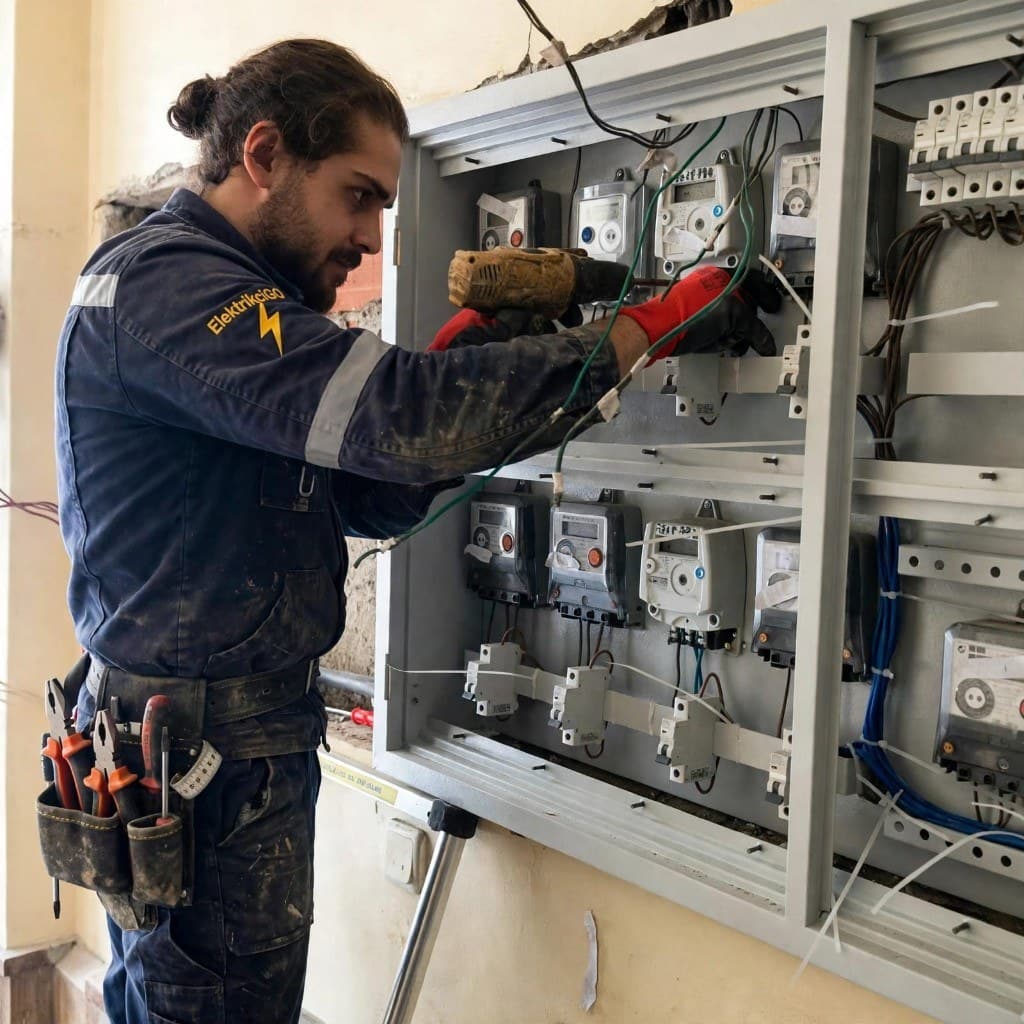
Adnan Şemiye, ElektrikçiGO electrician, fitting an Istanbul meter cabinet
Mounting height is the most common error in this trade, and it comes from physics. The main component of natural gas is methane, lighter than air; a leak rises towards the ceiling, so a natural gas detector goes thirty centimetres below the ceiling and no more than four horizontal metres from the gas source. LPG, bottled gas, is heavier than air; it sinks and pools, so an LPG detector is mounted thirty centimetres above the floor. Placing a natural gas detector near the floor puts it where the leak will never reach.
Carbon monoxide is an entirely different risk and needs a different detector. CO is toxic rather than flammable, and because its density is so close to air it mixes through the room; a CO detector therefore goes at breathing height, around one and a half metres. The source of CO is not a gas leak but incomplete combustion: a boiler with a blocked flue, a water heater with inadequate ventilation, or a generator running in an enclosed space. A natural gas detector cannot see CO and a CO detector cannot see a gas leak; neither substitutes for the other.
There is a second rule about position: air movement. A detector placed right in front of a window, door, extractor or air conditioning outlet alarms late, because escaping gas is swept away before it reaches the sensor. Equally, a detector directly above a hob produces constant false alarms from cooking vapour and is eventually switched off by its owner; a switched-off detector is no longer a detector. The right spot is close to the source but out of the direct path of draughts and steam.
A detector merely shouting is often not enough; with nobody home the alarm sounds into an empty room. So a solenoid valve is fitted to the gas line and cuts the supply when the detector alarms. The valve is mounted after the meter, on the line entering the premises, at an accessible and ventilated point. The critical choice is its type: a normally closed valve is specified, so that on loss of power it moves to the closed position and a power cut in an empty house cannot allow gas to flow.
The valve and the detector are fed from the same circuit, and that circuit is taken to its own breaker without exception. Hanging a detector off a socket group is a common but dangerous shortcut: when a fault on that group trips the breaker, the detector dies quietly and nobody notices. The separate circuit is clearly labelled at the board and that breaker is not switched off during routine maintenance. The circuit sits behind residual current protection, but on its own 30 mA device rather than sharing one with other loads.
On completion the valve is genuinely tested, and how that test is done matters. Pressing the detector's test button only sounds the siren; it proves nothing about the valve. The correct test applies calibrated test gas to the detector and confirms together that the valve closes, that the flame at the hob goes out and that the alarm relay pulls in. The test date and result go onto the service report, and the next test is diarised.
A conventional system wires detectors into zones; the panel tells you which zone is in alarm, not which detector. In a small business or a single-storey workshop that is enough and the cost is markedly lower. Zone count is the critical decision here: every floor and every separate fire compartment gets its own zone, because in a system with thirty detectors on one zone the staff walk thirty points one by one during an alarm, and those minutes are decisive in a fire.
In an addressable system every detector has an address and the panel names it and its location directly on alarm. In multi-storey buildings, hotels, schools and factories this is now standard; the cost difference at installation is real but returns in operation, because a contaminated detector shows as a fault at the panel and periodic maintenance is read off it rather than walked point by point. Addressable systems also make integrations possible: releasing escape door locks, sending the lift to ground and shutting down ventilation.
A smoke detector catches a fire earliest and is the standard choice for clean-air areas such as corridors, offices, hotel rooms and escape routes. But in spaces with dust, steam, exhaust or aerosols it alarms falsely and repeatedly. Using smoke detection in a kitchen, boiler room, paint shop, car park or dusty production area makes the system lose credibility and the zone eventually gets disabled by staff; a disabled zone is an unprotected zone.
Heat detection is used in those spaces. A heat detector measures temperature rather than smoke; the fixed-temperature type alarms once a set threshold is passed, and the rate-of-rise type when temperature climbs sharply. In places that are hot anyway, such as kitchens and boiler rooms, rate-of-rise is the more accurate choice, because it catches an abnormal climb even where the ambient baseline is high. Detectors are specified against ceiling height: in a high-roofed warehouse hot air dilutes before it reaches the ceiling, so standard detection is late and an aspirating system is needed.
Gas sensors do not work forever, and that is the point that surprises people most. Electrochemical and semiconductor sensors age with time rather than with use; manufacturers typically give five years, three on some models. When the period is up the detector still shows a green light but no longer detects the threshold gas. So the installation date is written on the detector itself and on the service report; an expired detector is replaced rather than repaired.
Periodic testing of a fire alarm system is a practical necessity as much as a legal duty. Smoke detectors are checked with test aerosol, heat detectors with a heat source, call points by hand and sounders by measuring sound level. The panel's battery backup is load-tested, because only that test tells you how many hours the system stands up when the mains fails. Every point checked is entered in a maintenance log with its date and result; after a fire this is the first document asked for.
A contaminated detector is seen more often than a faulty one. Grease vapour collects in the chamber of a smoke detector near a kitchen, and dust in the chamber in a dusty warehouse; in both cases the detector either alarms falsely or not at all. At maintenance detectors are removed and cleaned, or replaced where contamination has gone far; blowing the chamber out with compressed air is a common error, because it drives dust deeper onto the sensor surface. The addresses of detectors cleaned and replaced are recorded in the maintenance log.
I do not lock a price on the phone. The range I give is an estimate drawn from similar jobs. The binding figure is written after I have seen and measured the fault, before I start. Extra work does not begin without your approval. Payment is on completion, invoiced, in Turkish lira. Nights and public holidays are a separate rate, and I say so before I leave. We work as an approved technician network. I give you the arrival window for your district on the call, and a live location link is shared once the technician sets off.
On most bodies the detector relay is a dry contact. The contact does not feed the valve coil from inside itself. The coil voltage is on the valve label: 230 volts alternating or 24 volts direct. Putting 230 on a 24 volt coil burns the coil. Tying a 230 volt coil to the small supply inside the detector never pulls the coil. The test button sounds and the valve stays open. The coil is fed from the separate breaker's circuit, through the contact. On a conventional zone the end-of-line resistor sits at the last detector, not inside the panel. If the zone still looks normal when the cable is lifted, the resistor is in the panel and a cut cable stays invisible. A 230 volt bell is not fitted on the panel's 24 volt sounder output. Fresh silicone is not squeezed beside a catalytic sensor. Silicone blinds the sensor. The green light keeps shining and the gas is not seen.
A manual call point stands beside the escape door, not inside a locked room. A system whose call point cannot be reached while the door is locked leaves the alarm to the staff. A dwelling sounder sits where it is heard with the bedroom door shut. The sound measured in front of the panel cover is not the sound in the bedroom. The work does not leave Istanbul. Gebze is not written from this page.
The band below is the published 2026 list. It is an estimate. The binding figure is written on site after measurement, and the work starts after that.
The bands below are the labour ranges actually seen on recent call-outs and exclude materials. The binding figure is given in writing after on-site measurement, and no work starts without approval.
| Job | Typical price range | What is included |
|---|---|---|
| Fault diagnosis and measured survey | 750 TRY – 1,500 TRY | Diagnosis with a True-RMS clamp, megohmmeter and thermal camera; the survey fee is deducted if the repair is accepted. |
| Breaker / RCD replacement | 1,250 TRY – 3,200 TRY | A 30 mA Type A device; varies with the number of ways and whether Schneider or Siemens is specified. |
| Dedicated air conditioning circuit | 2,400 TRY – 5,500 TRY | 3x2.5 or 3x4 mm² solid copper with a C20-C25 breaker; varies with run length and trunking route. |
| Flat board renewal (modular DIN) | 6,500 TRY – 16,000 TRY | Varies with room count, circuit splitting and whether a surge arrester is included. |
| Chandelier, spot and socket installation | 650 TRY – 2,800 TRY | Priced per unit; heavy chandeliers include a steel anchor set into structural concrete. |
| Internet and Cat6 data cabling | 1,100 TRY – 4,200 TRY | Includes a Cat6 run per room, an RJ45 data outlet and verification with a cable tester. |
| Factory / power factor periodic maintenance | 4,500 TRY – 18,000 TRY | By panel and step count; includes a thermal sweep and a written measurement report. |
Prices are estimated labour ranges and exclude materials. A binding quote is issued in writing after the technician measures on site and before any work begins. Last updated: October 2026.
Service covers the neighborhoods of Istanbul's 39 districts. Not the whole of Turkey. A survey is not a binding quote.
About thirty centimetres below the ceiling and no more than four horizontal metres from the gas source. Methane, the main component of natural gas, is lighter than air so a leak rises. LPG is heavier than air and sinks to the floor; an LPG detector is mounted thirty centimetres above floor level.
Yes. They measure different things and do not substitute for each other. A gas detector senses a flammable gas leak; a CO detector senses the toxic carbon monoxide produced by incomplete combustion. CO comes from a boiler with a blocked flue or a poorly ventilated water heater, and a CO detector goes at breathing height, around one and a half metres.
It is a valve on the gas line that cuts the supply when the detector alarms. With nobody home, an alarm sounding on its own changes nothing. The valve is mounted after the meter at an accessible and ventilated point, and specified normally closed so that it moves to the closed position on loss of power.
No. The test button only sounds the siren and proves nothing about the valve. A real test applies calibrated test gas to the detector and confirms together that the valve closes, that the flame at the hob goes out and that the alarm relay pulls in. The test date and result go onto the service report.
Yes. Electrochemical and semiconductor sensors age with time rather than with use; manufacturers typically give five years, three on some models. When the period is up the detector still shows green but does not detect the threshold gas. The installation date is written on the detector and an expired one is replaced rather than repaired.
No. Cooking vapour produces constant false alarms and the zone eventually gets disabled by staff or the householder; a disabled zone is an unprotected zone. A kitchen uses heat detection, preferably the rate-of-rise type, because the space is hot anyway.
In a small business or single-storey workshop conventional is enough and more economical, but the zone count must be right: each floor and each fire compartment gets its own zone. In multi-storey buildings, hotels, schools and factories an addressable system is standard; the panel names the detector and its location directly on alarm.
You can, but you should not. When a fault on that socket group trips the breaker, the detector dies quietly and nobody notices. The detector and solenoid valve are taken to their own breaker at the board, clearly labelled and protected by their own 30 mA residual current device; that breaker is not switched off during routine maintenance.
No, and it is a common error: compressed air drives dust deeper onto the sensor surface. At maintenance the detector is removed and cleaned by the proper method, or replaced where contamination has gone far. The addresses of detectors cleaned and replaced are recorded with date and result in the maintenance log.