Founding master
Adnan Şemiye18 years in the field
MYK-certified master
Adnan Şemiye reads this job in the field. The price is written before work starts.
Estimate 650–2,800 TRY
In exterior lighting, the fitting is the cause far less often than people expect. On most call-outs the fitting is sound and the problem is under the ground: a junction that has taken in water, light fading at the end of a run because the conductor was undersized, or a body corroded through in two years of sea air. Quality in garden lighting is therefore measured not by the visible fitting but by how you treat the places nobody will open again. Digging twice costs several times doing it right once.
Call a certified electrician
Asian side 24/7 emergency. European side by appointment. Arrival time is confirmed on the call.
Founding master
Adnan Şemiye18 years in the field
MYK-certified master
Adnan Şemiye reads this job in the field. The price is written before work starts.
From the field
 Emergency van · +90 582 403 10 87
01 / 03
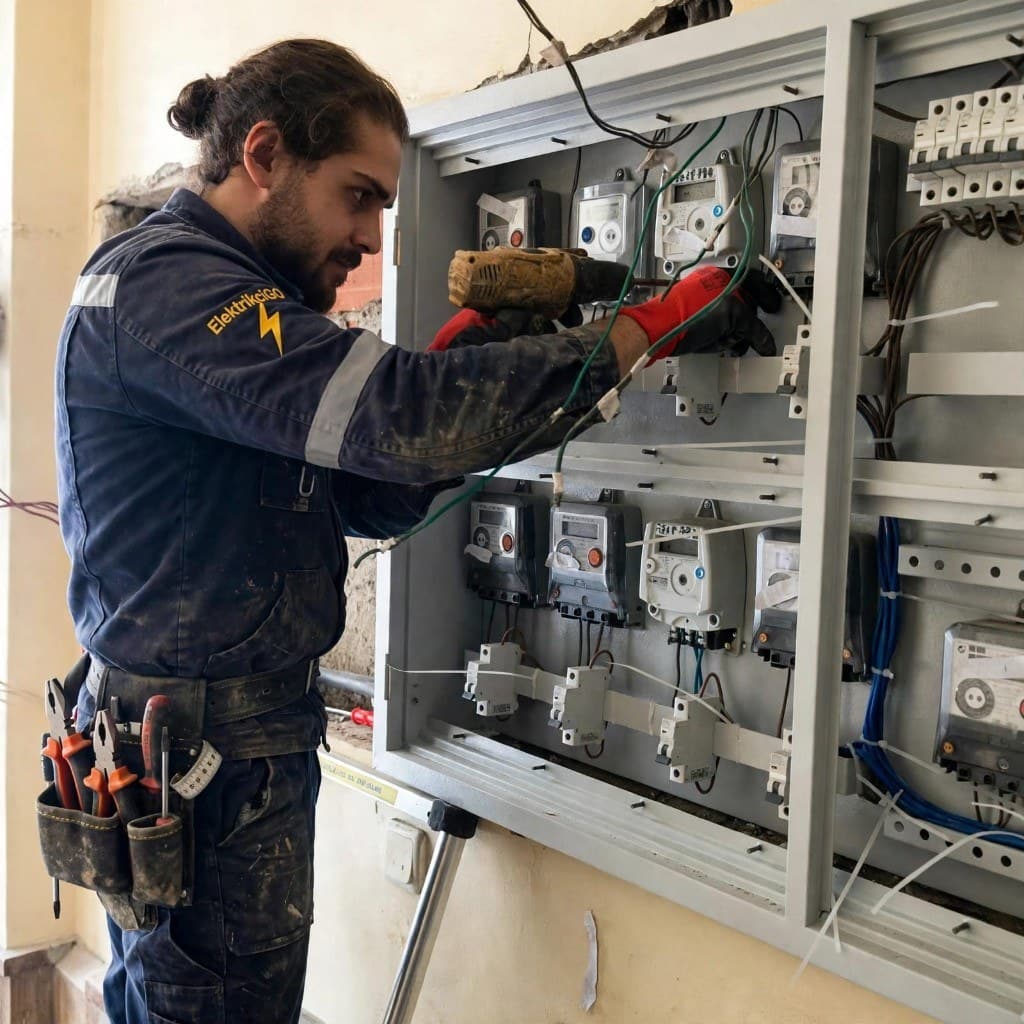
Adnan Şemiye, ElektrikçiGO electrician, fitting an Istanbul meter cabinet
An IP rating is not a marketing label but a two-digit measure of where a fitting may be placed. The first digit covers solid objects and dust, the second water. Under an eave, on a wall light the rain never strikes directly, IP44 is enough. On an exposed wall washer that takes rain and a hose directly, IP65 is required. On a recessed ground spot that is walked on and sits in a hollow where water collects after rain, nothing below IP67 will do; around a pool or inside a water feature, where submersion is possible, IP68 is mandatory.
On the coast a second measure comes in: corrosion. Along the Tuzla, Şile, Beykoz and Kadıköy shoreline, salt-laden damp blisters an aluminium body in two or three years and seizes screws that looked stainless. Here the body material matters as much as the IP rating; 316 stainless steel or marine-grade anodised aluminium is preferred, bolts are specified stainless and silicone grease is applied to the gasket face. A cheap fitting lasts two years on the coast and a suitable one ten; the difference is understood not at first purchase but at the second replacement.
There is one case where a high IP rating alone is not enough, and it is often misunderstood: a fully sealed body breathes as the air inside warms by day and cools at night, drawing in a little humid air on every cycle. Over years that moisture condenses inside and destroys the driver. Good exterior fittings therefore carry a one-way breather membrane; on models without one, the fitting is mounted so that condensation can run out, with the drain hole facing down. Mounting a fitting upside down turns it into a water tank even at IP68.
The cable used in a garden is NYY; NYM and flexible TTR are not made for this and their sheaths break down in soil within a few years. Cable is not thrown straight into the ground but run inside flexible or rigid corrugated conduit, so that adding a circuit later or pulling through a failed one becomes possible without digging. Burial depth is not less than sixty centimetres in planted areas with no vehicle traffic and eighty under driveways and parking, with warning tape laid above the cable.
The most frequent failure point in exterior lighting is the buried joint, and it is nearly always avoidable. A joint taped up or placed in an ordinary terminal box underground takes in moisture after the first watering; resistance rises, the circuit heats and before long the residual current device starts tripping. The correct method is an IP68 gel-filled joint box, or avoiding joints altogether: looping from fitting to fitting carries the circuit through unbroken and removes every joint that would need digging to reach.
The gland at a fitting's cable entry decides the job's fate. If the gland is not matched to the cable diameter, or is nipped up by hand and left, the seal does not grip and water tracks into the body by capillary action; the fault appears months later, on the first cold night. The gland is tightened with the correct spanner and the cable left with a drip loop before it, so that water collecting on the cable falls away instead of running towards the gland.
Garden circuits are long, and that is the basic difference between exterior and interior lighting. Sixty or seventy metres of cable from the board to the last fitting at the end of a garden is ordinary, and over that distance voltage drop has to be calculated. At the end of a 3x1.5 mm² run pulled without that calculation, fittings are visibly dim; LED drivers run inefficiently at low voltage and their life shortens. Going up to 3x2.5 or 3x4 mm² on long runs is always cheaper than renewing the circuit later.
On low-voltage 24 volt systems this problem grows far faster, because for the same power the current is roughly ten times higher and voltage drop is directly proportional to current. On a 24 volt garden circuit the transformer belongs in the middle of the garden, near the centre of the loads; the run is fed from both ends where possible, and total load should not exceed eighty per cent of the transformer rating. Run at full capacity, its thermal protection trips in hot weather and the garden goes dark mid-evening.
Garden lighting is not hung off indoor circuits. A separate way is opened at the board with its own breaker and its own 30 mA Type A residual current device. The reason is safety rather than comfort: when water causes a leakage fault outdoors the device drops that circuit only, instead of taking the refrigerator and the house lighting with it. It also narrows the fault area immediately; which way tripped tells you where the fault is.
The device type matters. LED drivers and some control units produce leakage with a DC component; a standard Type AC device cannot see it and the protection exists only on paper. So exterior lighting gets Type A as a minimum, and Type F where drivers are dense. On completion the device's trip time is measured with a dedicated tester and the value written onto the service report; unmeasured protection is protection fitted but not proven.
Metal garden posts and metal pergola fittings are earthed. An unearthed metal post, once leakage reaches its body, is lethal to someone touching it barefoot on wet grass, and a residual current device alone does not catch that in every condition. The post body is bonded to the circuit's protective conductor, the connection made with stainless nut and washer, and earth continuity verified by measurement.
Switching exterior lighting by hand is never sustained in practice; within weeks it either burns until morning or never comes on. The simplest automation is a photocell and it does its job, but its position decides the outcome: a photocell that can see another fitting's light cycles on and off all night and tires the drivers. It is mounted facing north, where no artificial light reaches it, and its sensitivity set on site.
An astronomical timer is a step up and the one we prefer on estates. The unit calculates sunset and sunrise itself from latitude and longitude, so no clock-shifting is needed as the seasons change. A curfew is programmed on top: path lighting dims or switches off after midnight while security lighting stays on. That both lowers the electricity bill and stops unnecessary light being thrown into neighbouring windows.
The purpose of facade lighting is to light the facade, not the sky. When a fitting is aimed blindly upwards most of the light misses the wall altogether; energy is wasted and it strikes the windows of the floors above. Correct practice places the fitting close to the wall and sets the beam to graze the surface; this both reveals the texture and minimises spill. Where needed a shield is fitted to cut the top of the beam.
Colour temperature is a decision that affects the facade all night. On stone and rendered facades 3000 K warm white renders the texture softly; on glass and metal-led modern facades 4000 K reads cleaner. Two colour temperatures are never mixed on one facade, because the difference is invisible by day but immediately obvious at night as one fitting yellow and the next blue. When replacing, the existing fitting's Kelvin value is read and matched.
I do not lock a price on the phone. The range I give is an estimate drawn from similar jobs. The binding figure is written after I have seen and measured the fault, before I start. Extra work does not begin without your approval. Payment is on completion, invoiced, in Turkish lira. Nights and public holidays are a separate rate, and I say so before I leave. We work as an approved technician network. I give you the arrival window for your district on the call, and a live location link is shared once the technician sets off.
The band below is the published 2026 list. It is an estimate. The binding figure is written on site after measurement, and the work starts after that.
The bands below are the labour ranges actually seen on recent call-outs and exclude materials. The binding figure is given in writing after on-site measurement, and no work starts without approval.
| Job | Typical price range | What is included |
|---|---|---|
| Fault diagnosis and measured survey | 750 TRY – 1,500 TRY | Diagnosis with a True-RMS clamp, megohmmeter and thermal camera; the survey fee is deducted if the repair is accepted. |
| Breaker / RCD replacement | 1,250 TRY – 3,200 TRY | A 30 mA Type A device; varies with the number of ways and whether Schneider or Siemens is specified. |
| Dedicated air conditioning circuit | 2,400 TRY – 5,500 TRY | 3x2.5 or 3x4 mm² solid copper with a C20-C25 breaker; varies with run length and trunking route. |
| Flat board renewal (modular DIN) | 6,500 TRY – 16,000 TRY | Varies with room count, circuit splitting and whether a surge arrester is included. |
| Chandelier, spot and socket installation | 650 TRY – 2,800 TRY | Priced per unit; heavy chandeliers include a steel anchor set into structural concrete. |
| Internet and Cat6 data cabling | 1,100 TRY – 4,200 TRY | Includes a Cat6 run per room, an RJ45 data outlet and verification with a cable tester. |
| Factory / power factor periodic maintenance | 4,500 TRY – 18,000 TRY | By panel and step count; includes a thermal sweep and a written measurement report. |
Prices are estimated labour ranges and exclude materials. A binding quote is issued in writing after the technician measures on site and before any work begins. Last updated: October 2026.
Service covers the neighborhoods of Istanbul's 39 districts. Not the whole of Turkey. A survey is not a binding quote.
Usually not. The first suspect is the buried joint: once damp gets in it gains resistance and trips the residual current device. Circuit insulation resistance is measured with a megohmmeter, the joints opened and remade in an IP68 gel-filled box. The fitting is most often sound.
IP44 on a wall light under an eave, IP65 on a wall washer open to rain and a hose, IP67 on a recessed ground spot that is walked on and can sit in water, IP68 around pools and inside water features. On the coast the body material matters too: 316 stainless or marine-grade anodised aluminium.
At least sixty centimetres in planted areas with no vehicle traffic and at least eighty under driveways and parking. The cable must be NYY, run inside corrugated conduit rather than straight into soil, with warning tape laid above it, so that adding a circuit later needs no digging.
It is not; it indicates voltage drop. The distance from the board to the last fitting is long and the conductor was sized without calculation. The fix is a larger cross-section, moving the transformer to the centre of the loads on 24 volt systems, or feeding the run from both ends. Low voltage also shortens LED driver life.
Yes. A separate way is opened at the board with its own breaker and its own 30 mA Type A residual current device. A water-related leakage fault outdoors then drops that circuit only, leaving the refrigerator and house lighting alone; and which way tripped tells you where the fault is.
LED drivers and some control units produce leakage with a DC component. A standard Type AC device cannot detect it and the protection exists only on paper. Exterior lighting uses Type A as a minimum and Type F where drivers are dense, with the trip time measured and recorded.
Yes, without exception. An unearthed metal post, once leakage reaches its body, is lethal to someone touching it barefoot on wet grass. The post body is bonded to the circuit's protective conductor with a stainless nut and washer and earth continuity verified by measurement.
In a small garden a photocell does the job, but it must face north where no other fitting's light reaches it. On estates an astronomical timer is preferred: it calculates sunset from latitude and longitude, needs no clock-shifting as seasons change and allows a post-midnight dimming programme.
It means the fitting sits too far from the wall and is aimed blindly upwards. The fitting is moved closer and the beam set to graze the wall surface; where needed a shield cuts the top of the beam. That reduces spill and shows the facade texture better at the same time.