Founding master
Adnan Şemiye18 years in the field
MYK-certified master
Adnan Şemiye reads this job in the field. The price is written before work starts.
Maltepe district
Çınar 24/7 emergency electrician. In this Maltepe neighbourhood we respond without a minute promise to midnight breaker tripping, residual current device faults, burnt sockets and consumer unit failures. In apartment and complex stock, saturated kitchen circuits, bathroom water heater runs and riser overheating are measured on site. Certified technicians, faults proven with a True-RMS clamp meter and a megohmmeter, written price approval and an official 1 year workmanship guarantee.
Founding master
Adnan Şemiye18 years in the field
MYK-certified master
Adnan Şemiye reads this job in the field. The price is written before work starts.
From the field
 Emergency van · +90 582 403 10 87
Calls from Çınar start with two descriptions. The first: 'We pull the TV out from the wall to watch, then when we push it back the living-room breaker trips. Not every time, but it happens when we press the screen fully against the wall.' The second is more dangerous: 'My wife touched the iron arm of the bracket while turning the screen; her hand tingled, it gave a light shock. Nothing tripped.' The two descriptions are two faces of one fault. If the RCD trips, phase has found a path to earth somewhere and that path opens and closes with the screen's position; the fault is mechanical and triggered by movement. If touching the arm tingles and nothing trips, the arm is sitting at phase potential; there is no path to discharge and the human body completes it. If the line has no RCD at all, or has one that does not work, this second description can become a severe shock. Sometimes a third description comes: 'We pushed the screen back, there was a crack from behind, we saw a spark, the breaker tripped.' That is the case where both conductors are cut and phase and neutral touch inside the steel arm. In all three cases the first step is the same: do not touch the screen or the arm, switch off the living-room socket circuit at the panel, pull the screen's plug only after the line is off, and do not move the screen again until the survey.
An articulating arm consists of a wall plate screwed to the wall, a VESA plate screwed to the back of the screen and one or two pairs of steel links joining them. The links work like a pantograph: they open when the screen is pulled out and fold over each other when it is pushed back. In the fully closed position the gap between links drops to a few millimetres and at the hinge points the steel edges pass over each other like scissors. In most homes the socket behind the screen is either at skirting height or right behind the screen near the wall plate. The TV's power cord, the sound system's adaptor and the aerial cable hang loose from this socket to the screen; at installation they were gathered with a cable tie but not routed for the arm's movement. When the screen is pulled out the cords go tight; when it is pushed back they slacken and the slack falls between the links. As the scissors close the cord ends up between two steel edges. One push does not cut it; but hundreds of openings and closings first flatten the outer sheath of a thin, soft appliance cord, then cut it, then open the inner conductor's insulation. A press mark on the links, a shiny rub line, or a flat stretch on the cord is the trace of this process.
What happens after the insulation opens depends on which conductor opened and what the arm touches. Most TVs are double-insulated and fed by an unearthed two-core cord; the bracket's steel arm is not connected to the protective conductor even if it touches the screen's metal rear frame through the VESA screws. The wall plate is held to the brick or concrete with plastic or steel anchors; that is not a reliable earth path. So when the phase conductor touches the arm, usually no current flows at all and the arm, screen frame and VESA screws all rise to phase potential together. The RCD does not see this, because there is no leakage yet; the leakage starts the moment someone touches the arm and goes through that person's body to earth. If the RCD works, it opens the circuit before or as that current reaches 30 mA; if it does not, the shock continues. Sometimes an earth path is already there: the aerial cable's outer braid is earthed through the building's aerial system, or the sound system's or satellite receiver's plug is earthed. If one of these cables touches the arm, the phase–arm–braid–earth path closes and the RCD trips every time the screen is pushed back. If both conductors open and touch each other inside the arm, that is not leakage but a phase–neutral short; the breaker trips and a blackened spark mark is left on the arm and the cord.
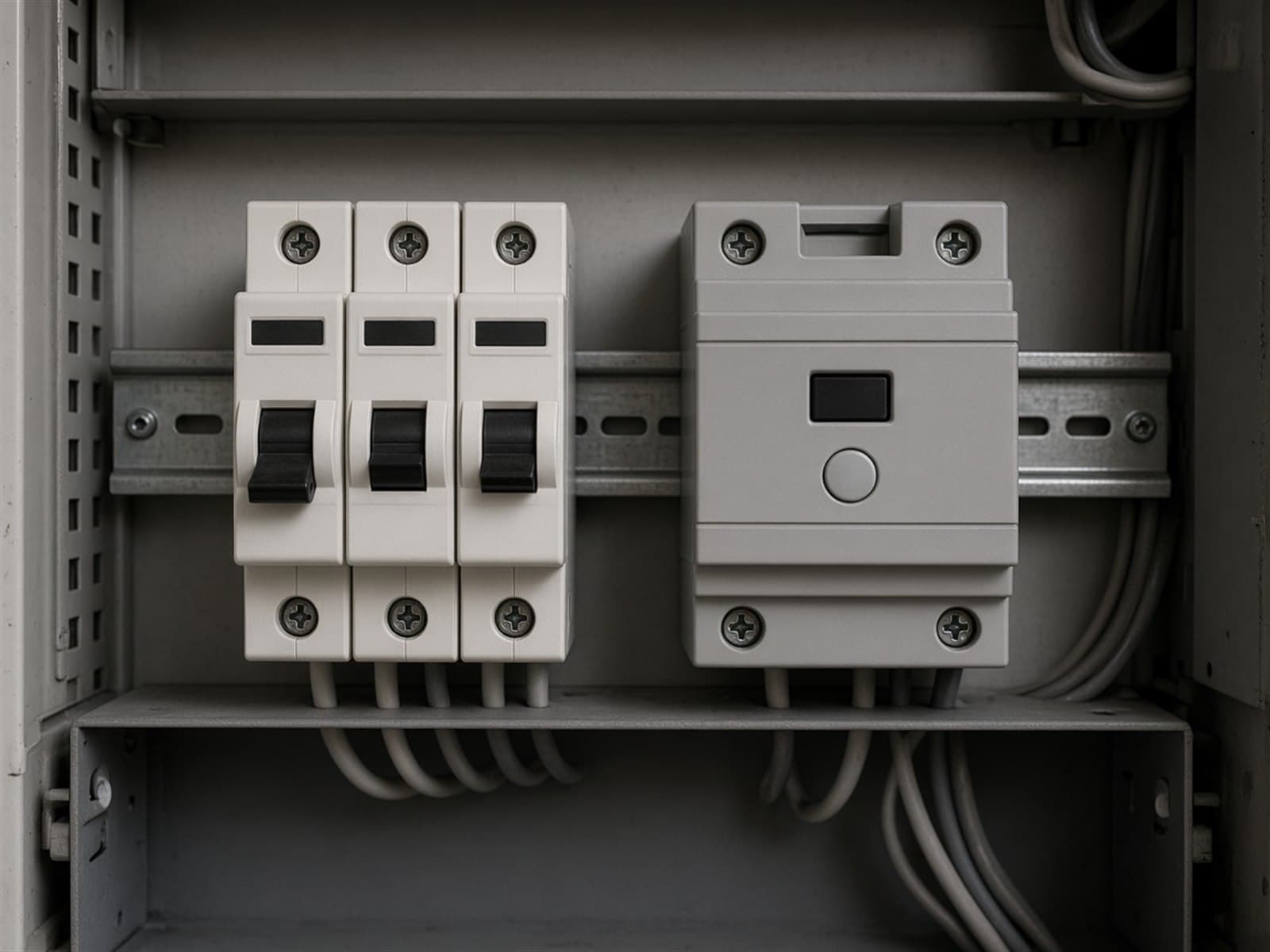
The survey starts without touching the arm. If the line is still live, the electrician measures the voltage between the arm and the socket's protective conductor with a suitable instrument; if the arm carries phase potential the fault is confirmed on the spot and no one touches the arm by hand. Then the panel: which breaker feeds the living-room sockets, is this line under a 30 mA RCD, does the RCD drop when its test button is pressed. On a socket line without an RCD, this is where it becomes clear why the person touching the arm got a shock and nothing tripped. After the line is switched off and dead is proven by measurement, the plugs are pulled and the screen brought forward. How the cords run along the arm is checked: a flattened stretch, a cut sheath, visible copper, a press mark or blackened spark mark on the links, whether a cable tie has fixed the cord at a hinge point. Whether the aerial braid and the sound-system cable touch the arm is noted. Then the wall socket: is it within the arm's sweep, are the plugs jammed and bent between the wall plate and the wall, are there heat marks on the socket cover. Finally the fixed socket line, with appliances disconnected, is megger-tested at 500 V DC for phase–PE and neutral–PE, and the continuity of the socket's protective conductor is proven.
The first rule of the repair is not to try to save the crushed cord. An appliance cord whose insulation has opened is not taped, not cut and joined in the middle, not sleeved and reused; the same cord in the same scissors opens again at the next push. If the TV's cord is the detachable type that plugs into a socket on the back of the screen, it is replaced with a sound new one of the same connector type and the same cross-section. If the cord is fixed inside the appliance, opening the screen or sound system is not the electrician's job; replacing that cord is the job of the appliance's authorised service, and the appliance is not used until then. The second step is the socket. The socket's position is half the fault: a long, sagging cord reaching up from a skirting-height socket is the ideal cord to get between the links. A recessed TV box is placed behind the screen, inside the area covered by the wall plate but at a point the links do not sweep. In a recessed box the plugs stay inside the wall surface, the arm does not press and bend the plug against the wall when it closes, and the cord stays short. For this new outlet a NYM 3×2.5 mm² feed is run inside the wall in concealed conduit; the aerial and HDMI go in a separate conduit, not in the same conduit or tie as the power cord. The new run is written separately, not hidden in this fault's bill.
The crushed cord's phase has touched the steel arm. With an unearthed TV the arm has no path to discharge, so leakage only starts when someone touches it. If there is no RCD, or it does not work, nothing trips. The line is switched off at once and the arm is not touched.
As the arm closes, the phase in the crushed cord touches the arm and, through it, an earthed cable, often the aerial braid or an earthed sound-system plug. Because the path only closes in that position, the RCD trips when the screen is pushed back.
No. Tape opens again in the same scissors at the next push. A detachable cord is replaced with a new one of the same type; replacing a cord fixed to the appliance is the job of the appliance's authorised service.
Between two steel links the metal sleeve itself can be cut, its edge cuts the cord inside, and because it conducts it enlarges the leakage path. The cords run through the arm's clips, with a slack loop at every hinge, inside a plastic cable spine.
Behind the screen, inside the area covered by the wall plate but at a point the links do not sweep, in a recessed TV box. The plugs stay inside the wall surface and the cord stays short. The new outlet and its run are written separately.
There is no fixed minute. Istanbul 24/7. Arrival depends on the queue at that moment and E-5 and TEM traffic. A 30-minute claim is not invented.
With dispatch coordinated from our Pendik hub and GPS-tracked vans patrolling the main Maltepe corridors, average arrival in Çınar is no fixed minutes. When the technician departs, their name, vehicle plate and a live tracking link are sent by SMS or WhatsApp. We do not promise an undeliverable time; if we are busy the next shift is stated plainly.
The survey fee is stated clearly on the call, with no surprises. The binding price is written only after on-site measurement: no figure is given before the clamp current, terminal temperature and insulation resistance have been seen. No work starts without approval. The brand and model of switchgear fitted, the measured values and the labour charge go onto a signed service report, and parts and labour carry an official 1 year guarantee.
Service covers the neighborhoods of Istanbul's 39 districts. Not the whole of Turkey. A survey is not a binding quote.
Çınar, Maltepe. The map is centered on the neighborhood. Arrival changes with the hour and the traffic.