Founding master
Adnan Şemiye18 years in the field
MYK-certified master
Adnan Şemiye reads this job in the field. The price is written before work starts.
Tuzla district
Cami 24/7 emergency electrician. In this Tuzla neighbourhood we respond without a minute promise to midnight breaker tripping, residual current device faults, burnt sockets and consumer unit failures. In apartment and complex stock, saturated kitchen circuits, bathroom water heater runs and riser overheating are measured on site. Certified technicians, faults proven with a True-RMS clamp meter and a megohmmeter, written price approval and an official 1 year workmanship guarantee.
Founding master
Adnan Şemiye18 years in the field
MYK-certified master
Adnan Şemiye reads this job in the field. The price is written before work starts.
From the field
 Emergency van · +90 582 403 10 87
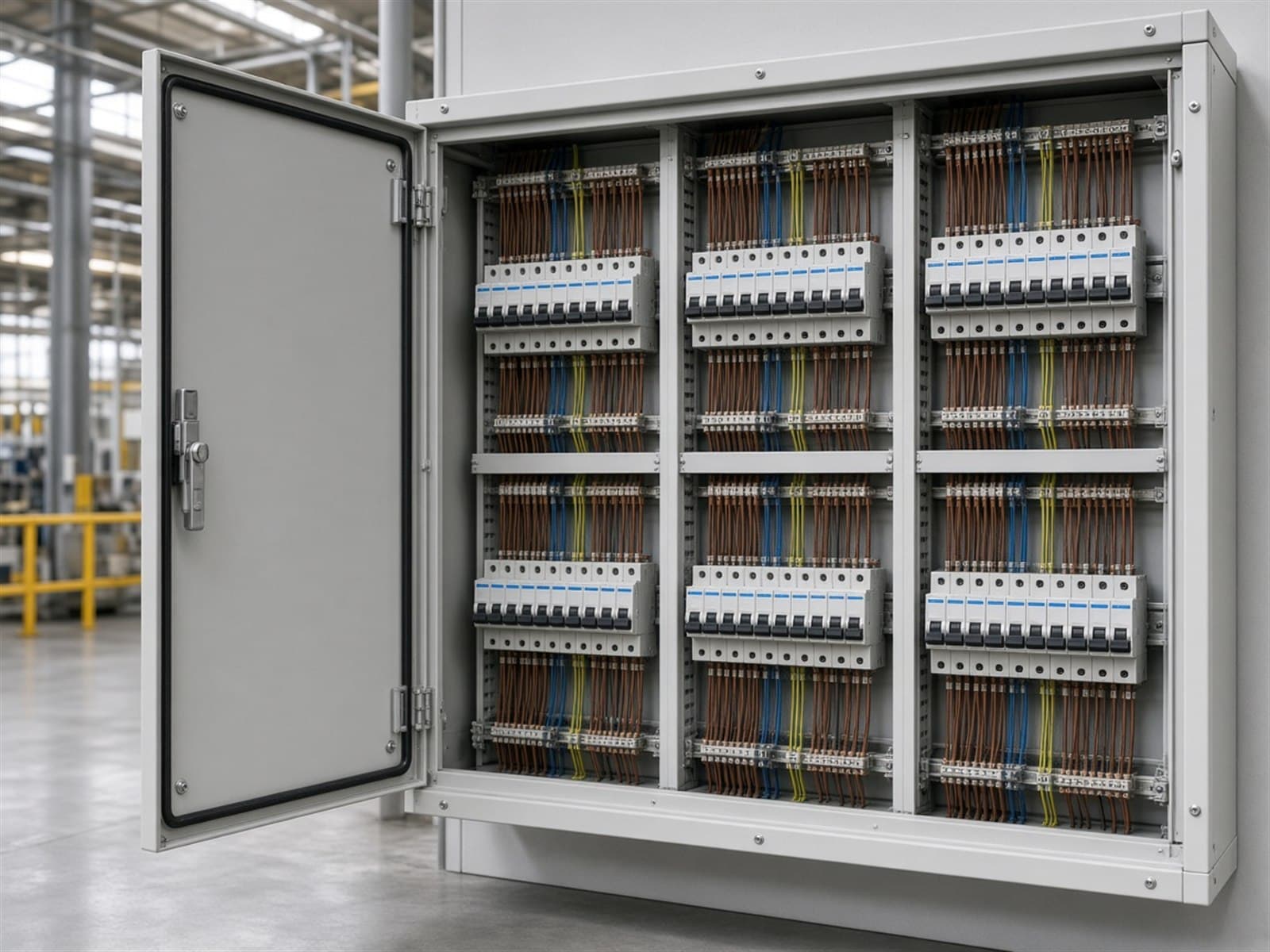
This call from Cami comes in the first cold week of winter and is told in almost the same sentences: 'The house used to be a summer place, we have lived here in winter for three years. In the evening when the oil radiator and the fan heater run, the fuse blows. The neighbour fitted a big fuse, it went well for a while. Now the inside of the meter cover is dark, there is a plastic smell, the lamps dim for a moment when a heater comes on, sometimes the television switches off.' There are three separate symptoms in this description and all three come from the same root. The first is the main fuse blowing; the fuse is doing its job, because the evening load of the house is above its rated current. The second is the heat and smell that come after the 'big fuse': once the fuse is enlarged, the feeder and terminals carry a current they are no longer protected against, and the weakest point heats up; that is usually the meter output terminal, the feeder's entry to the panel or an old cartridge fuse base. The third is the dimming of the lights: the resistance of a long thin feeder drops the voltage in the flat visibly when a heater cuts in. Together the three are not the picture of 'a faulty appliance' but of 'a supply that stayed small'. The first thing to do is switch the heaters off, never fit the big cartridge again and, if the meter cover is hot or smells, switch the house off at the main switch and wait for the survey. No heater is run next to a darkened meter terminal.
When these houses were built the load calculation was for a summer place: a few incandescent lamps, a fridge, a radio and television, maybe an iron. That load is under 10–15 A on a single phase; a 25 A main fuse and a 6 mm², sometimes 4 mm², feeder was more than enough for that day. The winter load is another world. A 2000 W oil radiator alone draws about 9 A. A 2000 W fan heater 9 A more, a 1500 W infrared panel 6.5 A, a 2 kW kettle 9 A, a washing machine 9–10 A while heating, an electric water heater 7–13 A depending on the model. On a winter evening three or four of these run at once and the total easily reaches 30–40 A. That the 25 A fuse blows every evening is therefore inevitable, and the fuse is right. Enlarging the fuse to 35 or 50 A does not solve the problem; it only removes the feeder from the protection chain: the current-carrying capacity of a 6 mm² copper feeder buried in plaster or in conduit is a little above 30 A depending on the installation method; for 4 mm² it is around 25 A. With a 50 A fuse the feeder works above its own limit, its insulation softens, its terminals loosen, heat up and darken. Voltage drop is the second problem of the same feeder. A rough copper calculation for a 30 A load at 230 V single phase on a 25 m run of 6 mm² gives about 4.5 V out and back, roughly two percent; on 4 mm² this approaches 6.7 V, about three percent. Add the contact resistances of the meter terminal, an old cartridge base and loosened connections, and the flat sees 215–218 V the moment a heater comes on; incandescent and halogen lamps dim visibly, sensitive devices restart. This is not the grid-side voltage fluctuation of the Dumlupınar note; the problem is after the meter and in the house's own feeder. Once a terminal has darkened its resistance rises further; heat grows with resistance and resistance with heat, and by the end of a winter this loop cooks the inside of the meter cover.
A second weakness in these houses is the flat panel. A summer-house panel is a small box with two or three breakers, sometimes still screw-in cartridge fuses, and usually no RCD. All the sockets sit on one 16 A circuit, all the lamps on one 10 A circuit. The heaters are plugged into that single socket circuit; the 2.5 mm² line runs at 20–25 A, socket boxes heat up, plugs darken. The cooked back-to-back socket bridge of the Pendik Fevzi Çakmak note is one end of this chain; in Cami the head of the chain, the main fuse and the feeder, is narrow. The third weakness is protection: in a house with no RCD, a washing machine on a wet floor, a water heater in the bathroom and old sockets with doubtful earthing stand side by side. Whether there is an earth conductor and where it goes is part of this survey; neutral-earth bridging and an earth tied to the water pipe are told on the Pendik Doğu and Kartal Orhantepe notes and are only checked here. The shore side of Tuzla also has damp: the meter board is often on the garden wall or at the building entrance, open to sea air. Salty damp oxidises terminal screws and fuse bases, and contact resistance grows from here too. The balcony socket salt of the Güzelyalı note is a separate fault; here salt is only a factor weakening the terminals in the feeder chain.
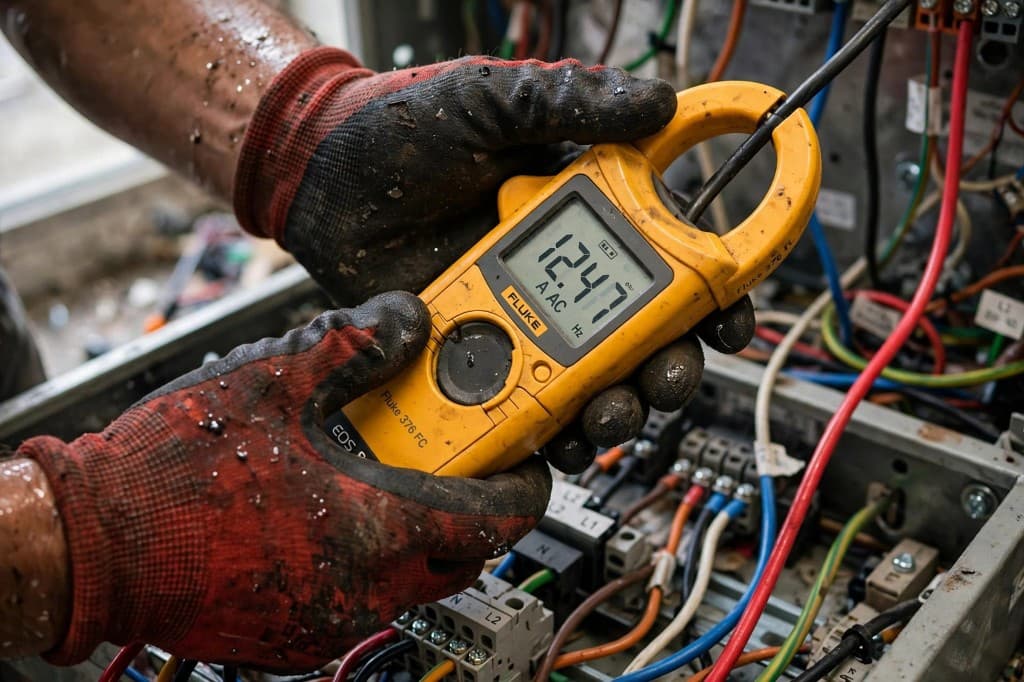
The survey starts at the meter board. The meter itself and the kofra before it belong to the distribution company; they are not touched, but the colour of the meter output terminal, the soot and smell inside the cover, and the type and rating of the main fuse are read. If it is a cartridge fuse, the base is checked for burning, the cartridge label is read and it is checked whether wire has been wound inside; a wire-wound cartridge is removed on the spot. The feeder size is read from the print on the cable or the conductor diameter, its length by walking from the meter to the flat panel; whether it runs under plaster, in conduit or on an outside wall changes its capacity. Then the load list is made: every appliance the owner runs at the same time in winter is read from its label and written down; oil radiator, fan heater, infrared panel, water heater, washing machine, oven, kettle. This list is not made by guessing on the phone. At the flat panel and at the meter output the actual current is measured with a clamp meter, the heaters are switched on one by one and the current of each and the total are seen. At the same time the voltage is read at the farthest socket of the flat: two values are noted, heaters off and heaters on; the difference is the drop of the feeder and terminals. A difference above three volts says the feeder size or a connection is insufficient. With a thermal camera or non-contact thermometer the meter terminal, feeder entry and panel busbars are read under load; a point clearly hotter than its surroundings is a loose or darkened connection. Finally the earth is checked: is there an earth bar in the flat panel, does a protective conductor arrive with the feeder, is earth continuity measured at the sockets, and if there is an earth electrode what does its resistance read. All of this is written down; the job is priced after that.
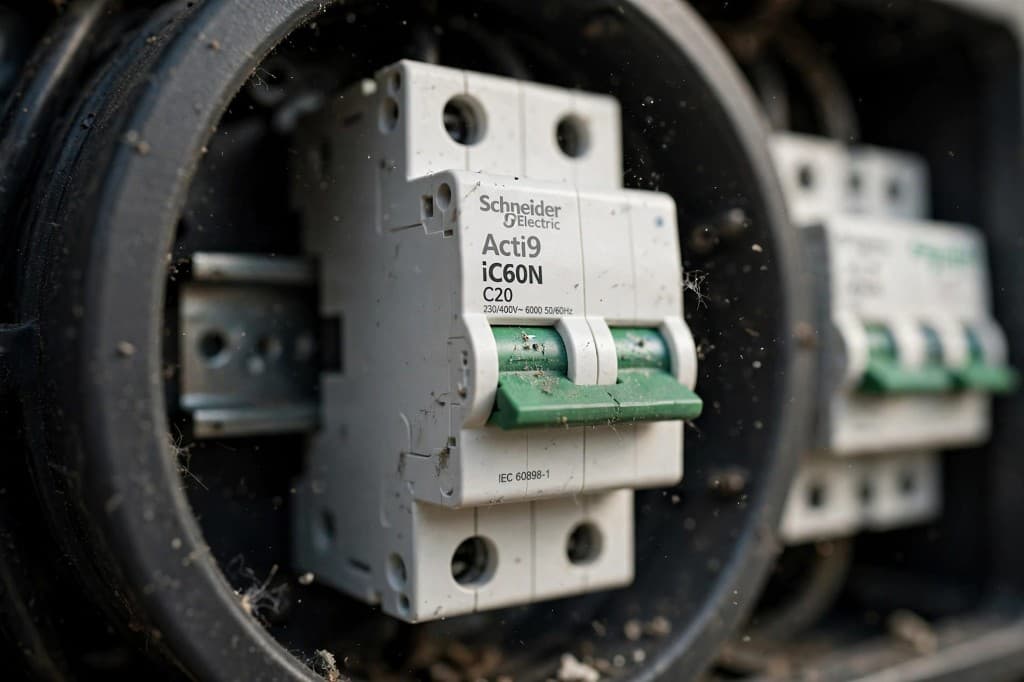
The repair runs on two tracks: the installation inside the house and the contract at the distribution company. The inside is the electrician's job. First the big cartridge is removed and a protection matching the feeder's real capacity is fitted; in this interim period the owner is told clearly which two heaters may run at the same time. In the permanent fix the feeder is renewed. The new feeder is chosen for the total of the load list, the run length and the installation method; on single phase the typical choice is 3×10 mm² NYY, and if the house is moving to three phase 4×10 mm² or 5×10 mm² NYY. NYY is chosen because the feeder usually enters the building from a meter on the garden wall by an outdoor, damp route; NYM is for dry inside walls. 10 mm² copper keeps the drop at 40 A over 25 m a little above one percent; the lights no longer dim. The feeder is run in one piece with no joint on the way; at the meter output and the panel entry terminals or ferrules of the right size are used and screws are tightened to the maker's torque. If the meter output terminal is darkened this is reported to the distribution company; the meter connection is their job. Then the flat panel is renewed: a main switch, a 30 mA RCD (type A for the mixed heater and white-goods load), a separate C16 breaker and a separate 3×2.5 mm² NYM line for each heater, its own line for the water heater, separate lines for kitchen sockets and the washing machine, lighting on its own B10. The heaters are no longer piled onto one socket circuit; each stands on its own line and its own breaker. Whichever of the Schneider, Siemens, Hager or Legrand families is chosen for the panel, busbars and terminals are fitted to that family; no mixed-brand busbar is made. If there is no earth or it is doubtful, an earth electrode is driven, its resistance measured and all sockets tied to the earth bar; this is a condition for the 30 mA RCD to work meaningfully.
No. The fuse protects the feeder; once enlarged, the feeder works above its own limit, terminals heat up and darken. The right path is a load list, renewing the feeder and a power-increase application to the distribution company.
The resistance of a thin, long feeder drops the voltage in the flat when a heater's 9–10 A flows through it; a darkened meter terminal and loose connections make the drop larger. Once the feeder is 10 mm² and the connections are renewed the drop falls below one percent.
Switch the heaters off; if the cover is hot, switch the house off at the main switch. The meter and kofra belong to the distribution company; a darkened meter terminal is reported to them. The feeder and panel after the meter are read at the survey.
It makes sense if the winter load exceeds 7–8 kW and there is an electric water heater or air conditioning; the load spreads over three phases and the feeder drop falls to a third. The decision is made with the load list; the application goes to the distribution company with the electrician's project.
It depends on the distribution company's calendar; the electrician does not invent this time. Until it is settled the house lives with the new panel but a temporary load limit; which two heaters may run at once is said at the survey.
If the feeder enters from a meter on the garden wall by an outdoor, damp route, NYY is run; NYM is for dry inside walls. The size is chosen for load and length, typically 3×10 or 4×10 mm². No joint is made on the way.
There is no fixed minute. Istanbul 24/7. Arrival depends on the queue at that moment and E-5 and shore-road traffic. A 30-minute claim is not invented.
In Cami we handle everything on the customer side of the meter: breaker tripping and residual current device faults, burnt sockets and terminals, board renewal and breaker replacement, earthing installation with resistance testing, lighting and chandelier mounting, dedicated circuits for boilers and air conditioning, and surge arresters. Measurement uses a True-RMS clamp meter, a megohmmeter and a FLIR thermal imager.
In most cases no. The fault is first narrowed down branch by branch at the board, then pinpointed with a FLIR thermal imager and an inductive cable tracer, so no needless breaking is done. Where leakage is in an underground or under-screed run, a cable fault locator usually narrows it to within a metre and only that area is opened. If breaking is unavoidable it is reported in writing and approved first.
Service covers the neighborhoods of Istanbul's 39 districts. Not the whole of Turkey. A survey is not a binding quote.
Cami, Tuzla. The map is centered on the neighborhood. Arrival changes with the hour and the traffic.