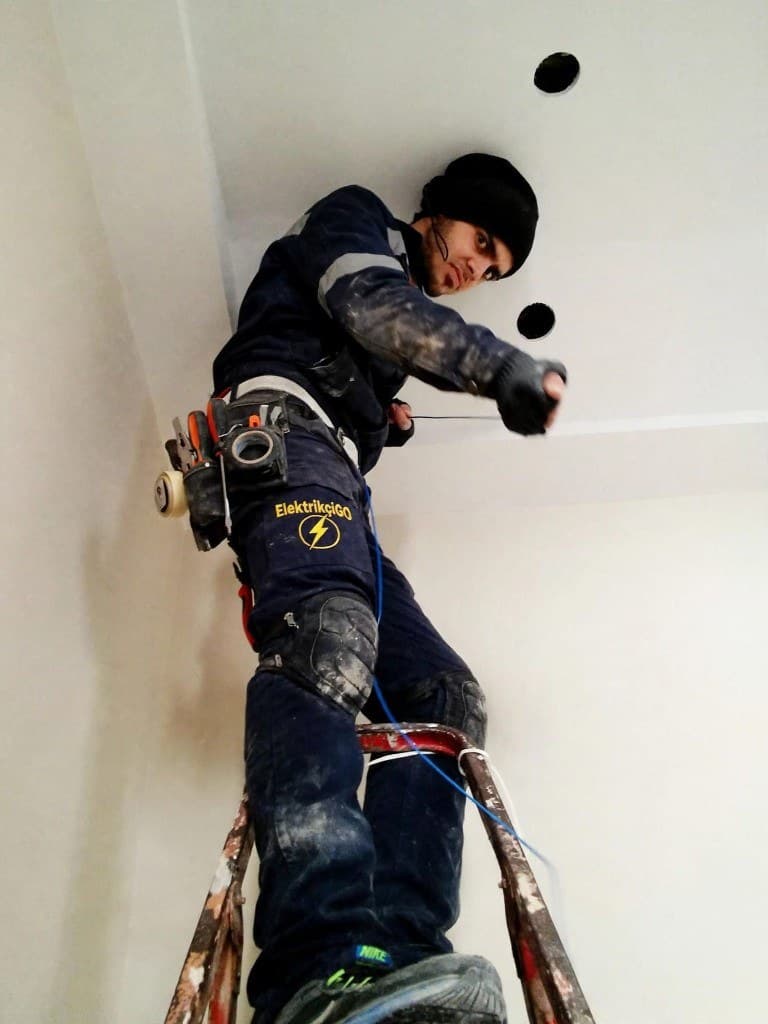
Founding master
Adnan Şemiye18 years in the field
MYK-certified master
Adnan Şemiye reads this job in the field. The price is written before work starts.
Sultanbeyli district
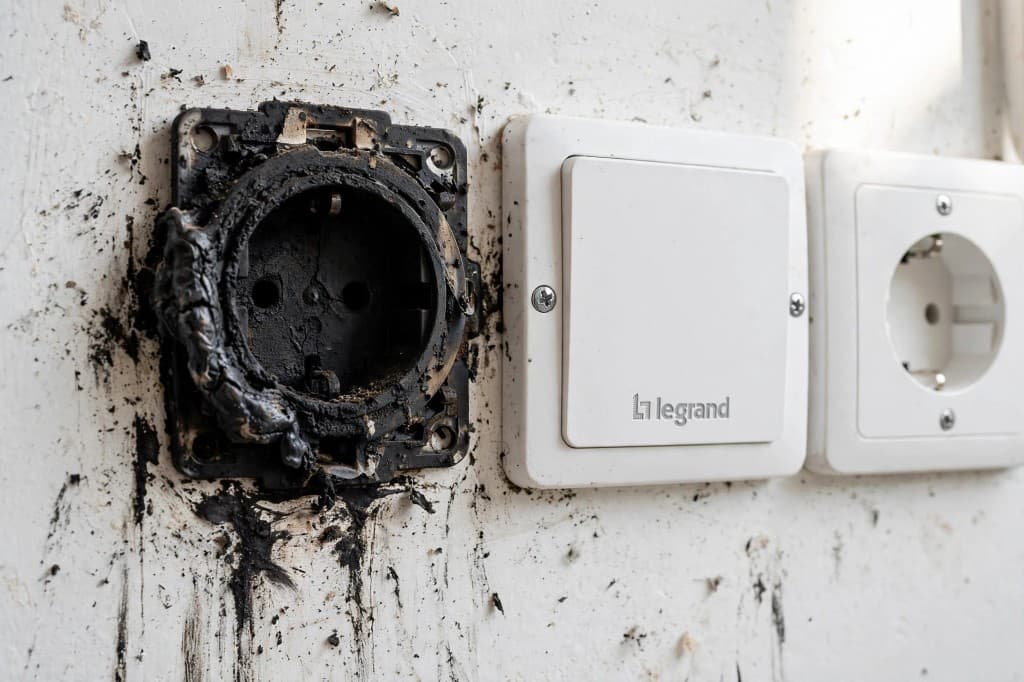
Hasanpaşa 24/7 emergency electrician. In this Sultanbeyli neighbourhood we respond without a minute promise to midnight breaker tripping, residual current device faults, burnt sockets and consumer unit failures. In apartment and complex stock, saturated kitchen circuits, bathroom water heater runs and riser overheating are measured on site. Certified technicians, faults proven with a True-RMS clamp meter and a megohmmeter, written price approval and an official 1 year workmanship guarantee.
Founding master
Adnan Şemiye18 years in the field
MYK-certified master
Adnan Şemiye reads this job in the field. The price is written before work starts.
From the field
 Emergency van · +90 582 403 10 87
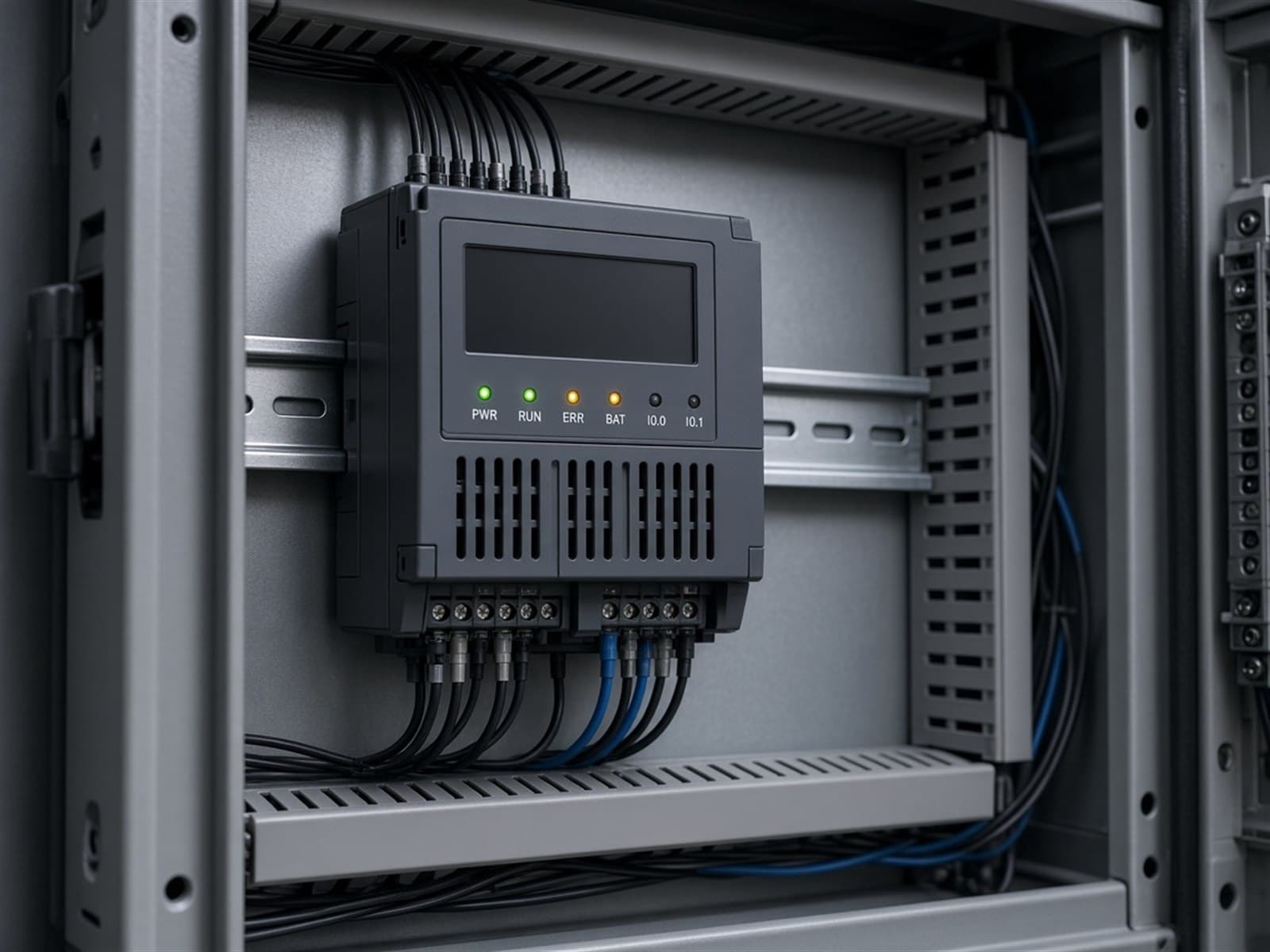
This call from the Hasanpaşa Sanayi Sitesi usually comes from the unit carrying electronics: 'Our laser marker shuts itself off and on five or six times a day, the PLC screen goes black and comes back, sometimes not even the computer but the PLC's power supply drops. The power does not go out, the lights stay on; they just flicker for an instant. The machine technician changed the board, it did not help. There is a body shop next door with a big compressor; it seems to happen when that stops.' The last part of that sentence is half the survey. First the timing: the fault comes not at the compressor's start but at its stop. Starting current dips the voltage for an instant and that dip shows on the lamps as a sag; but a PLC power supply carries that sag for a cycle or two on the energy in its capacitor. At the stop the current does not fall, a voltage spike rises, and that spike slips through the power supply's input filter. Second the selectivity: the computer, printer and modem on the same socket are untouched, the PLC and the laser's 24 V supply are hit. The undervoltage and disturbance detection of those supplies is more sensitive and protects the device with a reset. Third the place: the fault trips no breaker in the office's own panel, no protection drops; the complaint is only on the sensitive device. Those three clues together are not an overcurrent, leakage or loose-terminal fault; they are a conducted switching transient.
The survey starts in both units at once. The compressor unit is entered and the machine's cycle is watched: the piston compressor fills the tank to eight or nine bar and stops at the presostat's upper threshold, restarts when it falls to six or seven bar; in a busy body or auto-electric shop this cycle turns several times an hour. At the stop the control panel is listened to: a healthy break has a single 'click'; on a worn presostat the break comes with a few stuttering crackles, the contactor pulls in and drops out once or twice. That crackle is contact bounce and every bounce is a separate spike. At the same moment the PLC screen in the sensitive unit is watched; if the reset comes in the same second as the crackle, the link is made. This observation does not replace measurement, but it says where to set the measurement up.
Naming what happens correctly brings the right instrument and the right repair. A mains harmonic is a distortion at multiples of 50 hertz, flowing continuously, produced by non-linear loads such as drives, LED drivers and switched-mode power supplies; it accumulates third-harmonic current in the neutral and heats the cable, but it does not reset a PLC. What happens here is different. A contactor coil is an inductance; at the instant its current is cut, it produces a high voltage across its terminals to preserve its field. Depending on the coil, this kick-back can reach from a few hundred volts to a few kilovolts, rises in under a microsecond and ends in a damped oscillation in the megahertz range. When worn presostat contacts make that break not once but in several bounces, every bounce cuts the coil again and repeats the same spike; so a single stop produces a train of spikes in a row. In the language of electromagnetic compatibility this is called a fast transient or burst; the standards test PLC power supplies against it up to a certain level, but on site the spike produced by an unfiltered coil connected directly to the mains can exceed that level.
The spike's route to the neighbour is read too. In a sanayi sitesi the units are mostly fed from a single main board over a shared riser, and the main board has a single neutral bar. The compressor panel's control circuit sits between phase and neutral; the spike reaches the main board over that neutral and from there the neighbour's neutral. Because the neutral conductor is long and shared it shows an impedance at high frequency; across that impedance the spike current creates for an instant a difference of tens of volts between neutral and protective conductor. In a healthy installation the neutral-to-earth voltage does not exceed a few volts; here the peak reaches thirty or forty volts at the cycle. The neighbour panel's PLC power supply tries to filter that difference with its input filter; if the filter is not enough, the undervoltage detection restarts the device. The route can pass through a second place as well: if the protective conductor between the two panels is weak, or the two units are earthed from different points, the spike also circulates through earth. That is why the survey looks not only at the compressor panel but at the neutral and protective path between the two panels.
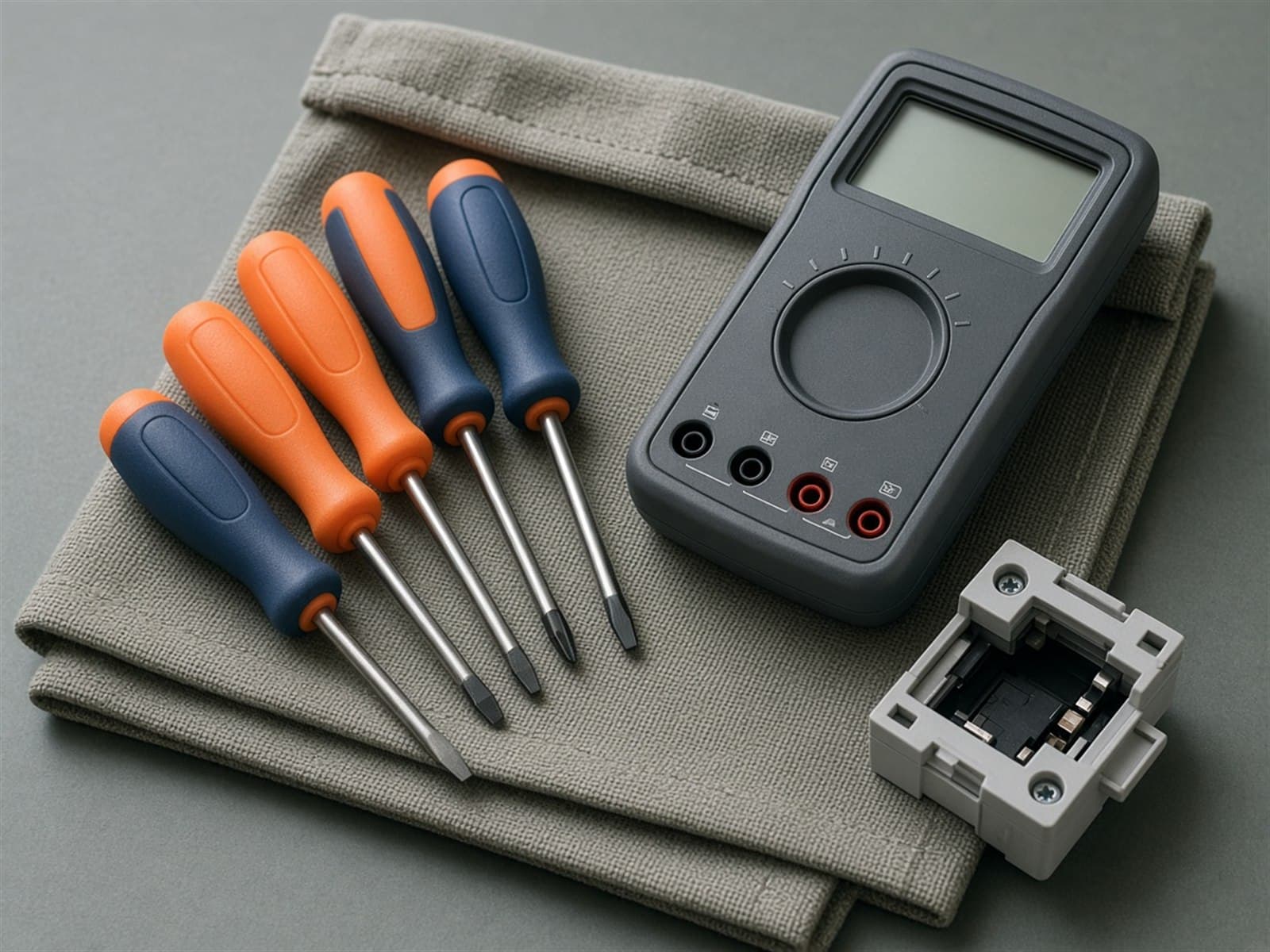
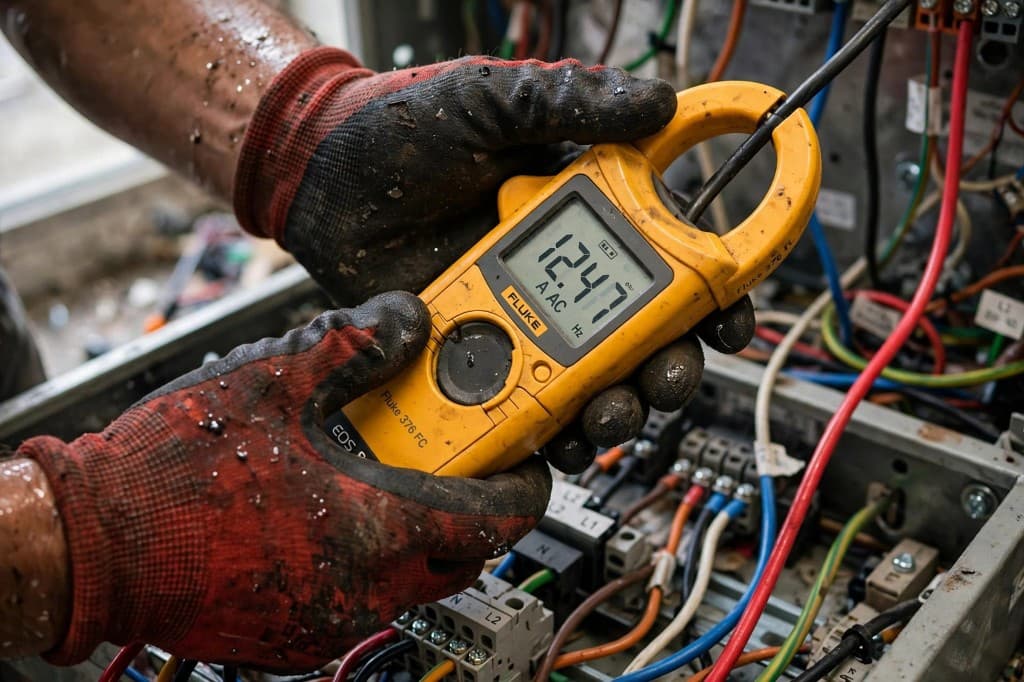
Measurement is set up at two points at once. At the compressor panel a logging clamp on one phase writes the start and stop moments with a timestamp; at the sensitive unit's panel a meter that captures peaks and transients, or an oscilloscope, is connected between neutral and protective conductor. With the two logs side by side the picture is clear: at every compressor stop one or several spikes of a few microseconds and tens of volts appear on the neutral-to-earth voltage, at the starts only a small sag. A spike only at the stop points to the presostat and coil; a spike at the start too points to the contactor contacts or the motor terminal box. With the same instrument the steady neutral-to-earth voltage is read as well: staying under two volts says the neutral path is healthy, exceeding five volts says the shared neutral is long or loose. Then the protective conductor resistance between the two panels is measured; more than a few hundred milliohms between the two units' panel bodies means the spike is circulating through the earth path too. In the main board it is confirmed by eye where the neutral bar comes from, whether the PEN split is at a single point, and whether the two units share the same neutral bar.
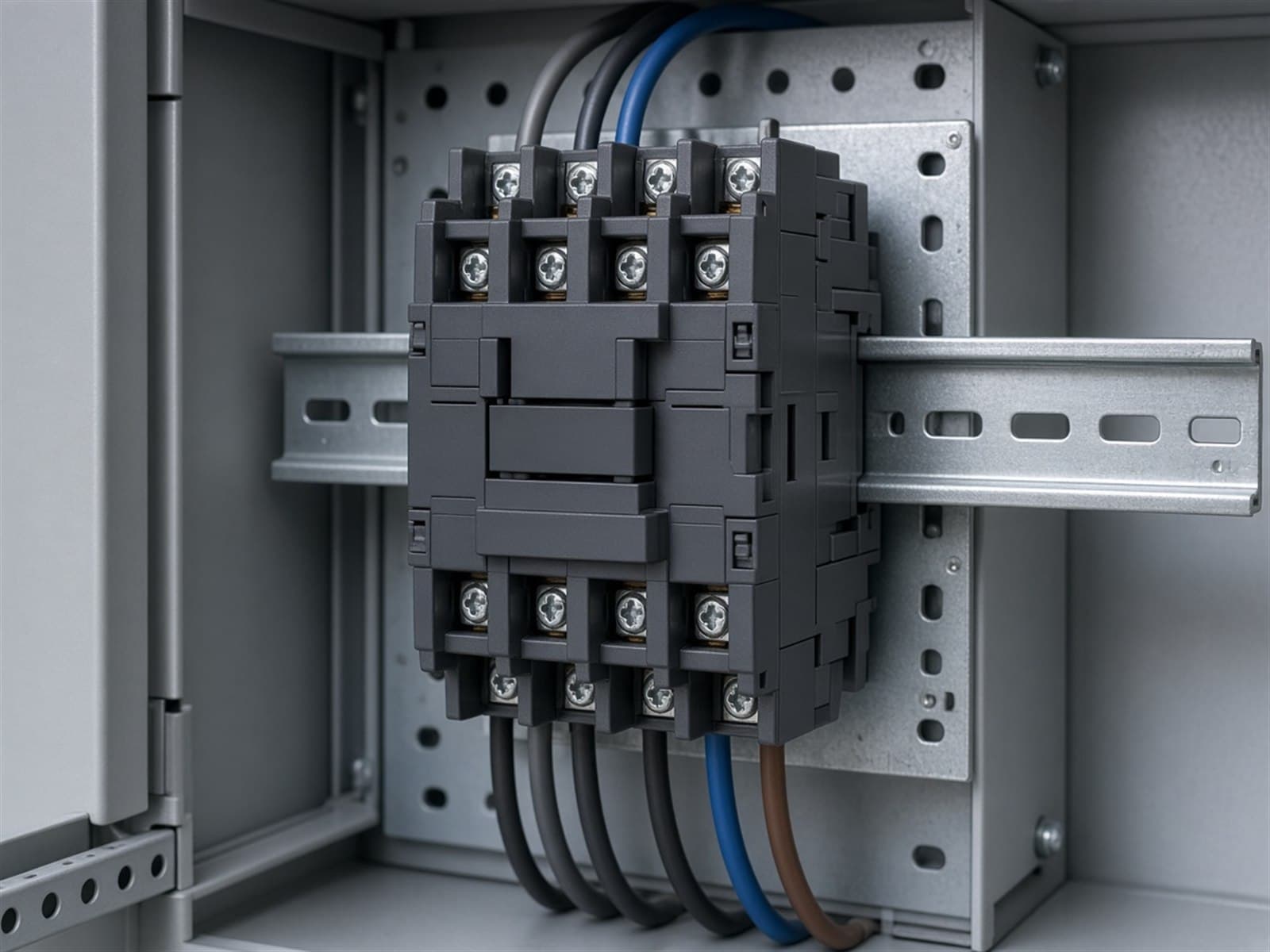
Once the measurement has built the picture, the compressor panel is opened dead. The presostat cover comes off: pitting, blackening, melted brass droplets on the contact faces and slack in the contact spring are looked for; when the diaphragm and spring wear, the break point trembles and the contact bounces before it has fully pressed. The contactor's A1–A2 coil terminals are looked at: if there is no suppressor module on them, an RC or varistor kit, the coil's kick-back lands straight on the control line. The power contacts are pulled too; a pitted contact arcs at the start as well. The thermal relay setting and the tightness of the motor terminal box are noted; a loose motor terminal is a separate arc source and carries the spike to the start too. Whether the control-circuit cable runs a long way in the same trunking as the power cables is checked. Everything found is photographed; both units' operators get the same report, because part of the repair belongs to the compressor's owner, part to the sensitive unit, and part to the site's main board.
The repair starts at the source, because once the source is silenced the measures on the path and victim side become only a backup. The worn presostat is replaced with a new one suited to the compressor's tank volume and working pressure, with adjustable cut-out and cut-in thresholds and an unloader valve; a part with pitted contacts is not cleaned and refitted. The manufacturer's own suppressor module is fitted on the contactor coil's A1–A2 terminals: an RC suppressor on an AC coil, a varistor module on some series; the module clips with zero lead length directly onto the coil's A1–A2 terminals, not onto a panel terminal block, because every centimetre of conductor in between adds inductance and slows the damping of a megahertz-range spike; the kick-back then never reaches the cable. A contactor with pitted power contacts is replaced with a new one chosen by reading the coil voltage and current class from the label; by its AC-3 current rating, not by 'the same one'. The motor terminal box is torqued. The control-circuit cable is separated from the power cables or renewed as screened cable. After these steps the measurement is repeated: the neutral-to-earth peak at the stop must fall to a few volts; if it does not, the spike is coming from another breaking point and the inspection moves there.
The second step is the path. The sensitive unit is fed from the main board on a separate branch with its own breaker and its own neutral bar; it does not share a neutral bar with the compressor unit. In the main board the PEN split is left at a single point, and an equipotential conductor of sufficient cross-section is run between the two units' panel bodies and machine frames; the resistance between the two panels falls to a few tens of milliohms. The third step is the victim: a mains EMC filter is fitted at the panel incomer in front of the PLC panel's 24 V power supply; the filter's metal body is bonded to the back-plate, paint scraped off, with a wide braided copper strap, because a single-core green-yellow conductor shows inductive reactance at high frequency and a long earth lead makes the filter useless. If a power supply is to be chosen, one with long hold-up time and a high burst class is chosen. The 0 V reference on the power supply's 24 V secondary is looked at too: depending on the system architecture it is either bonded to the protective bar in the panel at a single point or left isolated; a 0 V reference that touches earth in two places forms a ground loop, the spike comes down that loop onto the card inputs and burns the input card. Signal cables are carried on a route separate from power cables. If a Type 2 surge protector is wanted at the panel incomer it is fitted, but the customer is told clearly: a surge protector catches high-energy spikes from lightning and the network, it does not catch a contactor coil's microsecond spike; the surge protector and varistor note is Maltepe Gülsuyu. The job is handed over in writing with before–after measurement logs, photographs of the presostat and contactor, and the neutral-to-earth values.
Hasanpaşa's turn to be written comes from its fabric, not its population. The mahalle is 0.84 square kilometres, Sultanbeyli's smallest, and its population has held steady around seventeen thousand since 2007; so it is a settled place, not a growing one like Battalgazi. A settled place's electrical problem is different too: not new-flat acceptance or an added floor, but the effect that workplaces working side by side for years have on each other. In the Hasanpaşa Sanayi Sitesi, auto-electric, body, lathe and furniture workshops, each with its own compressor and welder, stand wall to wall in the same building with sign makers, laser markers and small offices, and are mostly fed from the same main board. That neighbourhood makes a contactor's stopping spike, not a motor's starting current, the fault to be read in this mahalle. The district note reads the Battalgazi–Adil TEM strip with a sheet-steel box and 300 mA, and the Necip Fazıl tower with a hall cupboard and 30 mA; Hasanpaşa's sanayi sitesi is neither, it is a third fabric and that is why it gets its own note. Kadıköy's Hasanpaşa is pier and çarşı stock, read on that district's hub; this page is Sultanbeyli Hasanpaşa only, and that is why its title starts with the district name.
The lived fabric of this note is this: the office side has called the machine technician, the board has been changed, a UPS bought; the UPS reset too, because the spike passes the UPS's input filter as well and comes over neutral-to-earth. The compressor side said 'our machine is fine, it does its job', and it is right; the compressor runs, pumps air, nobody has looked at its panel. In a fault where both sides are right, the solution is a third eye: an electrician who looks at both panels at once, matches the spike against time, and writes the report to both sides in the same language. There are other Sultanbeyli mahalles where a sanayi sitesi and offices sit together; if the same fault appears there it links to this note, a second page is not opened.
Mostly no. The reset is the microsecond voltage spike from the neighbouring compressor's contactor coil at its stop reaching your panel over the shared neutral. Before changing a board, both panels are measured at the same time.
No. A harmonic is a continuous distortion at multiples of 50 hertz and does not reset a PLC. This is a fast transient spike formed at the moment of breaking; it is seen with a peak-and-transient-capturing meter or an oscilloscope, not with a harmonic analyser.
The spike comes between neutral and earth and passes most UPS input filters; a line-interactive UPS does not filter it. The fix is the suppressor at the source, a separate neutral, and a short-earthed EMC filter at the panel incomer.
Not on its own. A Type 2 surge protector catches high-energy spikes from lightning and the network; the contactor coil's low-energy microsecond spike stays below its threshold. The surge protector note is Maltepe Gülsuyu.
An RC or varistor kit clipped onto the contactor coil's A1–A2 terminals; when the coil is cut it quenches the kick-back on the coil itself and keeps it off the cable. The module from the manufacturer's own series is chosen.
As a compressor, yes, it pumps air. But if the presostat contacts are pitted and the coil has no suppressor, its panel sends spikes to the neighbour. The report is given to both sides with the same measurement; the source part of the repair is in the compressor panel.
The steady value in a healthy installation is under two volts; exceeding five volts says the shared neutral is long or loose. The peak at the spike must fall to a few volts after the repair.
After the source is silenced it is mostly a backup measure; but if the shared neutral bar in the main board is long and crowded, a separate branch and separate neutral bar cut the spike's path and also protect when another motor is added later.
The survey fee is said on the call. The binding figure is written on site after both panels are measured and the presostat, contactor and neutral path have been seen; 'change the presostat and it is done' is not said on the phone.
In Hasanpaşa we handle everything on the customer side of the meter: breaker tripping and residual current device faults, burnt sockets and terminals, board renewal and breaker replacement, earthing installation with resistance testing, lighting and chandelier mounting, dedicated circuits for boilers and air conditioning, and surge arresters. Measurement uses a True-RMS clamp meter, a megohmmeter and a FLIR thermal imager.
In most cases no. The fault is first narrowed down branch by branch at the board, then pinpointed with a FLIR thermal imager and an inductive cable tracer, so no needless breaking is done. Where leakage is in an underground or under-screed run, a cable fault locator usually narrows it to within a metre and only that area is opened. If breaking is unavoidable it is reported in writing and approved first.
Service covers the neighborhoods of Istanbul's 39 districts. Not the whole of Turkey. A survey is not a binding quote.
Hasanpaşa, Sultanbeyli. The map is centered on the neighborhood. Arrival changes with the hour and the traffic.